Showing posts with label Acts 29. Show all posts

Tuesday, April 24, 2012

Why You Can’t Scare People Into Heaven

I am reading through Matt Chandler’s first book, The Explicit Gospel.  I am almost finished and Lord willing I will post my review on Thursday or Friday.  One particular section that highlights not only Chandler’s writing skills but also his gospel presentation concerns the inadequacy of “scare tactics” in evangelism. 

Knowledge of and belief in hell—as important as they are—are unable to create worshipers.  Yet misunderstanding this reality is historically how the doctrine of hell has been abused and misused by so many men in the name of God.  You cannot scare anyone into heaven.  Heaven is not a place for those who are afraid of hell; it’s a place for those who love God.  You can scare people into coming to your church, you can scare people into trying to be good, you can scare people into giving money, you can even scare them into walking down an aisle and praying a certain prayer, but you cannot scare people into loving God.  You just can’t do it.  You can scare them into moral acts of goodness.  But that’s not salvation.  It’s not even Christian.  (Matt Chandler, The Explicit Gospel, 49)

If you are familiar with Chandler’s hard-hitting and gospel-centered preaching style that is what you get in this book.  If you do not want to wait for the review you can go ahead and buy yourself a copy today: The Explicit Gospel.

Friday, June 25, 2010

Taking Issue with Rapping Motions

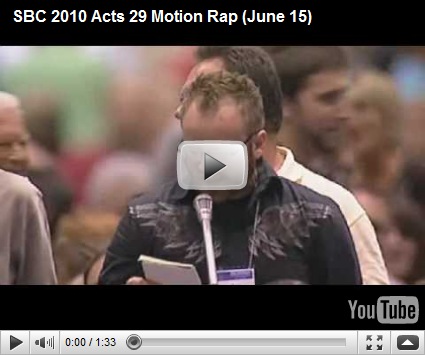
This is my first exposure to 5ptsalt.  Today he takes issue with Joshua Shank’s rap-motion at SBC 2010.  I showed the video a few days ago, but if you have not seen it you can do so here:

From what I can tell here is the gist of 5ptsalt’s argument:

Thesis:

Joshua was “more set on promoting Acts 29 than presenting a serious, worthwhile motion”. 

Support:

“not being satisfied with the proper use of the English language”

not “maintaining some degree of decorum”

he rapped his motion to the “shame of everyone who has even a modicum of an education”.

he spoke like an “ignorant, uneducated brute”

Conclusion:

Shank is “silly and self-absorbed”, “degraded the very existence of the SBC meeting”, and is a horrible witness and only recognized as a pastor but not one really. 

------

I want to be upfront and say that I do actually wish that Shank would have made his motion and not rapped it.  It was fun as well as funny.  But I do think that it caused it to not be taken seriously.  And the content was actually not all that silly. 

However, I take serious issue with what 5ptsalt is asserting here.  It grieves my heart.  And I want to let you know upfront my motivation in posting this.  I am not simply trying to call out him as a person or merely this article.  My desire is to look at the issue, make an argument that his evidence does not warrant his conclusion or support his thesis, and in the end look at my own heart. 

The Ignorant and the Gospel

Timmy Brister gives us a back story to the intention behind this post.  Like it or not here is what the motion was about: “expressing appreciation and affirmation for the investment of the Acts 29 Network for their work in planting gospel-centered churches in the SBC?” 

So, maybe 5ptsalt is onto something.  Or is it possible that the aim behind promoting Acts 29 is to promote gospel-centeredness and to do away with all of the division and hatred towards Acts29?  I think that is closer to the intent.  What I think Brister, Mitchell, and Shank have in mind is promoting the gospel above our extra-biblical divisions.  (Yep, that just opened up the whole can of worms about whether we should be for or against A29). 

spurge Let’s just say for the sake of argument that the motion really was ignorant, brutish, improper, and shameful to the educated.  Doesn’t the gospel trump this?  Is it possible that having someone rapping a motion is actually a better gospel witness because of its display of the diversity within the body of Christ?  Do we really want to make the argument that ignorant, brutish, and improper people cannot make motions or lead churches? 

"Redolent of bad taste, vulgar, and theatrical."  That is what a newspaper (and it was not alone) once said of Charles Spurgeon.  Spurgeon spoke the language of the common people.  Perhaps, Joshua Shank is doing the same. 

Looking at my own heart

But I am often guilty of this same thing.  I have certain things that I greatly dislike and some things to me seem like great issues that in the end probably are not.  I have to ask these questions of my own heart.  Do I have the attitude of Paul that is excited that the gospel is being preached, even if with wrong motives?  See Philippians 1:15, and this article. 

Do I have patience and grace with those that are doing things perhaps not the best or even most biblical way?  Do I have humility to say that I may be wrong—and perhaps I am not doing things the best or the most biblical way? 

Thankfully, Jesus used fishermen, tax collectors, zealots, redeemed prostitutes, former extortionist, and all manner of outcasts for his glory.  He even used wealthy and refined people too.  I’m thankful that his grace is big enough to cover my sin, and that his glory is great enough to overshadow and use broken vessels like me. 

Saturday, June 19, 2010

Acts29 Rap at SBC2010

For me this was one of the highlights of the SBC2010. 


I have read a few comments of people that thought this was offensive, but I personally found it hilarious and actually making a good point. 

Wednesday, April 1, 2009

The Ripple Effect of Humble Confession

I have a confession to make I sometimes struggle with doubt. Deep doubt. Sinful doubt. One of the greatest areas that I battle is in regards to God's ability to change believers. The sinfulness of believers (myself the chief) causes me to question whether or not God really is able to sanctify his followers. Yes, I know that we have to choose holiness over sin and I know that this is a huge part of the slowness of our progress in holiness.

One of the greatest areas that causes me pain (as I am sure it does Christ as well) is when believers are involved in ridiculous slander and pride. I can be horrible about this myself. I know that I stand guilty of slander and deep pride. Of this I must confess and repent anew.

This is proof that God is in the process of redeeming a people for Himself and that He is able to conquer our sinful hearts and bring unity where there once was discord. Only God could have done what is taking place in the heart of Steve Camp as it concerns Mark Driscoll. You have to read Steve Camp's humble confession and repentance. It caused my heart to leap for joy and my confidence in the power of God to grow. Grace truly does reign.

Isn't it amazing the ripple effect that a humble confession can have? It really proves the truth of Scripture in regards to the unity of the body of Christ. Sin hurts every member and repentance heals! Oh, how I long for the day when the bride is in unity and we stand before Jesus pure and spotless.

Monday, March 3, 2008

Thougts on Driscoll, Acts 29, Emergent, and those that oppose

Before I begin these thoughts I need to make 2 points of disclosure. 1) I reserve the right to be wrong. I do not propose to solve this problem, if it were so simple, that somebody like myself could solve it, then it probably would no longer be an issue. 2) I am certainly not Emergent, I do not agree with Driscoll/Acts 29 on everything, but I would not consider myself in opposition (at least to Driscoll/Acts 29). This is my humble offering to this discussion. Knowing that it can be a form of pride to take the "nobody is right in this issue" road, I timidly will take that position. Probably the most difficult thing in this discussion will be defining the issue. Usually by the time someone has nailed the proverbial jell-o to the wall, the discussion is already so confusing that the implications or application is thrown out the window. So for sake of clarity, knowing there are a gazillion other issues at stake, I will try to address only one major point: the idea of "making the gospel relevant".

Since I am not emerging/emergent I doubt I can give them a fair shake. In fact I only include them in this discussion because of their supposed association with the Driscoll/Acts 29 crowd. A true Emergent person would probably be speaking of something different by "gospel" anyway. Rather than asking, "how do we preach the gospel in such a way that someone comes to know Jesus", they are probably asking, "how do we live the gospel in such a way that someone lives a better life and has a better understanding and grows a soul-patch". I'm not concerned at this point with addressing the Emerging Church, it would be a distraction. But a distinction must be made. On issues of the gospel and soteriology ACTS 29 IS NOT EMERGING.

You will not understand this discussion until you come to that conclusion. There are some areas that Acts 29 will look like an Emerging Church. Their methodology sometimes will have the appearance of evil Emerging. But soteriologically speaking they are far from Emerging. You cannot brand them heretics. Doing so is irresponisble and just plain wrong.

On the other hand folks in the Acts 29/Driscoll crowd have the same foundational desire that Emerging Churches have; the desire to change the present structure and be relevant in their culture. The buzzword now is missional. You have to exegete your culture and figure out a way to make the gospel relevant. You do not sell out the message. But you have to make certain to speak the language of the culture. That is the mindset. Sometimes that gets a little shaky. What do you do if the culture you are ministering to eats monkey brains? Well, you eat monkey brains. What if the culture you are ministering to uses crass language? Well, you use crass language. Or do you? And here is the big discussion.

Those who oppose Acts 29/Driscoll say that you must not use crass language just to reach the culture. That is selling out the gospel. Methodoloy matters. If you are drinking a beer with an alcoholic, you are not doing him any favors. Total abstinence is the best way to share the gospel. The lost person, must see that your life is different. Then maybe at some point he'll ask questions. "Hey, buddy, why don't you drink"? Then you can share with him that it is because of your relationship with Jesus Christ, and that you have found happiness outside of a bottle. Maybe you were once a drinker. You can use this as a launching point to share your testimony. But the best way to share the gospel is not to become like the culture. That can lead to sin.

But wait, 1 John says that "greater is he that is in me". Wouldn't we all have been in a pretty precarious position if Jesus himself had not went to these sinful places? Doesn't Jesus say, "I have not come to call the righteous but sinners?" If Jesus always stayed out of bars then why did they call him a drunkard and a glutton. And as far as offensive language is concerned have you read Ezekiel? Do you pick up on some of the language of Paul? Does he not also use, inspired by the Holy Spirit, scatalogical language? So, are we not just following the methods of Paul and Jesus? Because of Jesus and his power we are getting as close to sinners as possible. Our task is to be like Jesus and Paul, they did not run away from sinners and hope that they came to them. They went to sinners. They engaged the culture.

So who is right? Before I begin to answer that question I have to add something else to the mix. Reformed Theology. Acts 29/Driscoll claims to be solidly Reformed. Many that oppose Driscoll claim to be solidly Reformed. Many that oppose Driscoll are not Reformed and oppose him based upon this point, but missionally speaking they might agree. This is the way I see the discussion. Driscoll/Acts 29 says, we are Reformed and because of the awesome power of the gospel we believe that God calls us to engage the culture with it, whatever that means. Reformed guys that oppose Driscoll, we believe that God is powerful enough in His Word that you do not have to add to it with all of this "engaging the culture" mumbo jumbo. Just preach the Word, and God will bring the increase. The non-Reformed Driscoll opposer will either dislike his theology, or dislike his methodology. This camp believes that people are won over to Christ by what we do. If they agree with the Acts 29 methodology then they will probably change their seeker-sensitive churches into Acts 29 churches...or, hey theology doesn't matter much...so why not just be Emerging. Or maybe they disagree with the whole alcohol issue. Maybe the methodology does not square with them. Nobody will be won to Jesus by a drinker. Then you have opposition from this side.

So who is right? All sides believe we are to engage the culture--at least in as much as that means "win lost people to Jesus". Note that I asked, "who is right", not what wins the most people. This is not a pragmatic question. If we make it so, then we will side-track this. You cannot say look at all those people Driscoll and Acts 29 is reaching. That's not a good argument, because look at all those people Joel Osteen is reaching. To which we respond, reaching with what? They key issue is this...who is most faithful to the gospel, as presented in the Word of God?

1) The gospel must be clear. It is very true that God's Word has power in itself--it doesn't need my help to accomplish its purpose. But it seems that there is a need for a preacher. (Rom. 10:14) And it appears that there is a need to preach in the "native tongue". (See Acts 8:26-40) So, there is some credence to this idea of "making the gospel relevant". But

2) Making the gospel relevant, if it is to remain biblical, must mean NO MORE than preaching the gospel in the "native" language. It does not mean that you have to make the gospel appealing. Paul models this in 1 Corinthians 2:1-5. It seems as if Paul labored to make the gospel unappealing. He did not want the Corinthians to be won over by his eloquence, but instead to be won-over by the message. But, Paul did labor to be like a Jew when he was with the Jews and like a Gentile when he was with the Gentiles. What does this mean? It means that Paul laobred to speak in their native tongue. He was not doing this to make the gospel appealing, he was doing this to keep from putting up stumbling blocks. He ate monkey brains, if his hearers ate monkey brains. But it is also important to note:

3) Speaking the native language does not necessarily mean engaging in native rituals and removing ALL stumbling blocks. Paul did not allow Titus to get circumcised. Nor did he sacrifice to pagan idols. You do not become a prostitute to minister to prostitutes. But this point is where we get into arguments. Is Mark Driscoll becoming a "prostitute" to minister to "prostitutes" when he uses coarse language to minister to those with "coarse language"? Do Acts 29 guys prostitute themselves when they have a beer to minister to those that drink? These are difficult questions and ones that must not be settled in a vacuum. Despite what some may believe this is not as black and white as it would appear. Therefore,

4) The Church and the church plays a critical role in taking the gospel to the nations; or to put that another way, you are not supposed to "make the gospel relevant" by yourself. That is why we must consider, and 99.4% of the time submit, to the authority of the consensus of the Church universal and, how this will be lived out most generally, to the local church. There are times that we need Martin Luther's. But, seriously, those are going to be really really rare. As long as the Church is being the Church then even if we have a few warts, we are genuinely the body of Jesus that he is caring for. She is worth submitting to for the sake of others. So what are the implications of this?

Let's take Driscoll's language for an example. Language can be a funny thing. What may not be offensive in Calcutta may be offensive in New Hampshire. And the reverse is also true. In Missouri I can walk side by side with my wife. But I better not do that in many Muslim countries. I realize that is not an example of language, but it serves my point well. There is nothing really innately offensive about words...only the meanings that they carry.

But lets consider this through our first four points. 1) To make the gospel clear, is it absolutely necessary for Driscoll to talk the way that he does? I do not know Seattle culture, but I am not certain that speaking the way that he occasionally does is necessary. 2) Is he doing it to make the gospel clear or appealing? It appears to me that his reasoning is to make the gospel "relevant", and by that I mean appealing. 3) Is he engaging in a sinful cultural ritual? This could be debatable. I would lean towards, yes; but lets try giving the benefit of the doubt and see what happens? Let's consider it a non-issue for the moment. 4) If you post a video on youtube it better be acceptable for not only Seattle but also the Bible belt. Why? Because you risk offending the body of Christ as well as creating a needless stumbling block for an unbeliever from a different culture. And I understand that we can easily do this unknowingly. But, you cannot tell me that Driscoll has no clue that what he says may offend somebody in New Hampshire.

Should it offend them? That's not the issue. Is it central to the gospel? No. Do you need to speak that way to preach the gospel? No. You do not need to say "knockin' boots" just to put the gospel in the native tongue. The issue to consider is this, are you trying to make the gospel understandable or appealing? If you say appealing then you are on really shaky grounds. Therefore, I believe Acts 29/Driscoll should abandon the use of potentially offensive "edgy" language. There may be instances where words are not innately sinful. Maybe saying "knockin' boots" is not offensive to folks in Seattle. But it is offensive to your brothers and sisters elsewhere. Therefore, for the sake of unity, and because it is not central to the gospel--abandon the practice.

At this point it probably seems as if I am not taking the "high road" of disagreeing with both sides. It sounds like I am coming down hard on Driscoll/Acts 29. So, this is where I disagree with the opposers.

1) I do not think that Driscoll really is considering all of the ramifications of his every action. I do believe that he is far too entrenched in his culture. But, is he a heretic? No. Is he blasphemous? I really think that is too strong of a charge. And such a statement might create shock but I am not sure that it furthers the discussion.

2) In discussing these matters with Acts 29/Driscoll people, are you trying to speak in their native tongue? We will not win our brother by name calling. Is it possible that you ought to bear their burden? Ought you not gently instruct and rebuke?

3) Are there some issues that they may be right on? Are these brothers in Christ? If so are we guilty of slander? Are we not also responsible for the way that we engage in our discussion with them? Might we cause undue offense by the way that we discuss these matters? Is it really helpful to the body of Christ to call those that follow Driscoll "Kool-Aid drinkers"?

4) Things are not as black and white as you wish they were. Engaging the culture is a difficult thing. Do we eat monkey brains? Do we pick a sheep up out of a well on Sunday? How close to sinners do we get? How do I keep from being culturally anorexic? How do I keep from being culturally gluttonous? These are very difficult questions. In no way does this statement negate the absolute sufficiency of Scripture. But you cannot always point to a biblical text and determine whether or not it is okay to watch a Rated-R movie. You cannot pull out Scripture that speaks of coarse language when the coarse language of Paul's day is different than ours. There are general principles, but it is NOT as black and white as we wish. To act like it is will be dangerous, and will not engage our brothers and sisters. We cannot ignore these issues. Nor can we simply make blanket statements and hope that it all goes away.

So here is my conclusion, to this rather long post. If you are a follower of Acts 29/Driscoll then you ought to repent and cling to Jesus and His gospel. If you oppose Acts 29/Driscoll then you ought to repent and cling to Jesus and His gospel. And I just bet that as we are both draw closer to our great King we will be drawn closer to each other. Maybe we all will give up our pride in the process.

Thursday, February 21, 2008

Borrowed Light: Today in Blogworld 02/20-21

Imagine this...Mark Driscoll has stirred up controversy. The discussions start with Challies review of Driscoll's Vintage Jesus. Then he asks, How Do You Solve a Problem Like Mark Driscoll? Brian Thornton weighs in, as does Carla Rolfe.

David, The Thristy Theologian, explains Why He is a Calvinst, today he discusses Depravity.

I'm not the biggest fan of the title, but the Reformed Mafia, is showing the Trouble with Frank Page. It's a play off Page's, ridiculous work, The Trouble with Tulip. If you have read Page's book you'll appreciate the review. See Part One and Two.

What does it mean to avoid every appearance of evil? Dan Wallace answers. This is a quality article, and very important given many of our recent discussions on alcohol, card playin', etc. Here is his conclusion: "To wield 1 Thess 5.22 as a weapon to restrict a believer’s personal freedom is against the general tenor of the New Testament and of the Lord’s life in particular. Ironically, to avoid every appearance of evil is far more in keeping with the Pharisees’ model of righteousness than with Jesus’!"

Michael Patton continues his series on the Emergent Church. Today he asks, "Are You Emerging"? He has also recently compared Fundamentalists, Evangelicals, and Emergents.

Are we under the Law? Nathan Busenitz continues his series with part two and three.

Our church is currently trying to reframe our mission statement and put together a few statements to go with it. Perhaps we should consider the words of Dr. Bart Barber. This flies in the face of your typical outreach material; I love it. (HT: Henry Institute)

David Mathis gives us a very helpful list on resources for Bibliology.

Thabiti has a really wonderful article on highly gifted pastors in small fields of labor. Are Our Gifts to be Big for Our Field of Labor?

David Wells guest blogs at 9Marks. He asks, Are We Fiddling While Rome Burns? In case you cannot pick it up by the title, this article is about alternate forms of "having church".

Lastly, Michael McKinley offers a Hypocrites Guide to Preaching.

Wednesday, December 12, 2007

The Effects of the Acts29/MBC decision

I just received this e-mail today from a brother that is affiliated with Acts 29 and receives funding from the MBC. It pains me to hear that his salary will be cut because he has good doctrine, a heart for Christ, a heart to reach people for Christ, adheres to the Baptist Faith and Message, and did I mention loves Jesus and is a brother in the Lord. Sad. Here is his e-mail:

Believer’s Church is affiliated with two different groups to further the cause of the planting Gospel-centered churches and reaching lost people with the message of Jesus Christ. One of those groups is the Missouri Baptist Convention and the other is the Acts29 Network. Although there are NO major theological differences between the two groups and they both, in the area of church planting especially, claim to be working towards the same end. One of the groups, by nature of its structure, is incredibly political in comparison to the other as was evidenced this past Monday. In spite of encouraging reports from Mark Devine, professor at Midwestern Baptist Theological Seminary, and a recent conference featuring the president and board members of Acts 29 at Southeastern Baptist Theological Seminary, the executive board of the MBC passed the following motion in a meeting Monday (which many board members were not able to be at because of the weather):

Effective Jan 1, The Acts 29 Network is an organization which the MBC Exec Bd. Staff will not be working with, supporting, or endorsing in any manner at anytime.
It was amended with the following statement:

While recognizing the autonomous nature of all areas of MBC life beyond that of the Executive Board Staff, the MBC Executive Board directs the Church Planting Department and other ministry departments to not provide CP dollars toward those affiliated with the Acts 29 Network.

This has caused quite a stir among many people in the MBC already, but the deed has been done. This means that our church will lose $12,000.00 in funding for 2008. This money will not affect our church budget, as our ministry budget is based of the giving pledges of our members. This is money that I am dependent on for my salary and it will definitely affect us with our second child due in February.

Please be in prayer for the Missouri Baptist Convention; that God would cause them to be more focused on Kingdom power than on personal power and political kingdoms. Also be in prayer for the church plants/planters that this is going to affect. Last of all, please pray for our family. We are confident that God will supply all of our need (Phil 4:19), we’re just not sure where from right now.

Thank you for your prayers and partnership in the Gospel,

Hey here is an idea--go to www.bchannibal.com and help support this brother! On the homepage click on Give. Also, I would encourage you to go to their website and see what type of "heresy" they are preaching at this Acts29/MBC church...His preaching is very foolish (1 Cor. 1:21-22).

Tuesday, December 11, 2007

Acts 29 and the MBC

I have to be cautious. All of the information is not yet out. My opinion is really really low on the scale of "Whose Opinion Matters". And I am pretty upset about this decision. With that being said, I carefully offer my opinion on this dreadful decision by the MBC Executive Board. Here is the motion:

MOTION:Effective Jan 1, The Acts 29 Network is an organization which the MBC Exec Bd. Staff will not be working with, supporting, or endorsing in any manner at anytime.

Amendment:While recognizing the autonomous nature of all areas of MBC life beyond that of the Executive Board Staff, the MBC Executive Board directs the Church Planting Department and other ministry departments to NOT provide CP dollars toward those affiliated with the Acts 29 Network.

Motion as amended passed by a vote of 28-10 HT: Jim Shaver

What does this mean? It means that if you are a new church plant with the MBC and you are not yet "self-sufficient", then you must decide whether or not you are going to drop your affiliation with Acts29 or the MBC. Because the MBC is providing much of their funding this puts them in a very difficult position. I would love to see Acts29 step up and provide funding in place of the MBC. I would love seeing Acts29 churches stay in the MBC--but the politicians have made this nearly impossible.

I will probably be posting more on this later. Until then there is a little conversation going on at
Founders, Scott Lamb at Thoughts and Adventures, and at Micah Fries blog.

Update: Here are a few additional thoughts I have after doing some research. They are also posted at the Founders blog:

Let me preface by saying that I am not very knowledgeable of all the inner-workings of the MBC; so I could be quite wrong in my hypothesis. Nevertheless after doing a little research I think I have figured out that this is more than just an "alcohol" issue. I think the Executive Board feels that they are doing us a favor by preserving us from the Emerging church movement.

If you know anything about Acts 29 you know that they are not affiliated with the emerging church movement (Emergent, McClaren, Tony Jones, etc.) However, the Theological Committee Review has reported that Acts29 and Emerging/Emergent are pretty much synonymous. Read section 3A of their report

It appears to me that the underlying problem is that they are lumping Acts 29 with the Emerging Church. Emerging Church we should be very concerned with as they often deny the biblical gospel...if you read the review you will see how Acts 29 is lumped in with Emergent...therefore, I think people associate the heresy of Emergent with Acts 29.

Here is the part I am unsure of...how serious did the Executive Board take the Report. But as I have studied I think it is more than "just alcohol". It's motivated out of misinformation and wrongly associating Acts29 with Emergent.

LinkWithin

Related Posts Plugin for WordPress, Blogger...