Showing posts with label revelation. Show all posts

Friday, August 9, 2013

Why Is It Always Revelation(s) That They Want to Study?

So, this unchurched guy comes in my office and tells me that he has started reading the Bible. I’m excited but I almost know what he’s going to say next.

I pause and wait for him to articulate what I know is coming…

The silence is broken. And my assumption is correct. He has chosen to begin his study in Revelations. (It is of course mandatory that you call it Revelations instead of Revelation when you pick this as your first book).

And I sit and wonder why anyone would begin with arguably the most difficult book in the entire canon of Scripture to begin his study. I assume Hollywood, coupled with our fixation on the world blowing up, is largely to blame. Yet I wonder if there isn’t another, not so obvious reason, why folks choose difficult Old Testament passages or Revelation to begin their study. Perhaps a hidden Jesus is safer and more attractive.

Deal With Jesus Directly

So, I counseled this confused looking fella as I normally do. I told him to stop his reading in Revelation and take up the Gospel of Mark. That probably sounds like I’m saying that Mark is better than Revelation and that I’m encouraging people to be red-letter Christians only. Not the case.

Let’s be honest and confess that this dude is doing everything backwards anyways. It shouldn’t just be him and Jesus alone in a room with an open Bible. He needs the church. He needs to study God’s Word alongside of God’s people. That’s ideal.

But he’s likely to insist on continuing as a lone ranger; and this largely because He hasn’t yet been reconciled to God and henceforth other believers. So if he must study the Bible on his own I want him to deal with Jesus directly. Not through shadows. Not through allegory. Just the bare Jesus of the Gospels.

Let him deal with Christ and be haunted by the Nazarene. Let him figure out how Mary’s son can calm a raging sea with the word of His mouth. Cause him to be confronted with the screams of the crowd saying, “Crucify him”. And leave him with the centurion’s confession, “Truly this man was the Son of God”.

He must be confronted and transformed by this Jesus. Then maybe he’ll get his tail in church and gather with other believers where we can start working through the Old Testament and Revelation.

Friday, April 26, 2013

4 Reasons Why I’m Tentatively a Historic Pre-Millennialist

Yesterday I proposed a grid for thinking through early church practices. I believe it partially works for how to apply early church theology too. Following a similar grid is why I am tentatively a historic pre-millennialist.

  1. New Testament passages explicitly deny a Post-millennial position; namely, those passages which show the world will get worse (2 Thess. 2:3-4) and those passages which seem to state the number of believers will be fewer than unbelievers when Christ returns (Mt. 22:14).
  2. I am not convinced by pre-millennial dispensationalism.This article explains that in part.
  3. The historical place that historic pre-millennialism holds. The Apostle John discipled Papias and Polycarp. Polycarp discipled Irenaeus. Between these three we have explicit claims that the apostle John held to a pre-millennial position.
  4. It is the most clear reading of Revelation 20:1-10. This seems to be the most clear reading of the binding of Satan and the nature of the resurrection.

In all honesty I want to hold to amillennialism. I find certain aspects of that position compelling. But I believe because of the place in history that the historic pre-millennial position holds the burden of proof lies on other positions. There is nothing in Scripture that seems to directly contradict a pre-millennial position. Therefore, I’m inclined to lean that way.

I hold the historic pre-millennial position tentatively. There does not, in my estimation, appear to be enough textual evidence to overturn the most clear reading of Revelation 20:1-10, nor to overturn the historical precedent set by the early church fathers. Therefore, I hold at least a form of historic pre-millennialism—yet there is still much that I do not know.

The one thing that I do know is that Christ is returning. Christ has defeated Satan on the Cross and will more fully defeat him in the culmination of the history as we know it. It is to the return of Christ that I look. Regardless of your view of the millennium it is appropriate to say, Maranatha!

Feel free to convince me of your position in the comments. I could be an easy sell to an a-mill position, you’ll have a more difficult time of convincing me on the others.

Tuesday, January 15, 2013

The Summit of Love

The church at Ephesus was a doctrinally solid church. It also had endured a great amount of hardship. They had remained faithful in the midst of false teachers. In our wishy-washy lite on truth society the church at Ephesus would have been a welcome sight. Yet, in the eyes of Jesus they were missing the mark:

But I have this against you, that you have abandoned the love you had at first. (Revelation 2:4 ESV)

Scholars debate whether this is love for the Lord or love for one another. I agree with those that believe it is probably a combination of both. Biblically speaking the two often go hand in hand. You can’t love the Lord and hate his bride. Likewise you aren’t going to be lacking in love for Jesus but exploding in love for his broken bride. The doctrinally sound church at Ephesus was missing an awe of God. Perhaps they had gotten to a point where they equated believing correct doctrine with treasuring correct doctrine.

Jesus tells them that the prescription for this lack of love is to remember, repent, and to get back to doing the works that they did at first. In this statement in verse 5 I find something very interesting. In verse 5 Jesus says, “remember therefore from where you have fallen”.

That tells me something about correct doctrine and endurance; namely, they aren’t the summit. Love is. (Or at least love is higher than both of those). Otherwise their lack of love wouldn’t have been a height from which they could fall. Love is not optional to correct doctrine. It’s not the icing on the cake of having sound theology. If you don’t have love then your whole cake is jacked up. 

Why does doctrine matter?

From such a truth some have erroneously concluded that doctrine really doesn’t matter. The only thing that matters is love. To this I say “poppycock”. Or at least I would if I said things like “poppycock”.

In Paul’s prayer for the Philippians he prays that their “love may abound more and more” and that it might do so “with knowledge and all discernment”. (Philippians 1:9) In other words Paul prays that they might have a growing love that is grounded in the truth.

You do not get to the summit of love without correct doctrine to fuel you upwards. Your love for Jesus grows when your grasping of the truth of Jesus grows. The argument from many of Paul’s letters is that there is an intimate link between our seeing and beholding Christ (doctrine) and our treasuring of Christ and His people (love).

You cannot treasure what you have little knowledge of. My son thinks that baseball is pretty cool. But he also still will sometimes run to second base before first base. Or he’ll think that the goal of the game is to tackle the pitcher after you’ve hit the ball. It’s a pretty cool version of the sport, I’ll give him that, but he doesn’t understand baseball and therefore he doesn’t rightly know how to treasure it. It’s the same way with Jesus. Correct doctrine fuels love. Or at least it ought to…

What does this mean for the local church?

I would like to also ask, “what does this mean for seminaries”, but because I have about as much influence on seminary life as Justin Bieber does on making solid music I will stick to the local church. I will say though, that I believe many seminaries err in training pastors how to have correct doctrine but seldom challenging them to learn love.

In the local church we must disciple people not only with correct doctrine but with a heart that treasures Christ. At the end of the day this is all the work of the Spirit. Even being able to swallow, embrace, and treasure correct doctrine is a work of the Spirit. How much more then is it the work of the Spirit to cause people to respond to correct doctrine with worship and and a life of love?

How does the church keep from churning out theological dolts and/or loveless theology nerds? I believe it’s by continually exposing them to the word of God while modeling humility and pushing them towards that. When discipling others we must value truth and excel in love.

Some need to be reminded that they haven’t arrived simply because they can win games of Bible trivia or go toe to toe in theology discussions with a seminary professor. They need to be reminded that doctrine truly embraced will express itself in worship of God and humble and loving service in a local church.

Others need to be reminded that if their doctrine is shallow more than likely so is their love. They ought to be congratulated that they are excelling in love but spurred on to make that love more grounded in the unchangeable truth of Jesus.

Both must, through the power of the Spirit, aim for the summit of love.

Thursday, September 6, 2012

Husbands, Understand Your Wife

Likewise, husbands, live with your wives in an understanding way…

If you want to see what that looks like it is modeled in Revelation 2-3.  Every letter from Jesus to these individual churches display’s his understanding.  All seven letters have the phrase, “I know”. 

Jesus knows His Bride.  He knows her struggles.  He knows her circumstances.  He knows her good.  Her motivations.  Her reputation.  Her love.  Her faith.  Her service.  Her pain.  Her needs.  Her wounds.  Her sin. 

When he speaks tenderly to her he does so out of knowledge.  When he exhorts her to more faithfulness it is from a storehouse of understanding.  Jesus knows His Bride.  Husbands, do you know yours?

--

Of course this analogy breaks down at one point.  Husbands are not called to make sure that our wives find their ultimate joy in us.  We are never in a position to “remove a lampstand”.  But we are encouraged to pursue our joy in their joy in Jesus.  May such a pursuit be done with knowledge. 

Friday, February 10, 2012

Review of Revelation: The Spirit Speaks to the Churches by James M. Hamilton Jr.

As a preaching pastor (for students on Wednesday evenings, Sunday morning Sunday school, and adults on Sunday evenings) about 6-8 times per year I come to that most difficult time when a series is almost completed and I have to decide on what book of Scripture or topic we will cover for the next few weeks/months. 

Most of the time I welcome input as I am trying to discover what to teach on next.  I usually eliminate the pleas for “let’s go through Revelations”.  First of all I eliminate it because Revelations is not a book in the Bible.  The Revelation of Jesus Christ to John is a book of the Bible but not Revelations.  I jokingly say that but underneath that joking statement is the reason why I usually avoid going through Revelation.  Most people view it as a manual for the end times.  I take a different approach to Revelation.  So out of fear of sorely disappointing people—or perhaps because I am afraid I do not quite have enough rapport to dismiss the Left Behind series—I tend to avoid going through Revelation. 

That may change.

Book Summary:

Jim Hamilton has written a tremendous “commentary” on Revelation.  It is part of the Preaching the Word series edited by R. Kent Hughes.  Hamilton shows how one can hold a historic-premillenial view (as I do—though I want to be amillenial) and preach through Revelation without every week just being “I’m not sure what this means but I do know that Jesus wins”. 

This book is marketed as a commentary.  While it could serve as a commentary and do a very good job it is actually a collection of sermons that Hamilton preached at his church.  These manuscripts are tweaked to fit a commentary type of mold.  For those familiar with Martin Lloyd-Jones’ “commentary” series on Romans this is almost what you are getting in this offering from Hamilton. 

There are 37 chapters with each having a catchy introduction followed by a brief placing of the text and a stating of the main point.  Hamilton then engages in practical exposition of the text at hand and then wraps it up with a helpful conclusion.  Revelation 1-22 is covered in this commentary, and the first sermon serves as an overview of the entire message of Revelation.

One could theoretically read through the book from front cover to back cover and benefit greatly.  But those that will perhaps benefit most from this work are pastors looking for a supplement to their own study and preaching through Revelation.  A large part of sermon preparation is trying to really come to grips with what the text says.  Hamilton’s commentary will be somewhat useful for that task.  But it will be most useful for the more difficult task of the preachers task; namely, trying to figure out how to say what the Scriptures say in a compelling way.  I could see myself consulting Hamilton’s work asking the question to myself, “how could I best explain this truth”. 

Is It Helpful?

As I worked through this book I asked two questions of it:

Is the book solid theologically and still fair to other positions?  This first question is important because I have read a decent amount of commentaries or books on Revelation that are either not sound theologically or largely dismissive of other positions.  Eschatology has proven to be a hot-bed for theological controversy.  So obviously the book that is often seen as an end times manual is usual fodder for end-times controversy.  So how does Hamilton handle these passages?  Consider is explanation of Revelation 3:10—an often used verse for those of a pre-tribulation mindset.  Does Hamilton just dismiss them as nutjobs or does he engage their views with grace? 

Whether you think 3:10 means that the church will be raptured before the tribulation happens, or whether you think the verse means that the church will be preserved through the tribulation, we can all agree that Jesus says he will keep his people from the tribulation ‘because you have kept my word about patient endurance’…It seems to me that this text refers to the church’s being preserved through the tribulation rather than the church being raptured before the tribulation…But again the important thing for us to see and on which we can agree is the clear commendation of the way the church has kept Jesus’ word.  (Hamilton, 117)

I love it.  He is never shy in explaining his position and why he holds it, but at the same time he is not dismissive of other views, nor does he castigate them and cast them off as “not believing what the Bible clearly teaches”.  Because of his gracious tone I believe that any reader, regardless of eschatalogical persuasion, could benefit from reading this work.

Would I use this book in my sermon preparation?

I have to be honest and say that though I love D. Martin Lloyd-Jones reading his sermons on Romans is about as laboring as typing out his entire name.  They are lengthy and often you would have to read 40 pages just to discover his commentary on a few verses that you might be preaching.  Because of my experience with Lloyd-Jones I was skeptical that Hamilton’s work could be beneficial as a commentary. 

However, I was wrong.  The sermons are broken up in such a way that it would be helpful for the busy pastor if he only wants to read Hamilton on a couple of verses.  It is not necessary to read through an entire sermon to catch a comment on a particular text. 

Furthermore, each sermon is usually only around 10 pages and they are easy and engaging reads.  I could see myself preaching through Revelation and after laboring over a passage coming to the sermon construction step of sermon preparation and turning to Hamilton to see how he dealt with a particular passage.  The wise pastor may even consider using (while citing of course) some of Hamilton’s introductions or conclusions—they are very beneficial. 

Should You Buy It?

If you are a pastor, yes.  If you are a pastor preaching through Revelation, then you would probably be a goon not to buy it or at least try to find it in a library.  If you are are not a pastor I would still say that you would benefit from this book.  I would encourage any member of our congregation to purchase this book and read through the chapters slowly and devotionally.  If it benefited God’s people being preached on a Sunday morning I’m pretty sure it would benefit them reading it on the toilet on Monday….Or maybe I should have said bathtub, bedroom, or breakfast table. 

For a commentary its very inexpensive at only a little over 20 bucks.
As a devotional book its a little expensive at just over 20 bucks. 

Either way you can buy it here.

Tuesday, May 31, 2011

Top 7 Reasons The Earth Will Be Here on October 22nd, 2011

During the whole rapture fiasco of May 21st I linked to my 7 reasons why I left behind a pre-tribulation rapture.  That, and the fact that Harold Camping is a false prophet and horrible exegete, left me with little expectation of a rapture on May 21.  Now we have this little gem from Camping:

"Five months from now from May 21, as we learn from the Bible is Oct. 21. We are not changing the dates at all. We are just learning that we have to look at all this a little more spiritual[ly]. But it won't be spiritual on Oct. 21 because the Bible clearly teaches that then the world will be destroyed altogether. But it will be very quick. It won't be a five-month difficulty as we have learned."

There are probably a good number of people that will share a bit of Camping’s eschatology but balk at his date giving.  I’m not one of them.  In fact I don’t think the earth is going to be destroyed.  Not on October 21st and not at the return of Christ. 

So I give you now my top 7 reasons that the earth isn’t going to be destroyed on October 21st or ever.  Renewed, yes.  Radically changed, yes.  Destroyed, no. 

  1. Revelation 21-22 helps us to see the end of the story.  The picture is not of us floating around in the sky as disembodied spirits playing harps on a cloud.  The picture here is of heaven coming down and transforming earth.  Notice in 21:2 that while the “first heaven and the first earth have passed away” this new city is “coming down out of heaven from God”.  It’s not the other way around.  Which is ironic because the place that we often turn to find out about the “end of the world” actually tells us about the “restoration of the world”.  We don’t ultimately “go up”, God “comes down”.
  2. The “obliteration passage” like 2 Peter 3:10 is probably, *gulp*, mistranslated in the KJV.  The ESV is probably closer to the original, “the earth and the works that are done on it will be exposed”.  As Christopher Wright comments, “we should not see in this passage an obliteration of the universe, but a moral and redemptive purging of the universe, cleansing it of the presence and effects of all sin and evil.
  3. The meaning of kainos.  Drawing from 1 Corinthians 15, my trusty ESV Study Bible says the meaning of kainos here is probably “best understood in terms of something that has been qualitatively transformed in a fundamental way, rather than as an outright new creation ex nihilo as in the case of God’s original creation. 
  4. Jesus is better than Plato.  Yes, Jesus had a pretty sweet new body that could do some “other-worldly things”.  But he also ate a piece of fish.  Spiritual=good, material=bad isn’t from the mouth of Christ it’s from the teaching of Plato and the Gnostics.  Therefore, there is no need for the earth to be destroyed.  It’s not in rebellion—we are.  Which leads to my next reason…
  5. Creation longs for redemption not destruction.  Romans 8 doesn’t make much sense if when we receive our reward creation gets annihilated.  Paul says that creation was subjected to futility in hope that, “the creation itself will be set free from bondage to corruption and obtain the freedom of the glory of the children of God”.  Sure doesn’t sound like a fireball blowing up the whole earth to me. 
  6. The Storyline of Scripture.  There are several threads of a beautiful story that are weaved all throughout Scripture.  One of these is the Garden/Temple as the Presence of God with man.  Again the picture in Revelation 21 is a restored Garden.  The theme of Scripture isn’t that God starts over completely with is covenant community and that his “new” is ex nihilo.  Even with Noah—God brought a sinner into the ark and it was a sinner from the same flesh as Adam that was brought out of the ark.  But Noah was a sinner now in covenant with the LORD.  God doesn’t start over He transforms. 
  7. It Simply Makes More Sense.  This isn’t the best argument and certainly should not stand alone, but this view makes more sense of my desires.  That’s dangerous isn’t it?  But this gets me excited, “Think of the prospect!  All human culture, language, literature, art, music, science, business, sport, technological achievement—actual and potential—all available to us.  All of it with the poison of evil and sin sucked out of it forever.  All of it glorifying God.  All of it under his loving and approving smile.  All of it for us to enjoy with God and indeed being enjoyed by God.  An all eternity for us to explore it, understand it, appreciate it, and expand it.”  (Christopher Wright, The God I Don’t Understand, 203).  The problem with creation isn’t creation—it’s sin.  God removes the curse and redeems.  How amazing will that be?

Maybe the earth will be completely destroyed and for a few short days we’ll be floating in space.  Perhaps God will then create a new (ex nihilo) that is nothing like what we could ever even imagine.  Maybe.  But maybe He’ll just show His awesome power by turning all evil, sin, death, etc. on its head and completely redeeming this very same earth that you and I are walking on.  Maybe the oxygen we breath will not be consumed by fires but rather redeemed. 

Maybe heaven will be more like picking strawberries without the chance of a rotten one and less like playing an spiritual harp on an spiritual cloud with my spiritual fingers. 

Friday, February 18, 2011

Why I’m Not Doing a Series of Devotions on Revelation Even Though A Good Number Wanted Me To…

One of the things I want to do is use my writing ministry more in my ministry here at Jasper.  So, to this end I hope to start writing daily (maybe somewhat daily) devotionals going through a particular place in Scripture.  A few people (some on Facebook others in person) suggested that I go through Revelation.  At this particular time I am not and here is why:

Mostly it is because, I can almost guarantee that I have a different view of Revelation (eschatology) than 90% of our members.  That’s okay.  I’m not afraid of having a different view, nor am I embarrassed of my view.  But I do think that eschatology (end times) for some is a hot button issue.  So I will briefly share my view of the end times (without much explanation) and then close with why I am going to start these devotions at another place in Scripture. 
-My core belief on eschatology is that Jesus wins, and fully redeems the church He bought with His blood.  That’s the story. 

-I don’t believe the church is secretly raptured before a seven year period of tribulation.  Nor do I believe the church is raptured half way through, or any other time.  I believe in the second coming, but not a secret rapture of the church.  Here is a brief explanation of this position…

-I could probably sum up what I don’t believe by saying I disagree with the Left Behind books, though I think they are well written fiction.  I disagree with Hal Lindsey though I do like his mustache. 

-I don’t think the Middle East is the center of Bible prophecy.  I am not what is called a dispensationalist.  I do think that there may be a great conversion of Jewish people, but I don’t think that God has a special plan for ethnic Israel and a special plan for spiritual Israel. 

-I don’t think you should read Revelation as an end times manual.  So, if I did a study on it you would continue to hear me say day after day “Christ is the conquering King, that is what this text is about”.  And that wouldn’t be a bad thing but I can do that from other texts that aren’t as loaded with controversy. 

-In line with this fundamentally Revelation is not a “revelation of the end times” it is “the revelation of Jesus Christ”.  Yes it may be about “the things that will soon take place” but at the center of the story is the conquering King Jesus and not the Tribulation Force.

-I’m either a historic premillenialist or an amillenialist.  If you know what that means good.  If not, don’t worry about it. 

Okay those are a few of my general eschatological views.  So why am I not going to do a series (at least now) on my interpretation of Revelation?  Because it would cause more trouble than what it is worth.  What I mean is that I can proclaim to you the message of Revelation (as I understand it) from a ton of other places that are not loaded with controversy. 

Yes, Revelation is essential to Scripture.  And, no I’m not refusing to teach the entire Word of God.  I’m just saying that I’d rather start somewhere else…

If you have any questions, or want more explanation on these views, then feel free to leave a comment or email me at mike@fbjasper.org

Tuesday, August 3, 2010

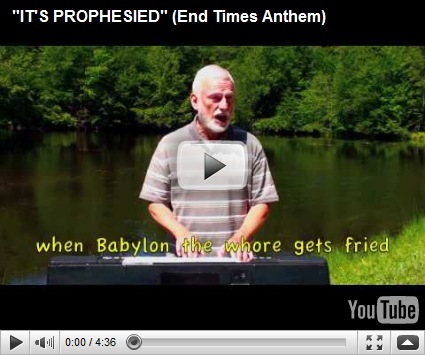
Prophecy by the Lake

(HT: TCC)

I apologize for this one.  I cannot resist posting this gem.  I’m not laughing at this simply because I do not believe in a pretribulation rapture.  I’m laughing at the lyrics and the way the guy sings things like “burn in hell” in a high almost happy voice.  Furthermore, calling Obama the leopard-king and other amazing lines that you’ll have to see for yourself.  But perhaps what makes me laugh more than anything is the setting.  Seriously?!?!  A dude playing a piano by a lake and switching the camera angle with every stanza. 

Saturday, March 28, 2009

How Should We Read the Book of Revelation?

How do you read Revelation? Is it a mystical document that tells the story of the end of the world? Is it a cryptic document that John uses to clothe his message to struggling Christians? Is it a timeless document that has a mixture of both? And I guess you could have a few other options as well.

I once believed it was a mystical document giving us clues to the end of the world. I have since changed my view. I think John had a particular message to the people of his day. John knew what he was writing and he knew what this vision meant. Once my view changed the pendulum began to swing too far the other way into a cryptic document that explained events that have very little to do with the future. This is where I am today—tomorrow this might change:

History tends to repeat itself. Therefore, is it possible that Revelation describes relevant history for John’s people but also relevant history for people throughout the centuries? I tend to read Revelation as the ongoing cosmic reconciliation that is taking place with its ultimate culmination in the victory of Christ over all. In a way I think it has the same message that we have been discussing in Ephesians: God redeems broken people and a broken world. It meant that to John’s audience and it means that to us.

Will there be more intense persecution as we close out the chapters of this book and open up the pages of the next? Certainly. Will there be a literal end times Antichrist? Perhaps. Is John foretelling of a one-world economic system? Maybe, but I do not think that Revelation is about John looking into a crystal ball and trying to explain in his terms what he saw. Again, the Book of Revelation, in my opinion, is about “uniting all things in him, things in heaven, and things on earth.”

What do you think?

LinkWithin

Related Posts Plugin for WordPress, Blogger...