Showing posts with label Christmas. Show all posts

Friday, April 19, 2013

Traded Everything for Love?

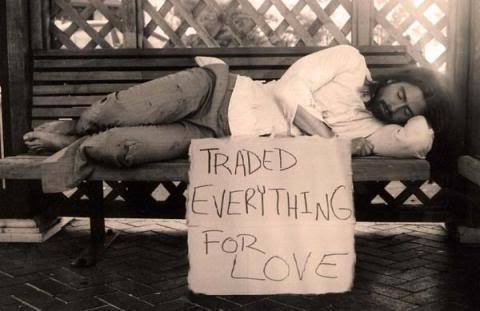
I stumbled across this photo last week and it captivated me. There is beauty in the simplicity of it.

Here is Jesus. Homeless. Tattered clothes. With the reason for his condition scrawled out on a dirty piece of cardboard: “Traded everything for love”.

The passerby would be left to wonder—what did this guy trade? How marvelous must this beauty be that he would make himself homeless to have her be his? What magnificent love must this man have…

When you fill in the details of the story with the gospel narrative the passerby would be even more astonished. To realize that the one he traded everything for isn’t some captivating beauty but an unfaithful harlot that has made herself haggardly from her rebellion. Now the passerby begins to grasp the depth of His love and the glory of His character.

What a phenomenal picture of the Story behind all stories. 

But is it true?

In one sense it is an absolutely beautiful and true picture of the incarnation. When he walked the earth he had no place to lay his head. He was as a homeless man. And all of this was because of love—love for His bride and Love for His Father.

I believe that the statement “Traded Everything for Love” comes from Philippians 2:6-8

…who, though he was in the form of God, did not count equality with God a thing to be grasped, but made himself nothing, taking the form of a servant, being born in the likeness of men. And being found in human form, he humbled himself by becoming obedient to the point of death, even death on a cross.

Love compelled Jesus to “take the form of a servant” by “taking upon himself human flesh”. Do you notice what is missing from Philippians 2, though? He didn’t “trade everything in”. Yes he “made himself nothing”. But he did not stop being God when He became man. This is the wonder of the incarnation. God became flesh but He didn’t cease being Deity.

This isn’t a City of Angels type of story. The pre-existent Son of God did not drop this identity and become a mere human. He remained the pre-existent Son of God but he took upon human flesh.

This is good news.

Our redemption is tied up in the fact that Jesus did not “trade everything” for love. The incarnation is only a means to the greater end of “reconciling all things to himself”, creating a people for himself, overturning the works of the devil, and ultimately restoring everything in the new heavens and the new earth. He doesn’t do this simply by becoming a man. He does this because He is the God-man.

So did Jesus “trade everything for love”? Kind of…but not really.

Friday, December 21, 2012

The Christmas Victory March

With his one good arm the decaying man hoisted himself up from his slumber.

“O Come all ye faithful, joyful and triumphant…” the humble choir sang.

A sparkle now seemed to fall upon his eyes. This dying man was looking upon a victory march. Perhaps his own.

“O come, let us adore Him, O come, let us adore Him, Christ the Lord.” Young and old passed by his room. Some too young to know what they were singing. Others so beaten down and distracted by the cares of the world that they’re only singing from memory, not taking in the full effect of this parade. Yet, some are truly belting out the victory of Christmas.

The sounds of adoration now fade down the halls. The old man turns his feeble ear to hear the fading sounds of Christmas victory. The parade continues marching down the corridor proclaiming the joys of Christ to others enduring the curse. Reaching the end of the hall, the choir marches back towards his room as they begin a new song.

“Joy to the world…”

What a silly, and even offensive, song to sing to dying men if the gospel isn’t true. This isn’t a birthday song. This is a victory cry. The curse is being lifted. The long awaited King has come and joy is the only fitting response. Yes, such far-reaching joy would be silly to proclaim to those that are daily assaulted by the atrophy of their bodies. Unless of course the gospel is true. Then, it’s not silly at all, it’s altogether necessary.

The choir now passes by the old man’s room again. “He comes to make His blessings flow, Far as the curse is found, far as the curse is found, Far as, far as, the curse is found…”

He feels that curse every day. But tonight he feels something different. Tonight, he feels the victory of Christmas. He will still die. Maybe days from now. Maybe months. He might even hang on for a year or two, but eventually the curse will overtake him. Yet, if he is found in Christ, the curse will not consume him. Death has lost its sting.

We still live on the fallen side of a Redeemed Eden and so we still mourn and we still sing things like “O Come, O Come Emmanuel”. We long for just to make things fully right. Yet because of the victory of Christmas and the Cross we march down the halls of this nursing home proclaiming the triumph of Christ over the curse.

I’ve always enjoyed the phrase “charging hell with a water pistol” to speak of youthful vigor. Wednesday night I enjoyed doing something similar as my four year old son and I walked into a nursing home with our brothers and sisters in Christ and proclaimed to dying men and women that the curse is lifted. The Conquering King has been born.

“…Born that man no more may die, Born to raise the sons of earth, Born to give them second birth”…

May we continue this Christmas march throughout every day of 2013.

Monday, December 10, 2012

What Is An Ebenezer and Do I Need to Raise One?

I remember sitting (or probably standing) in church and singing all the verses of Come Thou Fount for the first time. The song was pretty jazzy and the words seemed pretty profound. I was starting to get into the song. Then it happened…

“Here I raise my Ebenezer…”

Wait, what? I could not focus on the rest of the song because the only Ebenezer that I was familiar with was the crotchety old duck from Mickey Mouse’s Christmas Carol. Why did the worship leader just encourage us to raise a crotchety old duck? And what does that have to do with Jesus? What in the world is an Ebenezer?

After reading through all of the words my solution at the time was to think that perhaps the word Ebenezer meant “complaint”. So the dude who wrote the song is raising a complaint. That complaint, I figured, was that his heart kept wandering. So in this song he is raising a complaint (kind of like a holy dissatisfaction) to the Lord.

Sounded plausible, but unfortunately quite wrong.

What is an Ebenezer?

The term Ebenezer comes from the Hebrew which means “stone of help”. So, back in the day (like in the 1700’s when Richard Robinson wrote the hymn) the term was used to speak of a marker that you set up to remind you of God’s great faithfulness in times past. John Newton used it similarly when he speaks of the mature believer reflecting on his life…

“while he reviews the Ebenezers he has set up all along the road, he sees, in almost an equal number, the monuments of his own perverse returns…”

“Raising an Ebenezer” means that upon this place the author is setting his monumental stone. What is that place? What is that fount? It is Christ. He is saying that he is setting up his “stone of help” on the fixed work of Jesus Christ. Though his heart is prone to wander he knows that he has a surety in what has already been accomplished by Christ.

As a side note it is probably not an accident that Charles Dickens chose the name Ebenezer for Mr. Scrooge. Mark Roberts makes a compelling case that the character is “to remind us of things we ought not forget, lest we end up like Jacob Marley and the other spirits who walked the earth in sorrow, dragging the heavy chains they forged in life.”

Should You Raise One?

Though it sounds like something that might accompany a sneeze or call to mind a “bah humbug”, it is a great practice to raise an Ebenezer. An Ebenezer is actually the opposite of a “bah humbug", it is a permanent reminder of the Lord’s faithfulness.

I’m not necessarily talking about driving a stake in the ground outside your grandpa’s barn as a reminder of the day you trusted in Jesus. And then every time you doubt the veracity of your faith you go back to that stake and remember that you prayed a prayer. Though that might hold a little value I believe we ought to “drive our stake” in the same place that Robert Robinson did, in the finished work of Jesus Christ.

I have many Ebenezer’s in my life of the Lord’s faithfulness to me. I have many stories that remind me that the Lord is real and that He is active in my life. But none are as sure and as certain as the finished work of Jesus Christ. It is here that men like John Bunyan would raise their Ebenezer.

One day as I was passing into the field . . . this sentence fell upon my soul. Thy righteousness is in heaven. And I saw with the eyes of my soul Jesus Christ at God’s right hand; there, I say, was my righteousness; so that wherever I was, or whatever I was doing, God could not say of me, he lacks my righteousness, for that was in front of him. I also saw, moreover, that it was not my good frame of heart that made my righteousness better, nor yet my bad frame that made my righteousness worse, for my righteousness was Jesus Christ himself, “The same yesterday, today, and forever.” . . .Now did my chains fall off my legs indeed.

Christ is our Ebenezer.

Tuesday, December 28, 2010

Christmas, Cross, Crown


Keep in mind this Christmas season that the incarnation leads to the cross.  But don’t forget that the cross also leads to the resurrection which in turn leads to glory.  The gospel story doesn’t end with Matthew 27.  This is only the foreword.  The story doesn’t really get going until we live out Revelation 21-22 for all eternity. 

Wednesday, December 15, 2010

Rescuing Jesus’ Birthday

Earlier today I mentioned God admitting to hardening Pharoah’s heart.  I commented on this, that sometimes we rally to defend God when he does not seem too concerned about defending himself.  Here is another example:  The Grinch Alert

I’ll warn you early on.  This may turn into a rant.  This may even be offensive.  I’m rocking a sacred cow. 
I am so unbelievably sick of hearing people talk about this battle to save Christmas.  It is as if many people believe their entire mission on earth is to be certain that unbelievers celebrate the birth of Jesus.  I don’t get it.  Even if they somehow say, “Merry Christmas”, this does not ensure that they are preserving the “reason for the season”. 

I love Christmas.  I do not intend on not celebrating it.  But the truth is I find nothing in the New Testament where Jesus tells us to celebrate his birthday.  I do see places where Jesus encourages us to remember him through the ordinance of the Lord’s Supper.  I wonder what would happen if we were as passionate about preserving the true meaning of the gospel as we are about preserving the true meaning of our made up holiday. 

Yes, Christians should use the Advent season as a time to celebrate and marvel at the wonders of the Incarnation.  Yes, we should be passionate about exalting Christ above consumerism.  And yes, this is a wonderful time of the year where people are actually thinking about Jesus.  We should certainly take advantage of that. 

But this is not the time of year when we militantly encourage people to celebrate the birth of a Jesus they do not even know.  Perhaps, instead of making sure these darn liberals don’t take away our country we should model the Incarnation and sacrificially serve.  Maybe we should say Merry Christmas not only with our lips but with our life. 

Rant over.

You can enjoy a more thoughtful “rant” here.  Also, I should mention that I think Happy Birthday Jesus cakes are a fine idea—and the picture above is not meant to mock anyone that celebrates in that fashion. 

Thursday, December 2, 2010

More Amazing than Walking on Water

[47] And when evening came, the boat was out on the sea, and he was alone on the land. [48] And he saw that they were making headway painfully, for the wind was against them. And about the fourth watch of the night he came to them, walking on the sea. He meant to pass by them, [49] but when they saw him walking on the sea they thought it was a ghost, and cried out, [50] for they all saw him and were terrified. But immediately he spoke to them and said, “Take heart; it is I. Do not be afraid.” [51] And he got into the boat with them, and the wind ceased. And they were utterly astounded, [52] for they did not understand about the loaves, but their hearts were hardened. (Mark 6:47-52 ESV)

The above passage was one that was the subject of intense debate in 20th century quest for the historical Jesus.  Some considered this story an optical illusion caused by Jesus walking on the shore, or perhaps a deception—in that he was really only walking on a sandbar.  It was impossible in the minds of many of these scholars that the laws of nature could be broken by a man walking on the water. 

But I think they missed something.  Verse 48 really is not the most astonishing verse in this passage.  The most astonishing verse in this entire passage is verse 51, “And he got in the boat with them…”  THAT is what is mind-boggling about this passage. 

Let me explain. 

The Deity of Christ is all over this passage.  His intent to “pass them by” is more than likely a reference to Exodus 33 (the glory of God “passing by” Moses) or more likely even a reference to Job 9.  As James Edwards has pointed out, “The Job quotation summarizes a passage that begins in 9:1ff by recounting the awesome separation between God and humanity”. 

The astonishing thing in this passage is that the transcendent God, the wholly Other, the eternal I AM, has now become Emmanuel.  The majestic God that had to cover Moses’ eyes is now getting in a boat with His ragtag band of followers at 4 in the morning.  THAT is what is unbelievable about this text. 

God walking on water is not so hard for me to grasp.  After all He is God.  What is hard for me to grasp, though, is that this transcendent God bridged the gap of separation and could be found in a boat.  The I AM has become Emmanuel that is astonishing!

Wednesday, December 1, 2010

The Vapid Wasteland of Contemporary Worship Songs?

Yesterday Christianity Today posted a question to stir up some discussion:  Should churches ban Christmas carols with questionable theology?  The title of the post brings up some fond memories for me: Away with ‘Away in a Manger’? 

The discussion has been thoughtful at times, but what I found really interesting is the myriad of comments like these:

Hahaha- what a nonsensical article. What they should do away with are all those evangelical songs that focus like a laser on ME ME ME. Oh Jesus, I feel this, and my life has changed, I'm a better person, blah, blah, blah.

I wouldn't mind passing on the questionable lyrics in "Away in a Manger", provided that we also take a harder look at the theological mush that often passes as Sunday morning worship lyrics throughout the rest of the year.

Maybe we should go the praise-chorus route and only sing songs so utterly devoid of meaning that no one could possibly be offended.

So much (not all) of the current contemporary worship music is junk – literal, theological, musical, overly repetitive, shallow junk. Why not start cleaning the Lord’s House from some of those first.

There is one sense in which I agree with some of these comments.  We should take a hard look at many of the lyrics in the things that we sing.  But where I disagree is in saying that this is only the “praise-chorus” songs.  There are just as many beloved and precious hymns that are theologically vapid. 

And such blanket statements about contemporary worship music is irresponsible.  I’ll take many of my Crowder and Tomlin songs over Fanny Crosby’s Keswick-laced songs any day.

I say the solution is to not give any genre of music a free pass, nor to demonize any genre, but to consider how all of them stack up theologically.  Of course, it is also wise to consider the medium as well; leaving room for poetic license and not being a stubborn doctrinal Pharisee. 

Thoughts?

Thursday, December 20, 2007

The Promised King

Last night we completed our series on the Minor Prophets. As we reviewed each one of these prophets we saw that each is looking to something greater. Every book leaves us with nagging questions. It is almost impossible to paint a compelling enough picture for you of the heart and longing the Jewish people had for their coming Messiah. Therefore, when we look at the baby in the manger we are not filled with relief, excitement, wonder, and thankfulness at the long-awaited King.

The sermon is in only a little better than outline form, but you can find it here. Simeon knew that he held in his arms the Promised King. As the holiday season approaches we too must see Jesus as the Promised King.

Now there was a man in Jerusalem, whose name was Simeon, and this man was righteous and devout, waiting for the consolation of Israel, and the Holy Spirit was upon him. And it had been revealed to him by the Holy Spirit that he would not see death before he had seen the Lord's Christ. And he came in the Spirit into the temple, and when the parents brought in the child Jesus, to do for him according to the custom of the Law, he took him up in his arms and blessed God and said, “Lord, now you are letting your servant depart in peace, according to your word; for my eyes have seen your salvation that you have prepared in the presence of all peoples, a light for revelation to the Gentiles, and for glory to your people Israel.”
And his father and his mother marveled at what was said about him. And Simeon blessed them and said to Mary his mother, “Behold, this child is appointed for the fall and rising of many in Israel, and for a sign that is opposed (and a sword will pierce through your own soul also), so that thoughts from many hearts may be revealed.” (Luke 2:25-35)

Monday, December 17, 2007

Today in Blogworld 12/17

The first article I read this morning is probably the most sad. Dr. Mohler addresses a new agenda-filled T-shirt worn by toddlers. The T-shirt reads "My Daddy's name is Donor". No, that's not Donner, one of the 8 reindeer; it is a reference to a sperm donor. What is communicated to this little guy is that his daddy does not matter. Mohler sites Catherine Bruton of The Times in London who says: The T-shirt is offered by a company called Family Evolutions, founded by a lesbian couple whose son modelled the shirt. The co-founder, Stacey Harris, says that the T-shirt is empowering. "We want to lift the taboo surrounding donor conception so that kids don't feel that their coming into the world is a shameful secret," she says. "Kids who are empowered will grow up well-adjusted." Despite my concern over the political agenda behind this, I am most pained for this little child and the host of other little boys. What does it communicate to a male child when he is told that daddy doesn't matter? It means men do not matter. It means your masculinity does not matter. Truly sad.

John Piper reminds us that we need to feel homesick: "The likelihood of dying because you are a Christian is closer than it used to be for Americans. The freedom from such threats has generally existed in this country for a tiny portion of history (about 400 years). We have gotten used to it. It seems like the way things must be. So our first reaction to the threat that things might be otherwise is often anger. But that anger may be a sign that we have lost our sense of being aliens and exiles (“Beloved, I urge you as sojourners and exiles . . .” 1 Peter 2:11). Perhaps we have settled in too much to this world and this country in particular. We don't feel as homesick for Christ as Paul did..." Continue reading

In Acts29/MBC news, Founders has posted an interview with Kevin Larson. Larson is one of the 3 churches that will be deeply affected by this decision. The St. Louis Post has ran an article as well. My friend Sam of Believers Church, also deeply impacted by this decision, was interview for this article. My only regret is that in the Post article the author refers to these churches as "Emerging". That is not helpful to the discussion.

Josh Harris has parts two and three now posted on his affluenza series.

Pulpit Magazine attempts to answer a very good question about being unequally yoked: Question: Some people have told me that being unequally yoked is talking exclusively about marriage. Others have said that it applies also to business partnerships and other situations. Could you please expand on this? What does it mean to be unequally yoked and what type of a guideline should I have if it is okay for me to have a business partnership with a non-believer? Read the answer here.

And finally Thabiti Anyabwile, from Pure Church, tackles the Satan (I mean Santa) Claus debate. I am hoping that my friend Will accepts my invite to begin writing on this blog. If he does I would love to see him address this issue--I appreciate his stance on Christmas. As for Thabiti he says Down with Santa Claus. Here is his conclusion: "I'm not arguing a dogmatic causality here. I'm simply asking the question, "Why include Santa Claus at all?" Is the imagined upside of following the culture here worth what we think it's worth? And are our justifications helping us to point our children to Christ or masking the reality that we may be pointing our children away from Him? Personally, I doubt Santa Claus is worth it, and pointing our kids away from Jesus at Christmas may be the worst form of child neglect I can imagine."

LinkWithin

Related Posts Plugin for WordPress, Blogger...