Showing posts with label Reformed. Show all posts

Tuesday, April 2, 2013

3 Reasons the YRR Should Listen to John MacArthur

Two videos from a 2011 discussion with John MacArthur are gaining some traction again. In these videos MacArthur calls out the young Reformed guys that have adopted a Calvinistic soteriology but seem to be Arminian in everything else. He decries their worldliness; noting things like music, movies, beer, cursing, and even the pull to be and/or follow celebrity pastors. He also believes that the rise in “flat screen churches” stems from our catering to the larger culture. You can watch the videos below:


And part 2

My gut reaction to these videos is to place Dr. MacArthur as the leading candidate behind Twitter’s Church Curmudgeon. He simply seems ticked off at all these new fangled gadgets. In my opinion he is painting with a brush that is a bit too broad and making a mountain out of mole hills (like what clothes guys wear). The whole thing just rubs me the wrong way. 

Truth be told, I simply want to dismiss his words here. Which is why I should listen. Bad history is made by us young whippersnappers not listening to our elders, like MacArthur. As I continued listening to Dr. MacArthur I came to realize that there is a great deal of wisdom in his words. All of us YRR (Young, Restless, and Reformed) guys ought to heed his words here. He has earned our ear and we ought to listen.

Here are 3 reasons that we should listen to him:

  1. We can wrongly assume that right theology, right cultural engagement, etc. will be a formula for reaching the lost. It does seem like even in Reformed circles there is a drive to figure out the code to reaching the lost.
  2. We are prone to celebrity and rock-star pastoring. You really can’t shepherd from a flat screen*. We need to listen to this seasoned pastor about what it really means to be a shepherd.
  3. Ecclesiology is not unrelated to soteriology. Ecclesiology is not clay that we can mold however we want. It is just as much revealed truth as our soteriology.

Let’s not too quickly dismiss this dear brother. He has words that we need to heed.

---

*I realize that there is more to the debate about multi-site churches. It’s not quite as black and white as MacArthur has presented it. But his point is worthy of serious consideration.

Wednesday, February 6, 2013

Why I Wouldn’t Want to Attend the John 3:16 Conference Even If I Weren’t Reformed


On March 21-22 the second John 3:16 Conference will be held. The purpose of this conference will be to inform local churches of the viewpoints of New Calvinism. It is to be part of the continued discussion on the Calvinist Resurgence within the SBC and broader evangelicalism. Those speaking will defend a non-Calvinistic (or a self-dubbed Tradiontalist viewpoint).

They will be discussing topics like limited atonement, inherited guilt, regeneration and faith, historical views of salvation, election, and the sinners prayer among other things. It looks like it could be an interesting conference. And I appreciate that Jerry Vines’ intention is that all the speakers be “irenic in tone, theologically well versed and evangelistic and missions minded.” Yet…

I have no desire to attend

And that has nothing to do with the fact that I am Calvinistic. I’m not up in arms that these men will be promoting a theology that is not my own. In fact if this were a conference led by Calvinists that had the same topics I would also not have a burning desire to attend. Why? I’m very similar to John Newton in that I like my Calvinism as I do my sugar:

‘I am more of a Calvinist than anything else; but I use my Calvinism in my writings and my preaching as I use this sugar’—taking a lump, and putting it into his tea-cup, and stirring it, adding, ‘I do not give it alone, and whole; but mixed and diluted.’

Conferences like this hold very little appeal to me because I think they are largely distracting. And if I had any counsel to give to the non-Calvinists among us I would say that it would be to their benefit to make their non-Calvinism like their sugar.

If your position is true then proclaim it as truth and stop spending so much time battling this New Calvinism. If it’s of the Lord then you’re battling Him. If it’s not of the Lord then it’ll eventually die and fizzle. Just keep proclaiming the truth as faithfully as you can. God’s is faithful to His gospel and He’ll lead His church into all truth.

Honestly I think this is part of the reason why Calvinism has seen a resurgence…

T4G

Fundamentally, I would argue that Calvinism is surging for God-ordained reasons. But even if you don’t care to agree with that, consider with me the practical reasons. You have to admit that there is a great movement among younger generations to focus on Christ and His gospel and not be tied down by a ton of controversy. I believe that is part of the appeal of Together for the Gospel for my generation.

Look at the 2006 conference. Yes, all the speakers were Calvinists. But that’s not the driving force in the conference. That year it was preaching. Their Calvinism was used like sugar; mixed and diluted. In 2008 the only message that was overtly Calvinistic was John MacArthur’s on the doctrine of absolute inability.

2010 and 2012 were the two that I have been able to attend. And I left those conferences without one thought about Calvinism. I left those conferences reinvigorated with a love for Jesus and a new drive to engage in Christ-honoring ministry. Why? Because though all the speakers are Calvinists and their Calvinism shapes everything it is “mixed and diluted”**.

And this is the way it ought to be. That’s why when I hear conferences like T4G being advertised I get excited and hope that I can attend. Sure it makes me comfortable knowing that these guys largely have the same theological leanings that I do. But at the end of the day what really drives me is a passion to see Jesus Christ the only boast of this generation.

This is also why I wouldn’t attend the John 3:16 Conference even if I weren’t Reformed. I’d likely stay away from a John 6:44 Conference as well. For me it depends on what the driving force is behind the conference. If it’s a get together to discuss theology and you hope that everybody leaves being informed about New Calvinism, Old Calvinism, Good Calvinism, Bad Calvinism, Ugly Calvinism, or anything of the sort I’ll stay home. As much as I like to discuss theology, I’ll save my limited conference money to go to some place where I’m going to walk away enthralled by the risen Savior.

I want to attend a conference whose aim is in some fashion to enjoy God and extend His glory.

----

**Now those with an idea that we Calvinists are involved in some sort of vast conspiracy will turn that “mixed and diluted” phrase and say that they are hiding their Calvinism and that people are swallowing errant theology without even knowing it. I guess theoretically that could be what is happening. But as one being shaped by the Spirit’s use of this movement I believe it is something much different. These men aren’t obsessed with Calvinism. They are Calvinists and yes it impacts the way they see everything, but it’s not the driving force behind these conferences.

Saturday, August 20, 2011

Young, Restless, and Newtonian

One of the reasons why posting has been a little slow (at least as far as original material is concerned) is because I have been blocking off a little more time to work on a book I hope to write on John Newton.  I believe Newton to be a great model of a pastor-theologian that provides a wonderful pattern of effective soul-care and evangelical Calvinism. 

One particular area that I feel we “Young, Restless, and Reformed” can learn from Newton is in the way he held his Calvinism, and how he debate it—or rather how he did not debate it. 

In June of 1772 he published a letter On the Doctrines of Election and Final Perseverance (you can read that here).  Shortly thereafter a Methodist preacher by the name of Nicholas Manners published a detailed line by line response to Newton.  (I can’t find it online but you can buy it here). 

Let’s imagine that this took place in 2011.  Newton wrote an article on a popular blog (let’s say The Gospel Coalition).  To this another brother strongly disagreed and posted a lengthy series on his personal blog, going through Newton’s article line by line and disputing it. 

What would be the typical response in 2011? 

Pop your knuckles, get your Mountain Dew, sit at your swivel chair, and slam out a response.  Line by line.  Defending your argument and your dearly loved doctrine, under the guise of gospel fidelity. 

You know what Newton did? 

Nothing.

That’s right.  Nothing. “He let the dispute die in silence” (Hindmarsh, 162)

Why?  As Bruce Hindmarsh has rightly noted, “He [Newton] was increasingly convinced that a person became a Calvinist through personal experience, not by argument” (162). 

Newton to Ryland: Be Helpful, Not Displeasing

His advice to a young John Ryland is worth heading.  After a young and seemingly arrogant Ryland wrote in his book of poetry that he “aimed to displease the Arminians”, Newton responded thus:

You say, I aimed to displease the Arminians, I had rather you had aimed to be useful to them, than to displease them.  There are many Arminians who are so only for want of clearer light.  They fear the Lord, and walk humbly before him.  And as they go on, by an increasing acquaintance with their own hearts and the word of God, their objections and difficulties gradually subside.  And in the Lord’s time (for he is the only effectual teacher) they receive the doctrines of grace which they were once afraid of. 

Now these should not be displeased, by our endeavoring to declare the truth in terms the most offensive to them which we can find, but we should rather seek out the softest and most winning way of encountering their prejudices.  Otherwise we make a parade, and grow big with a sense of our own wisdom and importance, but we shall do little good. 

Our Lord you know taught his disciples that they were able to bear it, he did not aim to displease them though it is pretty plain they had a good deal of the Arminian spirit in them for some time after they began to follow him.  You will perhaps say, ‘An humble Arminian, Surely that is impossible!’ I believe it not more impossible to find a humble Arminian, than a proud and self-sufficient Calvinist.  The doctrines of grace are humbling, that is in their power and experience, but a man may hold them all in the notion, and be very proud.  He certainly is so, if he thinks his assenting to them is a proof of his humility, and despises others are proud and ignorant in comparison of himself.  (Wise Counsel, 15)

If we Calvinist long for our brothers and sisters to savor the doctrines of grace that we so treasure, perhaps the best way to see that happen would be for us to relish them ourselves, to trust the Lord’s sovereignty in this matter as well, and go about our days enjoying God’s grace and extending His glory. 

Tuesday, April 5, 2011

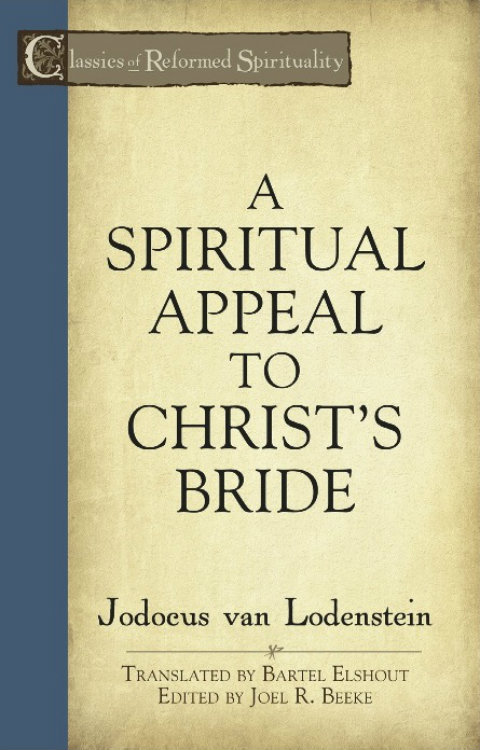
Review of A Spiritual Appeal to Christ’s Bride

A few months ago I bought an iPod Touch.  And I was perfectly content with my little iPod.  In fact it was awesome!  There was so much that could be done on it.  It expanded my world.  My iPod Touch was by far the coolest gadget that I owned. 

Then a very dear and gracious friend decided to simply bless me with an iPad.  (Yeah, I know you need to figure out where to get friends like mine).  Now my iPod seems tiny, stunted, and a little sad compared to my iPad.  An iPod can’t hold a candle to an iPad.  Compared to the greater the lesser doesn’t look so sweet. 

As I reflect on this I realize that this is the plight of many teenagers that I have ministered to.  Okay, I’ll be honest.  It’s the plight of my own heart.  I can be pretty content with my iPod to the neglect of the much greater iPad.  Rather than really striving to grab hold of and experience the fullness of Jesus I settle for a little bit. 

So as a pastor it is my task to encourage people that there is more to Jesus than the paltry experience that we often settle for.  And as a follower of Jesus I must constantly be reminded that my own heart is far too easily pleased. 

Jodocus van Who?!?!?

When settling for a paltry experience of Christ is the norm for the Church we are indeed in perilous times.  This was the climate that Jodocus van Lodenstein found himself in.  Lodenstein (1620-1677) was a preacher and poet of the Dutch Further Reformation; a movement that paralleled English Puritanism. 

Lodenstein believed that the Reformation did not go far enough in terms of practice.  It had recovered sound doctrine but in his mind that doctrine had yet to penetrate the culture of the church.  “Lodenstein equated the Reformation to Ezekiel raising bones in the valley of dry bones.  The Reformation renewed good doctrines, but it was only a skeleton on which flesh was yet needed.” (23)  What was needed for a thorough Reformation was the Spirit. 

To use our earlier analogy, Lodenstein firmly believed that those living in his day were satisfied with the iPod (doctrinal Reformation) when the iPad was much better (spiritual Reformation).  To this end he stressed the need for the Spirit’s work as well as the Christian life.  “He stressed sanctification more than justification…in so doing he paved the way for later pietists to follow in his steps.”  (31)

That which was dear to Lodenstein’s heart has been captured in the latest from the Classics of Reformed Spirituality series: A Spiritual Appeal to Christ’s Bride.  This book is a compilation of nine sermons preached by Lodenstein, that aim to awaken the nominal Christian from spiritual slumber and to experience more deeply the benefits of Christ. 

Summary

Since very few people have heard of Lodenstein the first twenty or so pages are dedicated to introducing the reader to his life and times.  Written by Joel Beeke, this section is worth the price of the book for history nerds like myself.  I’ve studied English Puritanism pretty extensively but have heard little of the parallel Dutch Further Reformation.  This introduction is helpful and informative.

The nine sermons are pretty typical of his era of preaching.  He introduces the text, makes a spiritual/theological point, raises objections, answers the objections, and then offers some application.  If you have read any of the English Puritans you know how they often take one verse, look at it from all angles, and then preach 25 sermons on that one verse.  Lodenstein is similar though he tends to be more heavy on applications than some of the English Puritans. 

Lodenstein does not engage in what you would term expository preaching but he has some real gems that need to be shared.  His passion for an experiential religion bleeds throughout his sermons.  You can feel his passion and angst for the people he ministers to as he pleads with them to reject vanity and embrace the fullness of Christ. 

Rather than discussing all of these sermons it may be beneficial to list their titles and then explain their common themes. 
  1. Belonging to God Involves Self-Denial (1)
  2. Belonging to God Involves Self-Denial (2)
  3. Self-Denial Involves Submitting to God’s Will
  4. Dead Hearts
  5. God’s Departure from the Church
  6. Divine Illumination in Conversion
  7. Vain Excuses for Turning from Christ
  8. The Bride’s Charge to the Daughters of Jerusalem
  9. The Bridge Brought into Christ’s Chambers
As you can see self-denial is a major theme for Lodenstein.  By this he means that “belonging to God therefore means that we possess nothing for ourselves but that everything is for the Lord.”  The first three sermons serve to flesh out this idea. 

Another major theme is Spirit-wrought repentance.  Lodenstein believed that his Church was living in Ezekiel 37; they were a lifeless body of professing believers but ones that lacked the Spirit.  “The life-giving Spirit who is in Christ Jesus was lacking, by whom the power of sin, which formerly held sway over us, must be slain.”  Because there was no Spirit there was no morality.  Therefore, Lodenstein prays for and pleads for a Spirit-wrought repentance.

The final theme that I will mention is the one that gives the book its title; the relationship of Christ’s Bride to her husband.  Lodenstein saw the Song of Solomon (as was typical in his day) as an allegory of Christ and the church.  As such he saw a few pictures of the Bride turning away from her husband.  These he used to call the church back into a vibrant relationship with her husband.  This passionate plea informs the entirety of his sermons. 

Concerns

There is one other theme that runs through at least the first few sermons fairly prominently; we must submit to God even if he doesn’t give us grace to over come sin.  Consider these quotes:
“…we are obligated to acquiesce in what God prescribes, which includes being submissive even if God does not give an increased measure of grace to obey His will.”  (37)
“Should he permit you to fall into sin and become spiritually dull and lethargic, you must learn to say, ‘Yes, Lord, my delight is in Thy will.’”  (39)
“…you should submit to God’s sovereign dispensation insomuch as He has been pleased to determine that you shall not gain further victory over sin.”  (109)
Now I don’t think that Lodenstein is encouraging his people to be comfortable with sin and just wait until the Lord gives them grace to overcome it.  That would contradict his frequent calls of repentance.  But I do think that he is taking his “Calvinism” into dangerous territories. 

He is practically denying the truths of Romans 6-8.  We have been freed from bondage.  It seems to me that he is assuming that the will is in bondage even during sanctification, and that is simply not the case.  We are free to obey the Lord. 

Perhaps, I am misunderstanding Lodenstein, and if so I welcome correction.  I also am sensitive to the fact that he ministered in a much different time than I do (although not so different really).  The church and the community were often so interwoven that the lines between believer and unbeliever were often muddied.  And Christian living was often expected of those even that were unbelievers.  So I can understand how the lines between justification and sanctification could get muddied.  But there is a hopelessness to some of Lodenstein’s appeals that really do not apply to someone that DOES have the Spirit of God. 

Why You Still Need This Book

Nonetheless, this is still a book worthy of adding to your personal library.  I am not certain that this would be the greatest fit for the average layman that is unfamiliar with reading 16th and 17th century literature.  There would be other books that would be more helpful introductions. 

However, to the pastor and student this book is helpful.  I hope to see more works from the Dutch Reformation.  There are some very reach truths in this work that will benefit many.  The history is also worthy of your ten dollars.  I found it interesting to see the way that a man from the Netherlands in the 17th century handled text and dealt with some of the same spiritual struggles we have in our day. 

There is much we can learn from Lodenstein, and to that end I recommend this book.  You can pick it up at Reformation Heritage for only 8 bucks

Friday, December 3, 2010

Review of Young, Restless, Reformed

Except for that time I went 3-5 with a couple RBI’s for my American Legion baseball team at a State championship game I have never read an article about me.  In 2008 Collin Hansen wrote a book about me:  Young, Restless, Reformed.  It’s a shame I did not pick it up until recently.   

Actually the book is not about me.  But it just as easily could have been.  I think that was one of Hansen’s hopes with this book.  There is a growing movement of “New Calvinists” and Hansen explores the in’s and out’s of the movement. 

Inside you will find interviews with “everyday folk” (broke seminary students like myself), as well as interviews with the “guys in lights” like Piper, Dever, Driscoll, Mahaney, Mohler, and Joshua Harris.  Hansen does not limit himself to only the T4G crowd, though.  He also goes to Yale and explores the Calvinism in that climate. 

It is an interesting journey; one that probably could have been a couple of years longer.  It would be interesting to see how Calvinism in England influences the Calvinism in the States.  There are neat anecdotal tales that really gets at the heart of this growing movement.  But there are also cautions for the newer Calvinists. 

As one within the movement I would be interested to read a review from someone that knows the “doctrines of grace” but disagrees with them.  It is obvious from reading where Hansen’s loyalties are.  He is part of the movement himself—I would almost like to see another similar book from an outsiders perspective.  At times I think Hansen may be overstate his case a little, or be a little harsh with the non-Reformed church culture, but overall it is straight-forward journalism.

Hansen does offer some occasional critique for those of us within the movement.  So, in that regard it is helpful to read it even if you are Young, Restless, and Reformed.  It will also be encouraging for many to know that they are not alone in their theological leanings. 

But this book may be most helpful for those outside the movement.  It may even be a good read for those that are critical of the Young, Restless, and Reformed crowd.  This book will certainly show a good part of what “we” believe and many of the reasons why. 

It’s an easy read and a relatively fun journey through the Young, Restless, and Reformed movement.  I would heartily suggest this book to anyone interested in the growing movement towards Reformed theology and Calvinism. 

Rating 4.5 out of 5 Stars

Buy It: 10.49 (hardcopy) 7.99 (e-book)

Wednesday, July 7, 2010

Active Symbols

I am really interested in this series by Les Puryear on the differences between Reformed and Southern Baptist Churches.  Today Les considers the difference between Ordinances and Sacraments.  He mostly highlights an article by Tim Challies.  It would also be helpful to read Justin Nale’s response

I am not sure if you would call my position Reformed, Baptist, sacrament, or ordinance.  Honestly, I’m not really all that concerned with the label that you give me.  But here is my view. 

Baptism and the Lord’s Supper are visible pictures of the gospel.  It is another way of proclaiming the gospel.  Baptism does not save, Jesus does.  The Lord’s Supper does not save, Jesus does.  But I believe the Spirit proclaims the gospel through baptism and the Lord’s Supper. 

Challies uses this statement to sum up the Baptist view: “Where sacraments revolve around what God does, ordinances revolve around what man does and what God did.”  I struggle with this statement because I struggle with memorialism.  What Challies defines as, “the sacraments have no real power, but are merely memorials, object lessons, which teach something about God.” 

I struggle with this view because I believe that God is active through His Spirit in the proclamation of the gospel.  And I believe that the gospel is being pictured/proclaimed in both Baptism and the Lord’s Supper. 

I think we as Baptist overstate what Baptism “isn’t” to keep us from falling into any form of sacerdotalism or baptismal regeneration.  And in so doing we undercut the activity of the Spirit in proclaiming the gospel to hearts through visible pictures like baptism and the Lord’s Supper. 

So, am I Reformed or Baptist?  You tell me.

Wednesday, June 23, 2010

SBC and Reformed? Why does it matter?

I must be missing something. 

There is a discussion on Les Puryear’s blog, and now at SBC Voices about whether or not you can be Reformed and Baptist.  This discussion really is not about Calvinism.  It is more about “Reformed” polity and other distinctives of Reformed theology. 

Allow me to tie a few things together, and then I will explain why I am confused.

1. The Southern Baptist Convention as a denomination began as a missions endeavor.  The hope was for like-minded churches to pool their resources to be more effective in missions. 

2. “Like-minded” is more about issues related to the gospel itself, the practice of baptism, and regenerate church membership.  It had little to do with other issues of polity.

3. Because of this belief the desire was to keep local churches autonomous.  That means that local churches are able to maintain their own polity, etc. so long as they held onto the gospel, the biblical practice of baptism, and regenerate church membership.  (Perhaps some will accuse me of rewriting history here—but I think it may be a decent summary). 

Summary: Southern Baptist Convention=like-minded autonomous churches pooling their resources to spread the gospel to the nations. 

This is why I don’t understand much of this whole discussion.  Can you be a Reformed Baptist?  At the end of the day this whole thing comes down to semantics.  What does it really mean to be Reformed?  What does it really mean to be Baptist?  I just do not understand why this matters. 

Obviously I believe that polity matters.  But I never thought the intention of the Southern Baptist Convention was to make certain that all of the churches held to a certain polity.  Puryear mentions 8 characteristics of being reformed and seems to say that only one is acceptable within the SBC.  I could be wrong but I just don’t think that historically these 8 things really matter as far as pooling together resources (except #6 of course). 

In my mind what the Great Commission Resurgence means is that we as a convention get back to what we original set out to do.  Find like-minded brothers and sisters in Christ, pool our resources, and take the gospel to the nations. 

And when the SBC becomes a bureaucracy or an agency to police tertiary doctrine/practice it is no wonder that young pastors are jumping ship.  Many aren’t leaving the historical SBC, they are just leaving what the SBC has become. 

But I’m probably missing something…

Tuesday, January 29, 2008

Christian Star...A Contradiction in Terms


"This is a point that our generation cannot afford to ignore. Why is it that we constantly parade Christian athletes, media personalities, and pop singers? Why should we think that their opinions or their experiences of grace are of any more significance than those of any other believer? When we tell outsiders about people in our church, do we instantly think of the despised and the lowly who have become Christians, or do we love to impress people with the importance of the men and women who have become Christians?"
D.A. Carson, The Cross and Christian Ministry, p.29
Amen! I fear that those of us in the "Reformed Camp" can gravitate towards the same thing. Some follow Piper, some follow Sproul, some follow Carson, some follow Christ...(By no means is this anything against Piper, Sproul, or Carson). We must be careful not to make "stars" out of our heroes of the faith. Remember that their light is borrowed. Let us magnify the grace of God in the life of a high school janitor as much as we do in the life of our first baseman. Let us boast in the Cross through the lives of the clean-up crew as much as the keynote speaker.
UPDATE: Also, I want to point out what I mean by the title. I am not saying that one cannot be a "star" and a Christian at the same time. What I am saying, and believe Carson is saying, is that at the point in which the "stardom" is the attracting power it fails to be Christian.

LinkWithin

Related Posts Plugin for WordPress, Blogger...