Showing posts with label books. Show all posts

Monday, August 12, 2013

10 Books I Packed For Vacation

This week I will be spending time with my family in Branson, MO*.

My wife and I spent our honeymoon in Branson, and have since went on a couple of vacations there. There is beautiful scenery there and quiet and peace resorts. I’m looking forward to getting away and unplugging. It will look like I am online but for the most part I will not be.

One part of vacation that I am really looking forward to is sitting out on the porch in the morning and spending some time reading a few books that I’ve been wanting to read for awhile. Here are 10 books that I am packing on vacation. (Not sure how many I will even open—but a guy can dream):

  1. The Pastor by Eugene Peterson
  2. A Lifting Up For the Downcast by William Bridge (hope to finish this one)
  3. INsourcing by Randy Pope
  4. Culture of Complaint by Robert Hughes (it’s an old one but intriguing)
  5. Test, train, affirm & send into ministry by Brian Croft (got it at T4G haven’t opened it)
  6. Growth Groups by Colin Marshall
  7. The Scandal of the Evangelical Mind by Mark Noll
  8. Communion with God by John Owen
  9. Revival and Revivalism by Iain Murray
  10. The Pastor’s Justification by Jared Wilson (plan to finish this one)

---

*Yes, that Branson, MO--the place where dreams go to die. I’m kidding, I’m kidding. But seriously, there is so much country music there I may not survive.

Monday, July 22, 2013

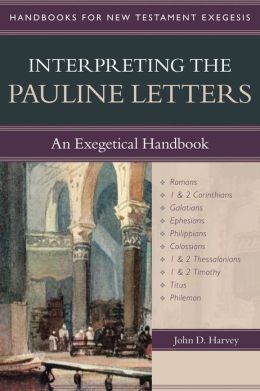
Review of Interpreting the Pauline Letters by John D. Harvey

“Designed as a handbook for seminary and graduate students, the book provides a go-to guide that will also serve seminary-trained pastors, upper-level college students, and well-motivated lay people. As readers work through this handbook, they will begin to see and interpret the narrative writings as Paul intended them to be understood.”

That is a brief snippet from the back of John D. Harvey’s, Interpreting the Pauline Letters. I provide it here because it lets you know what type of books this is intended to be. It is not a book that you casually read on the bus home from work. This book is one that is better used as a resource for preachers and students as they work through a text of Scripture.

When I first read the title I immediately thought of Dr. Schreiner’s excellent work Interpreting the Pauline Epistles. Schreiner’s work is one that has been influential in shaping my reading of Paul’s letters. Therefore, I was anxious to see how Harvey’s work compared to Schreiner’s.

At present I am preaching through 1 Thessalonians and so I thought it would be beneficial to use this as a resource to see exactly how valuable it would be in preaching through a text.

As I picked up this book to begin my study of 1 Thessalonians I immediately noticed that a general index and a Scripture index is missing from the back. That would have been immediately helpful. In fact the absence of such an index makes this almost too time consuming to use as a preaching resource. I have to scan through the entire work to find things on 1 Thessalonians.

What I do find is helpful. There is a section on the major themes of each of Paul’s letters. Here I get help in placing the text in it’s historical context. (Here I think Harvey is a little more in depth than Schreiner). I notice also that there is a section on the structure of the passages. Here Harvey helps the reader layout the structure of a given passage. (I immediately note that Schreiner’s treatment tops Harvey in this section).

I really appreciate Harvey’s sixth chapter, here he gives valuable homiletical tips on interpreting and preaching/teaching through Paul’s letters. The seventh chapter is also helpful in that it gives a couple of examples of preparing and communicating a sermon from one of Paul’s epistles.

Overall, I’m not exceedingly helped in my study of 1 Thessalonians. I learn some background information but that is information I could find elsewhere. I like the help that Harvey gives on structure but I can find that in Schreiner. So what I find that I am left with, is a book that is good to read, helpful in shaping the way that I do exegesis, but ultimately not one that I will continue to consult.

A scripture index would have made this a much more valuable resource. As it stands it is a book that I will probably read through once and not consult much more. And that is sad, because there is valuable information in here. But without having a helpful index I doubt I will think to pull this book out when preparing a sermon. This is simply because I will have to almost re-read the entire book to glean a few salient points on the passage I am preaching. I can get most of this information out of a commentary.

In summary this book provides great content but is lacking in one very needful tool to make this book more accessible through all seasons.

It’s a great book for the beginning seminary student or motivated lay-person trying to learn how to better interpret passages of Scripture. For this reason it has value and I’d encourage you to purchase it. But sadly not as much value as it could have had if someone had taken the time to add 4-5 pages of an index.

Buy it here.

Friday, June 21, 2013

Torn to Heal’s Intended Audience

Every author writes for an intended audience. Or at least he/she should. Whenever I am training young men in preaching I tell them to preach with a rifle instead of a shotgun. Writing is the same. If you aim too broadly you might hit a good number of people but the impact will not be very deep.

When I sat down to write Torn to Heal I had to decide whether I wanted it to impact scholars/pastors or lay people. I chose to write the book on a popular level. One of the most encouraging blurbs on the back was written by David Murray:

“Torn to Heal is the most concise, readable, and helpful theology of suffering I’ve come across. The content, length, and tone is just perfect for those who are in the furnace of affliction screaming ‘Why’?”

I did not write Torn to Heal for scholars to debate suffering and evil. I wrote it for people in the furnace of affliction that need a helpful theology of suffering and they need it yesterday. I wrote this book because I want to help suffering people give glory to God in the midst of life’s difficulties.

I wanted to write a book that a pastor or counselor could give to somebody in the midst of suffering. Something that is short enough that they could read it in a day or two if they desired. And something that is simple enough and practical enough that almost anybody could easily read.

My hope is that this book gets into the hands of pastors/counselors and that from there the book gets into the hands of struggling people. I really do believe that this book can help people. But it cannot help people unless they get it into their hands. I’ve been praying from the beginning that the Lord would put the book into the hands of anyone that needs it. Ultimately, I pray that the Lord leads suffering people into His own hands for healing and redemption. If that happens through other means then I’m happy—but I do believe that this can be a means to that end.

One of the reasons that I published with Cruciform Press is because their books are inexpensive and can be purchased in bulk for a relatively inexpensive rate. If you are a pastor/counselor/bookstore person let me know and I will try to hook you up with a copy. You can read through it and decide whether or not your congregation would benefit from it.

Buy your copy of Torn to Heal today.

Tuesday, June 11, 2013

10 Books that Shaped My Theology of Suffering

In Torn to Heal I encourage readers to develop a robust theology of suffering and to not be surprised to have to use it. This language comes from Peter’s exhortation in 1 Peter 4. As I’ve sought to obey Peter’s exhortation I’ve found a few books very helpful in this quest.

Certainly the Scriptures are the most helpful. If our theology of suffering doesn’t match up to Scripture then it isn’t worth much. There have also been a few other books that have helped me greatly:

  1. D.A. Carson, How Long, O Lord? provides a biblical and theological framework for understanding suffering and evil. If you want a book that is a little more intellectual to help you think through issues related to human suffering then this is your book.
  2. Richard Sibbes, The Bruised Reed, absolutely broke me and healed me at the same time. Sibbes has a way of opening up wounds and then pouring the gospel in.
  3. Wesley Hill, Washed and Waiting, is the reflections of a man that is suffering and struggling with unwanted sexual desires. More than many others this book helped me see how the gospel not only heals us but it also afflicts our fallen inclinations.
  4. Randy Alcorn, The Goodness of God, is a helpful little book that really shines in giving anecdotes and illustrations to give life to a book like D.A. Carson’s. I owe a great deal to Carson in providing the framework for my theology of suffering. But I owe a great debt to Alcorn in helping me put words to that framework.
  5. John Piper, Desiring God, along with many other works from Piper were influential in laying a God-centered foundation of a theology of suffering
  6. Christopher J.H. Wright, The God I Don’t Understand, gave me permission to be comfortable with mystery and questions that remain unanswered.
  7. Samuel Rutherford, Letters of Rutherford, was used by God several years ago to awaken in me a desire to value Christ above comfort. Reading the passionate letters written from prison by this man of God caused me to question my own devotion to Christ.
  8. William Bridge, A Lifting Up for the Downcast, has been personally beneficial in my own battle with depression and discouragement. He not only diagnosis the reason for our depressive episodes but provides sweet counsel.
  9. David Murray, Christians Get Depressed Too, put words to my developing thoughts that things like suffering/depression can still be used for God’s glory.
  10. Robert M. McCheyne, Memoirs and Remains, modeled for me what humble brokenness looks like. His dedication to Jesus assisted me in thinking through the trials that come with mission and ministry.

If you want to develop a theology of suffering I would suggest getting these 10 books. (Of course I’d also be honored for you to give my book a read as well).

Thursday, May 30, 2013

Why Does God Permit Believers to Lose Peace?

When a believer loses his/her sense of peace it is a terrible thing. Many of souls have been crushed by this trial. This often leaves those on the outside looking in, as well as those going through the trial, wondering why a loving God would permit a believer to lose peace. William Bridge, in his excellent work A Lifting Up for the Downcast, gives six reasons why “permits his own people and dearest children to be discouraged, and their peace to be interrupted”:

  1. Because “so long as man has encouragement elsewhere, he does not encourage himself in the Lord his God”. Our peace is interrupted so that we might run to Him who is our greatest good.
  2. Because “the interruption of an ordinary blessing does raise it to an extraordinary”. We are at times discouraged so that we might further appreciate the graces we take for granted.
  3. Because “He would not have His children to love their nurse more than Himself.” In other words, so that we will not be ripped off by pursuing inferior lovers.
  4. So that “He might train them up unto more perfection”. “Because as [God’s] comforts do wean us from the world’s comforts, so we have need to be weaned again from these weaners.”
  5. Because “many times the children of God…grow secure, vain, frothy and wanton under their peace and comfort”.
  6. Because Christ is a great surgeon. “He sees that the comforts of His people sometimes are not right laid, and therefore, says He, though I desire this poor wounded soul may be quickly cured, yet because this comfort, this promise, this experience does not lie right, it must be taken off again”. The Lord would have us to be truly and deeply healed.

This book is a great resource for those that feel crushed and those that minister to those that do. Get it here.

Monday, May 27, 2013

Why I Wrote a Book on Suffering

My first book, Torn to Heal, has been released for almost a month now. I’ve had a few conversations with people as a result. One question seems to keep coming up. “Why did you write a book on suffering?”

A partial answer is that I wrote this book to myself. It’s not that I have suffered more than other people. I haven’t. But I’m also not ignorant of personal suffering. I have had my fair share of pain. There are wounds from my past that still seethe at times. Add to all of this that a black dog is perpetually chasing me and sometimes he catches me. Going through seasons of depression as a pastor has forced me to not only develop a theology of suffering but also to use it. 

For years I tried dealing with my pain through the superficial remedies often hailed by the church. I found myself as the bleeding woman who had “spent all that she had, and was no better but rather grew worse”. Superficial answers don’t help in the face of deep suffering. My superficial answers couldn’t hide from the glaring words of Scripture. Nor would my inner turmoil be calmed.

While at a break point, I asked myself one question that changed everything. “What if this suffering isn’t solely from the hand of the devil, but is actually from a good God?”

I no longer had to run from verses like Philippians 1:29 that seems to view suffering as a gift of grace. But what would this mean for my battles with depression? What would it mean for the things that I’ve endured in the past? What if suffering is actually “a means that God uses to draw believers into greater conformity with Jesus Christ”? And not just “uses” as in “makes something beautiful out of a mess that Satan created”—but what if the Sovereign Creator actually orchestrated the mess as a God-ordained means of lasting joy?

That’s raw. That hurts.

And so I turned to the Psalms. And here I found that the Scriptures do not shy away from emotion. This is where I came up with “the gospel-driven path between dualism that acts as if God has lost control of his world and fatalism/stoicism that tires to bury our pain beneath an emotionless acceptance of whatever happens*.”

Neither dualism or stoicism helped me. And neither help the church. This leads to the full answer to why I wrote this book:

I want to see believers obey 1 Peter 4…Here Peter commands us to develop a Christ-exalting theology of suffering and then to not be shocked when we actually have to use it. My passion is that the church might learn to suffer well by modeling deep and abiding faith in God in the midst of suffering. I want to see a church that choosing suffering over ungodliness, a church that stares down the darkness of a lost world and says, ‘I’ll take the gospel to them,’ even if the only way to do that is to embrace difficulty, struggle, and suffering. (Torn to Heal, 55)

I believe this book can be very helpful to the church. One of the reasons that I chose Cruciform Press is because of the length of their books. This forced me to write a book on suffering that would be “concise and readable”. I believe folks that are currently in the furnace of affliction will be helped by this book. But I also believe you need this book even if you are not at present suffering—in fact you might want to read it even more in that season.

So I need your help. Here are four ways that you can help with this project.

  1. Buy the book. Read the book. Give it to others.
  2. Write an honest review on Amazon.
  3. If you have a blog, join the blog tour scheduled for June 10-14
  4. Get the word out. Tweet about the book. Share it on Facebook.

---

*That quote is from Dr. Jones’ endorsement on the back. I was very encouraged by his endorsement because it meant that I had been clear. He echoed perfectly my intentions for the book.

Monday, May 20, 2013

An Unhealthy Focus in Much Christian Literature

“Have you stopped beating your wife?”
That question is the classic example of a loaded question. It is already assumed in the question that the respondent at some point in the past is guilty of having beaten his wife. The question itself begs for a “yes” or “no” answer. Either make the respondent guilty.

Many of the questions in Christian books, small group studies, and Sunday school material reads like this question. At risk of side-tracking discussion, I will cite one question from Multiply by Francis Chan:
“Take a minute to think about your past experience with studying the Bible. Which of the wrong motivations listed above are you guilty of? Can you think of any others?”
My only option is to admit guilt for one of the three. Could it be that God has rescued me from these? A question a few pages later says, “How do you need to adjust your approach to studying the Bible?” Could it be that I don’t need to adjust my approach? I know that we all probably need to adjust in small ways, but should it be assumed that I have wrong motivations in studying the Bible?

Listen, I am greatly benefiting from Chan’s book. It’s very helpful in many areas. I love the plan and it’s a great resource for doing discipleship. We will probably continue to use this. However, I am concerned about an unhealthy focus that this could instill. And this unhealthy focus seems to be in many books that are meant to help with discipleship.

Most material these days has a general feel that seems to come from the assumption that almost everyone and every church is blowing it in their Christian life. And let’s be honest—we do still have remaining sin and no church or person is perfect. There is plenty areas in which we aren’t matching up to what Christ has called us to.

Yet I wonder if such a focus might train disciples to think more about their failures than the work that Christ has already been wrought within us. I am not advocating erasing all of the questions that point to areas where we need growth. We need these questions. But we need another question added. We need to also ask, “In what way do you see God’s grace evidenced in your life?”

Let’s celebrate redemption at the same time we cry out for further rescue.

Friday, May 17, 2013

Review of Saving Eutychus

You’ve likely heard of Eutychus. He’s the guy that was sitting on a window sill and fell asleep during one of Paul’s lengthy sermons. Thankfully he was resuscitated and lived to tell the story. Sadly, Eutychus isn’t the only person that has fallen asleep during a sermon, he’s just the poor sap that got his narcoleptic fit recorded in the Scriptures.

People fall asleep every Sunday. Sometimes because of sleep deprivation throughout the week. At times because of the lighting. But more times than not because it’s the only fitting response to the preacher’s drone. It’s not that they are bored with the Word of God it’s just that the preacher hasn’t properly wielded the sword and captured their attention.

We can’t do anything about people falling asleep because they are exhausted. But we can do something about putting people to sleep because we are boring. Gary Millar and Phil Campbell have written Saving Eutychus to help people preach God’s word in such a way that you’ll have to fight to go to sleep instead of to stay awake.

What is a sermon that will keep people awake? A prayer-drenched expository sermon that passionately presents the Word of God as it is written. That is the way that I would sum up Millar and Campbell’s answer in Saving Eutychus.

The book begins with a call to prayer and then proceeds to help preachers understand the necessity of faithful expository preaching (one that is grounded by faithful biblical theology that points to Christ). Then there are a couple of sections that are discuss the delivery and preparation of the sermons. The book closes by challenging preachers to invite critique and actually gives a few examples of a sermon by one of the authors and a critique his counterpart.

If this isn’t your first book on preaching then there will be a good bit of this information that is not new. Many books argue for the necessity of expository preaching. More these days discuss the need for having every sermon point to Jesus and his gospel. Yet, few do so in such an engaging and accessible manner.

This is the type of book that any preacher would benefit from. If you’ve been preaching for fifty years or fifty minutes there are things here that you can learn from. Personally, I’ve been preaching in various capacities for about ten years now. There were many things in this book that challenged me and caused me to analyze a few areas in which I might be stuck in a rut.

I especially appreciated the inclusion of a recent sermon that Campbell’s preached. He intentioned to use “the sermon [he is] working on right now, in real time” instead of “[his] best-ever sermon”. That made it really helpful. Writing through the process of sermon prep and delivery will be a phenomenal help to many preachers (including me). Furthermore, the addition of Millar’s critique also helps.

The book has an authentic feeling to it that is not present in some preaching books. It makes the preacher feel as if what these guys are saying actually would be translatable into any local church context. They are not talking about anything that will make the everyday preacher assume that he needs to start taking seminary courses just to exposit God’s Word. (Though, I’m not saying that cannot be a tool to assist in that endeavor). Campbell and Millar speak as one common preacher speaking to another—and this helpful.

I’m grateful for this book and I would recommend it to any regular preacher of God’s Word.

You can purchase the book here. (You may also try here)

Monday, May 13, 2013

A Preaching Lesson from Andy Griffith

Andy Griffith was a great story teller. Watch this if you don’t believe me:

Unless it comes natural, you may not want to adopt his southern drawl, but we preachers could learn something from the way that Andy could tell a story. Notice how he occasionally slips into a present tense as he tells the story. It’s terrible grammar but it captivates a listener.

Phil Campbell would agree:

Odd as it seems, translating narrative into the present tense makes a story seem real and immediate—it’s just like being there. Retell a biblical narrative with present tense verbs, and something refreshing happens. The same applies to illustrations. You can take your listeners back in time and put them right inside the action just by adjusting the tenses…they look, he whispers, he says. It’s alive! Keeping narratives in the past tense coats everything with dust.

For this and other helpful preaching tips consider picking up a copy of Saving Eutychus by Gary Millar and Phil Campbell.

Friday, May 10, 2013

Review of The Secret Thoughts of an Unlikely Convert

Rosaria Champagne was a tenured professor at Syracuse University, a rising administrator, and a well-respected community activist. At the age of 28 she had declared herself a lesbian. She was heavily sought after by those advancing “radical leftist ideologies”. She despised Christians.

Rosaria Butterfield is a pastor’s wife and a homeschooling mother that is active in her Reformed Presbyterian church.

The gap between those two paragraphs is explained in The Secret Thoughts of an Unlikely Convert: An English Professor’s Journey Into Christian Faith. At the age of 36 Butterfield says, “Christ claimed me for himself and the life that i had known and loved came to a humiliating end”.

The book is only five chapters long and is nearly impossible to put down. The reader is immediately pulled into the story. Butterfield begins with her conversion and then moves on to how the Lord brought about a renewed view of human sexuality (which is very helpful by the way). In the middle of the book she shares about her church and the reasons why she landed in the Reformed Presbyterian denomination. The book closes with her discussing family and homeschooling.

My Take:

I don’t know that I can say it any better than Carl Trueman, “I cannot recommend this book highly enough. I do not agree with everything she says; but I did learn from everything she wrote. It deserves the widest possible readership”.

I appreciate how authentic this book is. Butterfield doesn’t tell a clean testimony. I like that. I love that she makes statements like this one, “I believe that the Lord is more grieved by the sins of my current life than by my past life as a lesbian”. If you think that you are getting a book that will be arsenal for your war against the homosexual agenda you are wrong. This book will rock you to the core. At least it should.

Upon completion of this book I had one overarching thought—wow, God can do anything! For that reason I would encourage anyone to buy this book. It will help your convictions grow as your view of God expands.

LifeWay has decided to promote this book in all their stores, which is a great decision. Run to your local LifeWay store and pick up a copy. Or if you don’t like running you can simply order it online.

Thursday, April 18, 2013

Review of the Boy and the Ocean by Max Lucado

When you’re little everything looks big. Even as an adult there are some things that are breathtaking in their vastness. Max Lucado has captured this in his book, The Boy and the Ocean. Using the vastness of the ocean, the mountains, and the stars Lucado helps children (and adults) see that  God’s love is never ending.

The story is about a little boy that is captivated by the ocean. Then the mountains. Then the sky. It begins with the mother showing him how the ocean points to God’s love. Then dad joins in by showing him how the mountains point to God. At the end of the story the little boy has joined in proclaiming the depth of God’s love as he reflects upon the big sky.

The book is well written and the pictures are captivating. I’ve read it to my little boy (5) a couple of times and he loves it. It keeps his attention and the message of God’s love clearly gets across to him. My daughter (2) isn’t quite as entertained—the book is a little long for her at this point. But if your kid is around the ages of 3-7 this is a great book to help your child understand the depth of God’s love. It can even create conversation later as you take your child to look at the great things that God has created.

Isaiah wanted to help me review this book. His thoughts are below:

From Isaiah (5):

I really liked where the boy couldn’t see the end of the ocean. I also liked how they said everything was like God’s love. This book teached me how you can’t see the end of anything…like the ocean. And God’s love!! It helped me to see that God never ends and His love never ends. I just wanted to say this book is awesome! I loved all the pictures.

You can get the book here.

Wednesday, April 10, 2013

Review of The Psalter Reclaimed

My two-year-old daughter loves  spaghetti. She will pound down an entire plate of the stuff. That is, if we cut the noodles up for her. It’s not that she’s too young to eat the noodles without choking--she’s got the slurping action mastered. But if all she has to deal with are really long noodles she will exhaust herself before she finishes her plate. So we cut the noodles up and she tears into them.

Some books are like chopping up spaghetti for a two-year-old. They are really good but might be a little exhausting for the average reader. It’s not that you’ll choke on it and not be able to understand it, it’s just that you might get so exhausted that you don’t get the full benefit of the book. More experienced readers need to read these types of books and know how to “chop them up” for others to enjoy. The Psalter Reclaimed is one of those books.

Gordon Wenham is a well-respected Old Testament scholar. What we have in The Psalter reclaimed is a collection of various lectures that Wenham gave from 1997-2010. Wenham looks at reading the Psalms canonically as well as messianically. There are also more practical chapters such as his chapter on praying the Psalms. Wenham also doesn’t shy away from the difficult imprecatory Psalms, devoting an entire chapter to thinking about how we ought to read them and use them in our day. Though tipping it’s hat to it’s more scholarly audience, the blurb on the back of the book summarizes it nicely:

[The Psalter Reclaimed] provides hermeneutical guidelines for interpreting the book—making accessible to us the transforming messages of the Psalms.

You can tell from the use of the phrase “hermeneutical guidelines” that the ‘us’ is probably a reference to more theologically experienced readers. Most of the chapters reflect the audiences in which they were given; namely, scholars and divinity students. It is not surprising then that a reader would need to be vaguely familiar with Old Testament scholarship.

Yet, this book does not read like a dry seminary lecture. It is a passionate plea for churches to recover the Psalms and use them for their original intent, as prayers to God. For that reason it is a book that needs to be read by everyone. Either chopped up by a seasoned reader or swallowed whole.

I should mention as well that Wenham’s treatment of the imprecatory Psalms is very helpful. For me that section would be worth the cost of the book. There are many gems throughout this book that the church needs to hear.

You can buy your copy here.

Saturday, March 16, 2013

Two Resources for Practicing Biblical Church Discipline

Our church wants to take the SBC Resolution on Regenerate Church Membership seriously. In order to do this we need to think through the issue of church discipline. What are the best books to guide us in practicing biblical discipline?

Typically I give you a lengthy list. Not this time. There are only two (plus one + plus one) suggestions.

The absolute best book I have ever read on church discipline is Jonathan Leeman’s book The Church and the Surprising Offense of God’s Love. If you want to develop a theology of church discipline this is the place to turn (apart from the Scriptures of course). Leeman has also published Church Discipline: How the Church Protects the Name of Jesus. I have not had a chance to read this book—but I believe it is a more immediately helpful and practical.

The other book that I have found immensely helpful is The Handbook of Church Discipline by Jay Adams. Leeman’s is better, in my opinion, but this one is certainly worthy of your consideration. There are a few charts in here and practical steps that warrant a purchase.

The last resource that I want to suggest is one that I have not read. I am always cautious in suggesting resources that I have not read, but I have always benefited from the work of Ben Merkle. I would be shocked if his book, Those Who Must Give an Account, is not also a solid read. (Have any of my readers read this book? Can you tell me if it’s as solid as I assume it is?)

There you have it.

For only about 30 bucks and some time you will have a few helpful tools in navigating the choppy waters of practicing biblical church discipline.

Friday, March 15, 2013

Help Select Torn to Heal’s Book Cover

My first book, Torn to Heal, is releasing on May 1st. We need your help designing the cover. Our design team has narrowed their options down to these 11:

Which do you like the best?

You can read a sample chapter here: Torn to Heal Chapter One. After reading that chapter which cover do you feel best captures the books intention?

Go here and vote!!

Saturday, March 9, 2013

How Would You Spend $100 on Pastoral Ministry Resources

I’m a new pastor. I’ve got about $100 and not much of any library. I want hard copies—non of that e-reader stuff. When I was ordained last week a former professor bought me 5 books from your preaching list. Now I need to focus on building a few resources to help me with pastoral ministry. What do you suggest?

Here is my answer:

  1. Dangerous Calling by Paul Tripp for $12 
  2. The Reformed Pastor by Richard Baxter $8
  3. 9 Marks of a Healthy Church by Mark Dever $11
  4. The Conviction to Lead by Albert Mohler $15
  5. Brothers We Are Not Professionals by John Piper $10
  6. Instruments in the Redeemers Hands by Paul Tripp  $12
  7. Download this letter from John Newton $FREE

That’s about 70 bucks. Take the next $30 and take your wife out on a date.

Also there are a couple of books that you can get online for free that are great classics. I know you like hard copies so maybe you can save up a little money and print these off somewhere. Lectures to My Students by Spurgeon is an invaluable resource as is Charles Bridges’ The Christian Ministry.

I would also advise you to find an older pastor that is willing to mentor you. He’ll be really helpful also when you have questions about how to do a baptism, how to train a Sunday school teacher, etc. And he will talk you off the ledge when you want to give up after a few Monday’s on the job.

Lastly, find another pastor from history and make it your life ambition to follow him as he follows Christ. I’ve begun a lifelong friendship with John Newton—I just wish he knew it. You can get his 6 Volume works online for about $100.

How would you answer this question?

Friday, March 8, 2013

Review of Faithmapping: A Gospel Atlas for Your Spiritual Journey

I saw a movie once—or maybe it was a dream that I had—where a bunch of people had been given a treasure map. This treasure map, like almost all treasure maps, was to help them find buried treasure. Each thought that they had the whole map. But as the movie—or my dream—unfolded everyone realized that they only had a piece of the map. They needed to combine all the pieces in order to find the treasure map.

Am I a loon? Isn’t there a movie with that plot? Maybe it’s about 4 movies combined into one awesome movie that only shows in the theater of my mind. Either way there is a book that makes a similar point. That book is Faithmapping by Daniel Montgomery and Mike Cosper.

Cosper and Montgomery believe that “we are navigating the Christian life with fragments of a map—bits and pieces of the good news—rather than the whole picture”. Faithmapping is an attempt to “put those map fragments together”. They argue that we ought to think of the gospel in a tri-perspectival manner. Rather than emphasizing the kingdom, the cross, or grace we ought to bring these all together into a whole gospel.

The churches identity and mission flow out the gospel. “…the gospel, the church, and our mission are a coherent, organic, interrelated whole, rather than distinct independent ideas”. That is why the authorial intention of this book is to map a “whole gospel for the whole church on mission in the whole world”.

The book is structured around these themes. First, the whole gospel is outlined. One chapter is given to each of the perspectives (kingdom, cross, grace) and then and argument is made that we need the whole gospel. The gospel informs the churches identity. The second section outlines these five aspects of “gospel-informed identity”. These five might sound familiar: worship, family, servants, disciples, and witnesses. The last section, only one chapter, makes the argument that it is within the whole world that the church lives out their “gospel-transformed lives”.

The book is well written. Jessica Thompson is correct when she says “it is theologically profound and yet very easy to read”. Though it may feel a little like being entered into the middle of a theological discussion, I do believe that the average lay person would have no problem navigating their way through this book. In the same vein a well seasoned theologian would not be bored.

With all of the focus these days on gospel-centered books I believe this book is a welcome addition. I appreciate that Cosmer and Montgomery tie together friends that are often treated as enemies; namely the gospel as kingdom and the gospel of the cross. I also believe every disciple would greatly benefit from a thorough exploration of the second section of this book. The Map It section at the end of each chapter would make this book pretty easily adaptable for a small group gathering.

Personally, I found myself convicted, challenged, and confessing as I read through this book. It helped me as a pastor to articulate points better. But even more than that it helped me as a disciple to be a more holistic follower of Christ.

I would recommend this book to anyone. Get it here.

Monday, February 25, 2013

Feeding Sheep, Even If They Don’t Want to Be Fed

This is too good not to share. William Still brings it to a group of pastors:

If you think that you are called to keep a largely worldly organization, miscalled a church, going, with infinitesimal doses of innocuous sub-Christian drugs or stimulants, then the only help I can give you is to advise you to give up the hope of the ministry and go and be a street scavenger; a far healthier and more godly job, keeping the streets tidy, than cluttering the church with a lot of worldly claptrap in the delusion that you are doing a job for God. The pastor is called to feed the sheep, even if the sheep do not want to be fed. He is certainly not to become an entertainer of goats. Let goats entertain goats, and them out in goatland. (Still, The Work of the Pastor, p10, emphasis mine)

Shepherds are called to help sheep die to themselves and find true life in Christ. That isn’t always popular. Yet our call remains “feed the sheep, even if the sheep do not want to be fed”.

Still’s book is phenomenal and a very quick read. It is one that every pastor ought to read and heed. You can get it here.

Monday, February 18, 2013

10 Books I Want the Next Generation to Read

A Christian man that is battling cancer is compiling a list of ten books that he wants the next generation to be sure to read. He has sought my top 10.

Rather than just giving a top 10 books I think it might be more beneficial to say what 10 “types” of books I’d want to leave to the next generation. It is my hope that these books would ground the next generation and give them a passion for digging further. Because of that aim most of these are more introductory type of books to inspire further reading.

I’ll give an example or two of each of these. These are in no particular order.

  1. How to read the Scriptures: 40 Questions About Interpreting the Bible by Robert L. Plummer
  2. What is the gospel?: Gospel for Real Life by Jerry Bridges or God is the Gospel by John Piper
  3. How to apply the gospel: How People Change by Paul Tripp and Timothy Lane
  4. How to live the Christian life: Spiritual Disciplines for the Christian Life by Don Whitney
  5. Who is God?: Knowing God by J.I. Packer
  6. Something to break me: The Holiness of God by R.C. Sproul
  7. Something to introduce you to a deep well like the Puritans: The Bruised Reed by Richard Sibbes.
  8. Someone to model: The Works of John Newton (I would suggest also stockpiling biographies of Newton and his letters. Wise Counsel by Grant Gordon is also a great resource).
  9. How to fight for joy: Pleasures Evermore by Sam Storms or Desiring God by John Piper
  10. How to share the gospel: Tell the Truth by Will Metzger or The Gospel and Personal Evangelism by Mark Dever

I feel like the author of Hebrews must have felt when writing his eleventh chapter. I don’t have time to tell you of Dever’s 9 Marks, or Lloyd-Jones, or all the great books to help with preaching and ministry, or suffering, or the immensely helpful Puritans, or McCheyne’s diary. I didn’t even scratch the surface of church history. But my hope is that the aforementioned books would create a solid foundation and cause the next generation to seek further helps.

More than anything, though, it is my prayer that the next generation will have a hunger for knowing and living God’s Word.

Friday, February 15, 2013

Review of The Joy of Calvinism

Calvinism.

What comes to your mind when you hear that word? Some hear that word and start foaming at the mouth. For many this word elicits debate. Many think of a cold and stale religion. Others think of doctrines of grace that need to be vigorously defended. Some think of TULIP’s and formulas to be defended.

When Greg Forster think of Calvinism the first word that comes to his mind is “joy”. He believes that “real Calvinism is all about joy”. It is to prove this point that he has written The Joy of Calvinism.

It is not his intention to say that those that are not Calvinists have no joy. In fact Forster believes that “all the major traditions confess the same doctrines that are central to Calvinism”. The only difference is that Calvinists “preserve these doctrinal commitments more purely and follows them more consistently than other traditions do”.

After taking a brief detour to explain and defend Calvinism, Forster tackles some of those hard to swallow doctrines and shows how they are consistent with evangelical commitments and actually leads to further joy. The author attempts throughout to show how such sticky doctrines as limited atonement, unconditional election, and irresistible grace are actually just more consistent with the core of Christian belief.

First, he argues that Calvinists are more consistent in saying that God loves you personally. For every other tradition the “work of Jesus is creating a system of salvation. All it does is create the system…” but none can consistently say that Jesus died to save them personally. Save for those who hold to the Calvinistic tradition. Limited atonement teaches that Jesus actually died for actual people.

Secondly, Forster argues that adopting anything other than unconditional election leaves one in a difficult position of prioritizing systems over people. Only the Calvinist can consistently say that “God loves you so much that he will utterly demolish all obstacles in order to save you”.

He also compellingly argues that God’s love for us irresistible and unbreakable. In the new birth God completely transforms a sinners heart. Yes, contrary to their fallen wills, he gives us a new heart. As Forster explains:

God changes our natural systems of thinking, feeling, and willing not by working within the framework of our natural system, like a counselor, but by cutting out our natural system and transplanting a new one, like a surgeon.

In some ways his fourth chapter seems almost unnecessary. If God has went through such depths to save us isn’t it only logical that he would go through an equally great length to keep us. He concludes by restating his overall thesis that Calvinism does indeed help in our quest for joy in God. A lengthy appendix that attempts to answer various questions posed of Calvinism is also attached for the readers help.

My Take

I doubt I will hand this book to my non-Calvinist friends. I should restate that. I doubt I will hand this book to my settled non-Calvinistic friends. If someone is in a neutral position or wanting to learn more I believe they would benefit from this book. But if someone is a convinced non-Calvinist I doubt this book will change their minds. Not that it is isn’t good. It is. But I think his audience isn’t to a convinced non-Calvinist. His audience seems to be those of a Calvinistic persuasion that need a kick in their worship. And also to defend Calvinism to those that have only heard wrong stereotypes.

For me personally there were times when I had to put the book down and just marvel at the goodness of God. Forster is right, this doctrine ought to cause worship and profound joy. It even sparked my prayer life and gave me even more confidence that God can save anyone. Furthermore, it gave a boost in my evangelistic preaching. After reading Forster’s third chapter I put together a passionate sermon for our teenagers, opening up for them how much God actually overcomes in saving us. In it was an appeal to unbelievers as well. At least in my heart this book has done what it set out to do; give me more joy in Christ.

Should You Buy It?

It depends on what you are looking for. If you are genuinely curious about what Calvinist believe then I think this book might serve as a really helpful introduction. Or if you are a Calvinist looking to grow in your worship, at least in my experience this book will assist in that. It’s probably not a book for everybody but for those that it is written for you will be immensely blessed.

You can buy it here.

Monday, February 11, 2013

The Devotional Side of Calvinism

“Real Calvinism is all about joy”, says Greg Forster. In his book of The Joy of Calvinism he hopes to defend that statement. He believes that Calvinism is a wonderful path to rejoice in the Lord always. Calvinists have gotten a bad rap and a good amount of that is our fault. But at it’s heart Calvinism is about joy.

I’ll review the book on Friday, but in the meantime I want to give you a taste.

The trouble is that people outside the Calvinistic tradition only hear the formulas and technicalities. They don’t hear what we say ‘within’ Calvinism; they only hear what we say about Calvinism. So while Calvinists produce reams of positive, spontaneous, and devotional religious writings, the outside world never knows. If it hears our devotional voices at all, it never associates that devotion with our Calvinism; it thinks we’re pious in spite of our Calvinism, not because of it. “Calvinism” to the outside world means only the formulas, technicalities, and negations.

I pray along with Forster that this changes. A good place to start is by giving this book a read. It’s actually on sale this week for under 5 bucks.

LinkWithin

Related Posts Plugin for WordPress, Blogger...