Showing posts with label Book Review. Show all posts

Monday, August 19, 2013

Review of The Pastor’s Justification by @JaredCWilson

“That was terrible. I totally blew that sermon. Nobody was paying attention. Heck, I almost fell asleep..and I was the one preaching.”

There I was wailing and moaning and discouraged by a sermon that didn’t go the way that I thought it should have.

Then my sweet wife lovingly rebuked me. I don’t think she meant to really rebuke me, but she did. She quietly said, “Mike, I wish you wouldn’t speak that way after a sermon. Because when you do it makes me not believe what you just preached. Nor do I think you really believe what you just said.”

Ouch.

She was right. I had probably been preaching on the sufficiency of Jesus, the benefits of the gospel, the power of the risen Christ, etc. etc. and I left the pulpit not believing a one of them—at least not applying them.

It’s not always that way. Sometimes I exit the pulpit floating on cloud nine. I know that I knocked it out of the park. Everything that I wanted to say, I said eloquently. No slip ups. I preached passionately. I did it the way that you are supposed to. (Minus the pride of course). Totally faithful to the text. Centered on Christ (except for that pride thing again).

For some reason fewer people seem to have been impacted—but it’s probably because they are just soaking up my awesome sermon.

Both of those episodes betray a heart of unbelief. A foolish heart of unbelief. And I could replace preaching with counseling, planning, living, leading, loving, and a host of other things and it would be the same. We pastors (we disciples) vacillate between moments of pride convinced of our awesomeness and moments of despair convinced of our complete unworthiness.

Enter the Pastor’s Justification

This is why a book like The Pastor’s Justification is so helpful. Jared Wilson is a good writer. One of the things that sets this book apart from the others is that Jared can just flat out write. But more than anything Wilson keeps the gospel front and center. That is important—no, that is vital.

It is vital because the same gospel that strengthens and encourages the discouraged pastor is the same gospel that rebukes and humbles the puffed up pastor. Both need the gospel. In both of these foolish responses we need the sufficient Christ to remind us of who we actually are—not awesome and not scum. We are His. The gospel brings the lofty low and exalts the humble—bringing both to the place of Christ.

Wilson writes as a pastor. This means that he is not afraid to speak in a prophetic voice, as when he speaks to younger pastors:

Young men, be teachable. You do not know everything. And your theology and your position are never licenses for authoritarianism. If you don’t want others to look down on your youth, don’t look down on their age.

Yet, Wilson also speaks with pastoral tenderness and encouragement. After listing a myriad of questions that bring to light our sinfulness, he writes this:

You and I both know that you have transgressed over and over and over again. And you’re going to stand before a holy God to be judged by these things, according to a stricter standard than all other because you are a pastor, and he will ask you to give an account. And looking back over the failures of your life and ministry, you will grasp at straws. What do you think he will say to you?

“Justified.”

In this book Jared does what a good pastor does, he points to Jesus at every corner. He uses the glaring holiness of Jesus to expose our pride, sinfulness, and foolish ways that we pastor. And He uses the wide mercy of Christ to comfort weary pastors.

The Pastor’s Justification is a book that every pastor would do well to purchase. It has some of the same benefits as Paul Tripp’s, Dangerous Calling, and reads like Eswine’s Sensing Jesus. Those were two books that really benefited me in 2012. This book stands toe to toe with those immensely helpful books. But Jared’s writing has a tendency to stick in my brain and rattle around in my soul better than many other books on pastoral ministry.

You can buy it here. And you probably should.

Monday, July 22, 2013

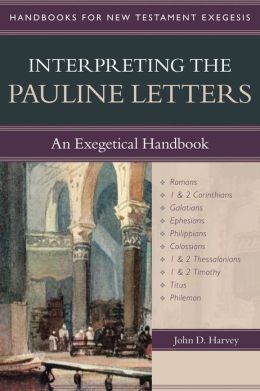
Review of Interpreting the Pauline Letters by John D. Harvey

“Designed as a handbook for seminary and graduate students, the book provides a go-to guide that will also serve seminary-trained pastors, upper-level college students, and well-motivated lay people. As readers work through this handbook, they will begin to see and interpret the narrative writings as Paul intended them to be understood.”

That is a brief snippet from the back of John D. Harvey’s, Interpreting the Pauline Letters. I provide it here because it lets you know what type of books this is intended to be. It is not a book that you casually read on the bus home from work. This book is one that is better used as a resource for preachers and students as they work through a text of Scripture.

When I first read the title I immediately thought of Dr. Schreiner’s excellent work Interpreting the Pauline Epistles. Schreiner’s work is one that has been influential in shaping my reading of Paul’s letters. Therefore, I was anxious to see how Harvey’s work compared to Schreiner’s.

At present I am preaching through 1 Thessalonians and so I thought it would be beneficial to use this as a resource to see exactly how valuable it would be in preaching through a text.

As I picked up this book to begin my study of 1 Thessalonians I immediately noticed that a general index and a Scripture index is missing from the back. That would have been immediately helpful. In fact the absence of such an index makes this almost too time consuming to use as a preaching resource. I have to scan through the entire work to find things on 1 Thessalonians.

What I do find is helpful. There is a section on the major themes of each of Paul’s letters. Here I get help in placing the text in it’s historical context. (Here I think Harvey is a little more in depth than Schreiner). I notice also that there is a section on the structure of the passages. Here Harvey helps the reader layout the structure of a given passage. (I immediately note that Schreiner’s treatment tops Harvey in this section).

I really appreciate Harvey’s sixth chapter, here he gives valuable homiletical tips on interpreting and preaching/teaching through Paul’s letters. The seventh chapter is also helpful in that it gives a couple of examples of preparing and communicating a sermon from one of Paul’s epistles.

Overall, I’m not exceedingly helped in my study of 1 Thessalonians. I learn some background information but that is information I could find elsewhere. I like the help that Harvey gives on structure but I can find that in Schreiner. So what I find that I am left with, is a book that is good to read, helpful in shaping the way that I do exegesis, but ultimately not one that I will continue to consult.

A scripture index would have made this a much more valuable resource. As it stands it is a book that I will probably read through once and not consult much more. And that is sad, because there is valuable information in here. But without having a helpful index I doubt I will think to pull this book out when preparing a sermon. This is simply because I will have to almost re-read the entire book to glean a few salient points on the passage I am preaching. I can get most of this information out of a commentary.

In summary this book provides great content but is lacking in one very needful tool to make this book more accessible through all seasons.

It’s a great book for the beginning seminary student or motivated lay-person trying to learn how to better interpret passages of Scripture. For this reason it has value and I’d encourage you to purchase it. But sadly not as much value as it could have had if someone had taken the time to add 4-5 pages of an index.

Buy it here.

Friday, May 17, 2013

Review of Saving Eutychus

You’ve likely heard of Eutychus. He’s the guy that was sitting on a window sill and fell asleep during one of Paul’s lengthy sermons. Thankfully he was resuscitated and lived to tell the story. Sadly, Eutychus isn’t the only person that has fallen asleep during a sermon, he’s just the poor sap that got his narcoleptic fit recorded in the Scriptures.

People fall asleep every Sunday. Sometimes because of sleep deprivation throughout the week. At times because of the lighting. But more times than not because it’s the only fitting response to the preacher’s drone. It’s not that they are bored with the Word of God it’s just that the preacher hasn’t properly wielded the sword and captured their attention.

We can’t do anything about people falling asleep because they are exhausted. But we can do something about putting people to sleep because we are boring. Gary Millar and Phil Campbell have written Saving Eutychus to help people preach God’s word in such a way that you’ll have to fight to go to sleep instead of to stay awake.

What is a sermon that will keep people awake? A prayer-drenched expository sermon that passionately presents the Word of God as it is written. That is the way that I would sum up Millar and Campbell’s answer in Saving Eutychus.

The book begins with a call to prayer and then proceeds to help preachers understand the necessity of faithful expository preaching (one that is grounded by faithful biblical theology that points to Christ). Then there are a couple of sections that are discuss the delivery and preparation of the sermons. The book closes by challenging preachers to invite critique and actually gives a few examples of a sermon by one of the authors and a critique his counterpart.

If this isn’t your first book on preaching then there will be a good bit of this information that is not new. Many books argue for the necessity of expository preaching. More these days discuss the need for having every sermon point to Jesus and his gospel. Yet, few do so in such an engaging and accessible manner.

This is the type of book that any preacher would benefit from. If you’ve been preaching for fifty years or fifty minutes there are things here that you can learn from. Personally, I’ve been preaching in various capacities for about ten years now. There were many things in this book that challenged me and caused me to analyze a few areas in which I might be stuck in a rut.

I especially appreciated the inclusion of a recent sermon that Campbell’s preached. He intentioned to use “the sermon [he is] working on right now, in real time” instead of “[his] best-ever sermon”. That made it really helpful. Writing through the process of sermon prep and delivery will be a phenomenal help to many preachers (including me). Furthermore, the addition of Millar’s critique also helps.

The book has an authentic feeling to it that is not present in some preaching books. It makes the preacher feel as if what these guys are saying actually would be translatable into any local church context. They are not talking about anything that will make the everyday preacher assume that he needs to start taking seminary courses just to exposit God’s Word. (Though, I’m not saying that cannot be a tool to assist in that endeavor). Campbell and Millar speak as one common preacher speaking to another—and this helpful.

I’m grateful for this book and I would recommend it to any regular preacher of God’s Word.

You can purchase the book here. (You may also try here)

Friday, May 10, 2013

Review of The Secret Thoughts of an Unlikely Convert

Rosaria Champagne was a tenured professor at Syracuse University, a rising administrator, and a well-respected community activist. At the age of 28 she had declared herself a lesbian. She was heavily sought after by those advancing “radical leftist ideologies”. She despised Christians.

Rosaria Butterfield is a pastor’s wife and a homeschooling mother that is active in her Reformed Presbyterian church.

The gap between those two paragraphs is explained in The Secret Thoughts of an Unlikely Convert: An English Professor’s Journey Into Christian Faith. At the age of 36 Butterfield says, “Christ claimed me for himself and the life that i had known and loved came to a humiliating end”.

The book is only five chapters long and is nearly impossible to put down. The reader is immediately pulled into the story. Butterfield begins with her conversion and then moves on to how the Lord brought about a renewed view of human sexuality (which is very helpful by the way). In the middle of the book she shares about her church and the reasons why she landed in the Reformed Presbyterian denomination. The book closes with her discussing family and homeschooling.

My Take:

I don’t know that I can say it any better than Carl Trueman, “I cannot recommend this book highly enough. I do not agree with everything she says; but I did learn from everything she wrote. It deserves the widest possible readership”.

I appreciate how authentic this book is. Butterfield doesn’t tell a clean testimony. I like that. I love that she makes statements like this one, “I believe that the Lord is more grieved by the sins of my current life than by my past life as a lesbian”. If you think that you are getting a book that will be arsenal for your war against the homosexual agenda you are wrong. This book will rock you to the core. At least it should.

Upon completion of this book I had one overarching thought—wow, God can do anything! For that reason I would encourage anyone to buy this book. It will help your convictions grow as your view of God expands.

LifeWay has decided to promote this book in all their stores, which is a great decision. Run to your local LifeWay store and pick up a copy. Or if you don’t like running you can simply order it online.

Thursday, April 18, 2013

Review of the Boy and the Ocean by Max Lucado

When you’re little everything looks big. Even as an adult there are some things that are breathtaking in their vastness. Max Lucado has captured this in his book, The Boy and the Ocean. Using the vastness of the ocean, the mountains, and the stars Lucado helps children (and adults) see that  God’s love is never ending.

The story is about a little boy that is captivated by the ocean. Then the mountains. Then the sky. It begins with the mother showing him how the ocean points to God’s love. Then dad joins in by showing him how the mountains point to God. At the end of the story the little boy has joined in proclaiming the depth of God’s love as he reflects upon the big sky.

The book is well written and the pictures are captivating. I’ve read it to my little boy (5) a couple of times and he loves it. It keeps his attention and the message of God’s love clearly gets across to him. My daughter (2) isn’t quite as entertained—the book is a little long for her at this point. But if your kid is around the ages of 3-7 this is a great book to help your child understand the depth of God’s love. It can even create conversation later as you take your child to look at the great things that God has created.

Isaiah wanted to help me review this book. His thoughts are below:

From Isaiah (5):

I really liked where the boy couldn’t see the end of the ocean. I also liked how they said everything was like God’s love. This book teached me how you can’t see the end of anything…like the ocean. And God’s love!! It helped me to see that God never ends and His love never ends. I just wanted to say this book is awesome! I loved all the pictures.

You can get the book here.

Wednesday, April 10, 2013

Review of The Psalter Reclaimed

My two-year-old daughter loves  spaghetti. She will pound down an entire plate of the stuff. That is, if we cut the noodles up for her. It’s not that she’s too young to eat the noodles without choking--she’s got the slurping action mastered. But if all she has to deal with are really long noodles she will exhaust herself before she finishes her plate. So we cut the noodles up and she tears into them.

Some books are like chopping up spaghetti for a two-year-old. They are really good but might be a little exhausting for the average reader. It’s not that you’ll choke on it and not be able to understand it, it’s just that you might get so exhausted that you don’t get the full benefit of the book. More experienced readers need to read these types of books and know how to “chop them up” for others to enjoy. The Psalter Reclaimed is one of those books.

Gordon Wenham is a well-respected Old Testament scholar. What we have in The Psalter reclaimed is a collection of various lectures that Wenham gave from 1997-2010. Wenham looks at reading the Psalms canonically as well as messianically. There are also more practical chapters such as his chapter on praying the Psalms. Wenham also doesn’t shy away from the difficult imprecatory Psalms, devoting an entire chapter to thinking about how we ought to read them and use them in our day. Though tipping it’s hat to it’s more scholarly audience, the blurb on the back of the book summarizes it nicely:

[The Psalter Reclaimed] provides hermeneutical guidelines for interpreting the book—making accessible to us the transforming messages of the Psalms.

You can tell from the use of the phrase “hermeneutical guidelines” that the ‘us’ is probably a reference to more theologically experienced readers. Most of the chapters reflect the audiences in which they were given; namely, scholars and divinity students. It is not surprising then that a reader would need to be vaguely familiar with Old Testament scholarship.

Yet, this book does not read like a dry seminary lecture. It is a passionate plea for churches to recover the Psalms and use them for their original intent, as prayers to God. For that reason it is a book that needs to be read by everyone. Either chopped up by a seasoned reader or swallowed whole.

I should mention as well that Wenham’s treatment of the imprecatory Psalms is very helpful. For me that section would be worth the cost of the book. There are many gems throughout this book that the church needs to hear.

You can buy your copy here.

Friday, March 8, 2013

Review of Faithmapping: A Gospel Atlas for Your Spiritual Journey

I saw a movie once—or maybe it was a dream that I had—where a bunch of people had been given a treasure map. This treasure map, like almost all treasure maps, was to help them find buried treasure. Each thought that they had the whole map. But as the movie—or my dream—unfolded everyone realized that they only had a piece of the map. They needed to combine all the pieces in order to find the treasure map.

Am I a loon? Isn’t there a movie with that plot? Maybe it’s about 4 movies combined into one awesome movie that only shows in the theater of my mind. Either way there is a book that makes a similar point. That book is Faithmapping by Daniel Montgomery and Mike Cosper.

Cosper and Montgomery believe that “we are navigating the Christian life with fragments of a map—bits and pieces of the good news—rather than the whole picture”. Faithmapping is an attempt to “put those map fragments together”. They argue that we ought to think of the gospel in a tri-perspectival manner. Rather than emphasizing the kingdom, the cross, or grace we ought to bring these all together into a whole gospel.

The churches identity and mission flow out the gospel. “…the gospel, the church, and our mission are a coherent, organic, interrelated whole, rather than distinct independent ideas”. That is why the authorial intention of this book is to map a “whole gospel for the whole church on mission in the whole world”.

The book is structured around these themes. First, the whole gospel is outlined. One chapter is given to each of the perspectives (kingdom, cross, grace) and then and argument is made that we need the whole gospel. The gospel informs the churches identity. The second section outlines these five aspects of “gospel-informed identity”. These five might sound familiar: worship, family, servants, disciples, and witnesses. The last section, only one chapter, makes the argument that it is within the whole world that the church lives out their “gospel-transformed lives”.

The book is well written. Jessica Thompson is correct when she says “it is theologically profound and yet very easy to read”. Though it may feel a little like being entered into the middle of a theological discussion, I do believe that the average lay person would have no problem navigating their way through this book. In the same vein a well seasoned theologian would not be bored.

With all of the focus these days on gospel-centered books I believe this book is a welcome addition. I appreciate that Cosmer and Montgomery tie together friends that are often treated as enemies; namely the gospel as kingdom and the gospel of the cross. I also believe every disciple would greatly benefit from a thorough exploration of the second section of this book. The Map It section at the end of each chapter would make this book pretty easily adaptable for a small group gathering.

Personally, I found myself convicted, challenged, and confessing as I read through this book. It helped me as a pastor to articulate points better. But even more than that it helped me as a disciple to be a more holistic follower of Christ.

I would recommend this book to anyone. Get it here.

Friday, February 15, 2013

Review of The Joy of Calvinism

Calvinism.

What comes to your mind when you hear that word? Some hear that word and start foaming at the mouth. For many this word elicits debate. Many think of a cold and stale religion. Others think of doctrines of grace that need to be vigorously defended. Some think of TULIP’s and formulas to be defended.

When Greg Forster think of Calvinism the first word that comes to his mind is “joy”. He believes that “real Calvinism is all about joy”. It is to prove this point that he has written The Joy of Calvinism.

It is not his intention to say that those that are not Calvinists have no joy. In fact Forster believes that “all the major traditions confess the same doctrines that are central to Calvinism”. The only difference is that Calvinists “preserve these doctrinal commitments more purely and follows them more consistently than other traditions do”.

After taking a brief detour to explain and defend Calvinism, Forster tackles some of those hard to swallow doctrines and shows how they are consistent with evangelical commitments and actually leads to further joy. The author attempts throughout to show how such sticky doctrines as limited atonement, unconditional election, and irresistible grace are actually just more consistent with the core of Christian belief.

First, he argues that Calvinists are more consistent in saying that God loves you personally. For every other tradition the “work of Jesus is creating a system of salvation. All it does is create the system…” but none can consistently say that Jesus died to save them personally. Save for those who hold to the Calvinistic tradition. Limited atonement teaches that Jesus actually died for actual people.

Secondly, Forster argues that adopting anything other than unconditional election leaves one in a difficult position of prioritizing systems over people. Only the Calvinist can consistently say that “God loves you so much that he will utterly demolish all obstacles in order to save you”.

He also compellingly argues that God’s love for us irresistible and unbreakable. In the new birth God completely transforms a sinners heart. Yes, contrary to their fallen wills, he gives us a new heart. As Forster explains:

God changes our natural systems of thinking, feeling, and willing not by working within the framework of our natural system, like a counselor, but by cutting out our natural system and transplanting a new one, like a surgeon.

In some ways his fourth chapter seems almost unnecessary. If God has went through such depths to save us isn’t it only logical that he would go through an equally great length to keep us. He concludes by restating his overall thesis that Calvinism does indeed help in our quest for joy in God. A lengthy appendix that attempts to answer various questions posed of Calvinism is also attached for the readers help.

My Take

I doubt I will hand this book to my non-Calvinist friends. I should restate that. I doubt I will hand this book to my settled non-Calvinistic friends. If someone is in a neutral position or wanting to learn more I believe they would benefit from this book. But if someone is a convinced non-Calvinist I doubt this book will change their minds. Not that it is isn’t good. It is. But I think his audience isn’t to a convinced non-Calvinist. His audience seems to be those of a Calvinistic persuasion that need a kick in their worship. And also to defend Calvinism to those that have only heard wrong stereotypes.

For me personally there were times when I had to put the book down and just marvel at the goodness of God. Forster is right, this doctrine ought to cause worship and profound joy. It even sparked my prayer life and gave me even more confidence that God can save anyone. Furthermore, it gave a boost in my evangelistic preaching. After reading Forster’s third chapter I put together a passionate sermon for our teenagers, opening up for them how much God actually overcomes in saving us. In it was an appeal to unbelievers as well. At least in my heart this book has done what it set out to do; give me more joy in Christ.

Should You Buy It?

It depends on what you are looking for. If you are genuinely curious about what Calvinist believe then I think this book might serve as a really helpful introduction. Or if you are a Calvinist looking to grow in your worship, at least in my experience this book will assist in that. It’s probably not a book for everybody but for those that it is written for you will be immensely blessed.

You can buy it here.

Friday, February 8, 2013

Quick Review of A Mouth Full of Fire

I thought about preaching through Jeremiah once. Then I tried to outline it. I decided I would postpone that Jeremiah series for a time when it made a little more sense. After reading A Mouth Full of Fire: The Word of God in the words of Jeremiah, I might be a little closer to a Jeremiah series.

Andrew Shead attempts to unify the book of Jeremiah around the central theme of “the word of the Lord”. Shead believes that it is best described as “the story of what happened when the word of the Lord came to Jeremiah”. And as we listen to this story it helps us shape our own doctrine of the word of God. This book, then, serves as both a discussion on Jeremiah and a discussion on the doctrine of the word of God.

The book begins with an attempt to defend his thesis and outline the suitability of Jeremiah to give us a solid theology of the word of God. He then goes about structuring Jeremiah. After engaging in these introductory matters, Shead, then shows how his argument bears on our doctrine of the Word. He looks at the Word and speaker, Word and hearers, Word and power, and finally the Word and permanence. He closes the book with a “conversation” with Karl Barth.

My Take

I got a great deal out of this book. It helped me to think through Jeremiah and read it more cogently. Furthermore, Shead does a great job of defending his thesis. I’m convinced that he is correct in his theme of Jeremiah. If I ever do preach through Jeremiah I will be sure to go back to Shead and structure the book accordingly.

What is most helpful in this book, in my opinion, is the distinction that is made between “word” and “words”. His chapter on The Word and Speaker was very beneficial to me. I write and speak the Word frequently. His statement that, “a prophet is made by God into a word-shaped person” hauntingly shows that you really cannot separate the messenger from the message.

Should You Buy It?

The book will not be for everyone. It is written in the middle of a scholarly discussion on the nature of the word of God. If you aren’t already introduced into that conversation it might be a little difficult to get brought up to speed. However, the book is not so pedantic that a casual reader couldn’t pick it up and benefit.

Those most likely to benefit from this book would be someone that is studying the doctrine of the word of God. This needs to be part of that study. Furthermore, someone attempting to study or preach through Jeremiah would benefit greatly by giving this book at least a perusal. Shead helps outline Jeremiah in a way that I haven’t really seen before. It is profoundly helpful if given to the right audience.

Purchase A Mouth Full of Fire today.

Friday, January 25, 2013

Review of Paul’s Missionary Methods: In His Time and Ours

I have an entire bookcase overflowing with books that were published over one hundred years ago. They have survived the test of time. For some of these books the truth contained within them has served the church for centuries. Sadly these gems are often left to collect dust. In what C.S. Lewis called chronological snubbery most modern readers neglect these classics to our peril.

Part of the reason for dust gathering on these treasures is that at face value some of them no longer seem relevant. Is it really still an issue how we ought to respond to the Guy Fawkes uprising? A host of my readers will not even know who Guy Fawkes was or why he mattered. And because it no longer seems relevant these pages often remain unturned.

One hundred years ago in his book Missionary Methods: Saint Paul’s or Ours?, Roland Allen asked important questions about the missiology of his day. On the centennial anniversary of that work, Plummer and Terry have decided to revisit some of those same questions asked by Allen at the turn of the 20th century. (Paul’s Missionary Methods: In His Time and Ours).

Summary

The book is divided into two sections. The first section, “Paul’s Message” is edited by Plummer. The second section, “Paul’s Missiology”, is edited by Terry. Each chapter is written by a different scholar that is well-respected in the field of which he is tasked with interacting.

Allen’s central aim was to present the missional principles of the apostle Paul and urge his readers to imitate Paul’s approach. In the last one hundred years there has been a great amount of work done in the area of Pauline missiology. Would Allen’s work stand the test of time? Does contemporary scholarship negate Allen’s points? Would “Paul’s answers” to the missiological questions of the early 1900’s be the same as “Paul’s answers” to the missiological questions of the early 2000’s?

Each chapter of the book addresses a different concern. There are questions of ecclesiology, suffering, and spiritual warfare. The chapter written by Dr. Plummer attempts to answer the much debated question of our day: what is Paul’s gospel. There are questions of missional strategy including issues related to church planting, indigenous missions, and contextualization.

If you have spent any time reading books about missiology you know the hot button questions of our day. The book is really a modernization of Allen’s major concern; namely, to take the contemporary issues and answer them in light of the approach of the apostle Paul. These scholars do that same thing in Paul’s Missionary Methods: In His Time and Ours.

My Take

I have never had the opportunity to read Roland Allen’s classic work. This book makes me want to—or at least makes me feel like I need to. I appreciate his (and their) central concern that the Spirit-inspired Scriptures dictate the way we do missions. I love books that ask contemporary questions and then set about to show how the Scriptures answer them.

I found Ben Merkle’s chapter on Ecclesiology to be particularly helpful. As our church looks at issues related to rewriting our constitution we continued to go back to the early church and ask what did they do. Merkle helps with that. For me this proved the effectiveness of the book. At present I am not asking questions about indigenous missions—but some are. And I assume that this chapter would be just as helpful to them as the chapter on ecclesiology was for me.

On another note I hope that more writers follow in the footsteps of Plummer and Terry. There are many classic works that would benefit from undergoing such a thorough look. It’s one thing to modernize the language of Calvin’s Institutes. It’s quite another to attempt to get in the mind of Calvin (as the authors have done with Allen here) and say, “what would Calvin say of this issue, and is he biblically accurate”. Many books would benefit from being modernized in such a way as these scholars have done with Allen’s work.

Should You Buy It?

This book is not going to be for everyone. If you aren’t prone to ask questions of missiology then I doubt you will have a desire to pick up this book. But for those that are pastors, church planters, etc. this is a very helpful book.

Also, everyone that reads this review that is a believer is a missionary and as such might benefit from thinking through some of the concerns raised in the book. I’m not sure that it will necessarily inspire mission but it will certainly inform it. If you are passionate about doing missions but wondering how it ought to be biblically done this book will be a helpful tool.

Such terms like missiology can be daunting. Especially when you see that the book is written by a group of scholars and then published by IVP. I assure the casual reader, though, that while this book is scholarly it is not poorly written. These men are good scholars which means that they can take that which is very difficult and make it sound somewhat simple (not simplistic). This book is well written and is not a drudgery to read. If you are interested in a theology of missions you will enjoy this book.

You can buy a copy today.

Friday, January 11, 2013

Review of Sensing Jesus by Zack Eswine

What does it say about the way we’re approaching the ministry if we who have been trained for it do not know how to follow Jesus when we have our pajamas on? –Sensing Jesus, page 286

That quote encapsulates what Zack Eswine’s book, Sensing Jesus, is all about. His desire is that we learn how to do life and ministry as human beings. Eswine is real about his own humanity and the humanity of many of our ministry heroes (noting at one point that Jonathan Edwards passed gas).

Eswine believes that “the stale waters of celebrity, consumerism, and immediate gratification” (17) has infiltrated pastoral ministry. As a response he has written a poetic and autobiographical book with the aims of guiding our hands into the nail-scarred hands of Jesus.

After the two introductory chapters, the book is divided into two sections. The first section exposes our temptations. Here Eswine tackles our desire to be everywhere, to fix everything, and to know everything. In the second part Eswine examines our mentoring. This is where the title sensing Jesus comes from. Here he considers the physicality of ministry and confronts such cultural idols as celebrity and immediacy. The book closes with a conversation with a young minister that serves as an apt summary of the book.

My Take:

Zack Eswine is not an old man. But he has been doing ministry for over twenty years. He is a seasoned pastor that we can learn from. The book reads as if this gracious and battle-tested pastor has agreed to meet with us once a week over a cup of coffee to discuss life in the ministry.

He writes poetically but it does not feel forced. It feels like a wise sage picking up a dandelion, blowing it in the wind, and teaching us about life as he does so. Here is an example. Read as Eswine describes a bagpiper at a funeral:

…the bagpiper stands as if ugly and holding a goose. He breathes in and out into a moaning that wheezes air into a haunting melody of ‘Amazing Grace’. A swan of music emerges and takes flight. Sobs and whimpers accompany the tune with red eyes, along with tear-stained mascara bleeding on cheeks. The wind ripples through the fall leaves…

The writing style makes the reader pause and feel. You can almost smell the coffee (if I drank coffee) rise to your nose as you listen to this pastor tell of his journey and the lesson that we can learn. Eswine forces pastors to feel. Which is something that many of us have perhaps given up on years ago.

I believe the book will stick with me. Much like meetings with pastoral mentors that I have had in the past. I might not even remember where it came from but as I guide others into an everyday relationship with Jesus, or shepherd other young men into pastoral ministry, I’ll be drawing from these encounters.

Should You Buy It?

Pastors really ought to buy this book. But not only pastors, any church leader would benefit from a month of Thursday’s over a coffee with Pastor Eswine. But not only church leaders, every disciple would benefit from thinking through doing life in Jesus as a real human being. The draw to celebrity snares far more than just pastors. We all need the message of doing life and ministry as human beings.

I cannot recommend this book enough. It is not a quick read but it is a necessary read. I imagine I will be revisiting this one a few more times in the upcoming years.

Get it today.

Here is an interview that Zack Eswine did with Justin Taylor on his book Sensing Jesus:

Friday, December 28, 2012

Quick Review of The Handy Guide to New Testament Greek by Douglas Huffman

I’m not good at Greek. At all. I passed my seminary Greek classes but mostly because my professor (Dr. Robert Plummer) was a really good teacher. For the most part doing Greek* hurts the same part of my brain that failing Pre-Calculus does. Nonetheless, I am going to challenge myself in 2013 to read through the Greek New Testament.

I fully expect to make it until about January 4th before I give up on this endeavor. But during those four days I will be certain to continue referencing Douglas Huffman’s The Handy Guide to New Testament Greek. It is this book that I wanted to bring to your attention today.

If you have already had at least one year of Greek and are struggling with remembering some of those tricky rules this book will help. Huffman notes in the introduction that, “If kept in hand with the Greek NT, this volume could be in constant use, assisting in the preparation of NT lessons and sermons.” I agree.

The book is divided into three parts. The first part is a reminder of elementary Greek. The reader will find over fifty pages of case endings, verb tenses, and other mnemonic devices. The second part is a guide for syntax and exegesis students. It is filled with the different case and verb usages. There are also memory devices for these as well. The third section is what sets this book apart from the others. In the final section the reader is exposed to the art of phrase diagramming. All of these helpful tools are scrunched into a mere 112 pages in a handy 5x7 pocket guide.

My Take:

For a book like this you really cannot review the content. Case and verb endings are pretty standard. But we you can judge is how accessible and useful such a book proves to be. Since receiving this book in the mail it has not only inspired me to pick up my Greek NT again it has also helped me when I do.

Now I don’t have to thumb through a 350 page text book or file through pages of notes and self-produced charts. The book truly is handy and of benefit to any learner of Greek.

Should You Buy It?

If you don’t know the difference between Greek and Pig Latin I doubt this book is for you. It will not teach you Greek. Furthermore, if you are a Greek master I doubt you’d need the references. But if you are anything like me—someone that knows enough Greek to be dangerous—this book would prove a handy resource for you.

Purchase it for only $12.40

----

*Don’t even ask me what doing Hebrew feels like.

Thursday, December 13, 2012

Quick Review of Church for the Fatherless

Fatherlessness is a growing epidemic in our culture. Not only father’s that physically abandon their children but also father’s that might be physically present but not actually there. How the local church responds to this crisis shows a good deal about what we really believe about the gospel. As Mark Strong writes, “…ministry to the fatherless is not simply an option”. That is why he has written his book Church For the Fatherless.

Mark Strong set out to plant a church. On one particular occasion the discussion of fatherlessness came up. Mark realized that three-fourths of his core leadership had grown up without an active father figure in their lives. That’s when he knew that one key component of this church had to be that they would become a church for the fatherless. Church For the Fatherless is filled with anecdotes from Strong’s ministry, but more than anything it is biblical advice on how other churches can become churches to the fatherless.

There are three overarching goals for the book. First, to gain a deeper understanding of the problems surrounding the issue of fatherlessness. Secondly to practically show church leaders how they can serve their communities and lead them to become churches of the fatherless. Lastly, Strong hopes to inspire and encourage his readers to be a part of God’s answer to the fatherlessness in our world.

My Take:

The book is filled with practical and easily reproducible ideas for your local church. Strong does an apt job of explaining the problems of fatherlessness. Some of the specifics of the book might be more geared to the African-American problem of fatherlessness. But the issue and the solution transcends culture. Even though I am a white dude from Southern Indiana I can see the impact of fatherlessness. Though at times tailored to an African-American community there is nothing in this book that could not be applied cross-culturally.

Strong is correct that this is not an option for churches. If we are not churches that minister to the fatherless then according to the Lord (James 1:27) we aren’t much of a church. More church leaders need to read and apply this book. It is very practical and very biblical. We have worked at FB Jasper to embed our values with help to the fatherless. This book has helped me to be more intentional in our wording. It has also inspired me to look for ways to infuse our teaching with messages for the fatherless and to fight against this epidemic.

Should You Buy It?

The book is mostly written to church leaders. You don’t have to be a pastor though to read and benefit from this book. I would love for people in our congregation to read this book and champion the cause of the fatherless. We need people to become a “pain in the neck” (75) for this neglected area of church ministry. Buy the book and be encouraged and inspired to touch society’s most pressing problem.

Get it here.

Tuesday, December 4, 2012

Review of Misreading Scripture with Western Eyes by Richards and O’Brien

Awhile back a fake news story made the rounds that went something like this:

A woman came home to find her husband in the kitchen, shaking frantically with what looked like a wire running from his waist towards the electric kettle. Intending to jolt him away from the deadly current she whacked him with a handy plank of wood by the back door, breaking his arm in two places. Until that moment he had been happily listening to his iPod.

Stories like this are believable because we have all had the experience of things turning out quite differently than how we first perceived them. According to E. Randolph Richards and Brandon J. O’Brien that same phenomena often plagues our bible study. They believe that “some of the habits that Western readers bring to the Bible can blind us to interpretations that the original audience and readers in other cultures see quite naturally”. (15)

This claim is not novel. Every book on biblical interpretation, worth any mention at all, will tell you that we must always be aware of our presuppositions. Richards and O’Brien have written a book, Misreading Scripture With Western Eyes, to expand upon this thought and to “offer readers an opportunity to identify and address our cultural blinders”. (15)

The book is divided into three sections. In the first section the authors look at three cultural issues that are obvious and above the surface: mores, race and ethnicity, and language. The next section looks just below the surface at the not so obvious western presuppositions: individualism and collectivism, honor/shame and right/wrong, and time. In the final section the authors probe the depths and look deep below the surface at presuppositions that most Westerners will not even recognize: rules and relationships, virtue and vice, and finding the center of God’s will.

O’Brien and Richards both have experience in cross-cultural missions. Their experience helped them to see the Bible with a new set of eyes. Each chapter ends with a few pointers from the authors on how to cultivate more cultural sensitivity in our Bible reading. Their goal is not to give a methodology or to give us the right process for reading the Bible; as “methodologies are the products of culture” as well. Their goal is to offer advice instead of a checklist.

My Take with a Concern

I thoroughly enjoyed reading this book. Even though I disagree with a few of their suggested interpretations I now find myself reading Scripture with more informed eyes. If nothing else this book has served to raise a red flag in my mind every time I think I have Scripture mastered. It reminds me to pause and consider whether my interpretation might be solely cultural.

Another thing that I appreciate about this book is that the authors are evangelicals. I have read books like this in the past that exalted presuppositions to such a spot that the reader was wondering if there was even such a thing as truth left. Truth is knowable. I further appreciate that the authors acknowledge that a Western reading of a text may not be wrong simply because it is Western, nor is one correct because it is Eastern.

There are a few statements in the book that left me scratching my head. In particular I had a difficult time with their chapter on honor/shame and their chapter on rules and relationships. I agree with their overarching point; that the world of the Bible is more concerned with honor/shame than right/wrong. But after reading that chapter I couldn’t help but think that perhaps this “new set of eyes” has caused them to make the pendulum swing too far the other way.

In the chapter on rules and relationships the authors seem to take a subtle shot at forensic justification. They acknowledge that “there is nothing wrong with the doctrine” but fear that it “casts our connection to God in terms of rules, not relationship". (173) They go on to give the example of Paul who “doesn’t seem to address the theology” of the Corinthians but instead the “status of their relationship”. In my opinion they are creating a false dichotomy here.

I disagree that Paul does not “seem to address [the Corinthian] theology”.

That seems to be precisely the point that he is making. Their relational issues are theological problems. Yes, Paul makes relational appeals. But he does so while teaching a robust theology centered on the foolish gospel. Richards and O’Brien ask “does relationship ever trump theology” (173). The answer to that question seems to be “what theology” are we talking about? It was “theology” that caused John to say, “If anyone comes to you and does not bring this teaching [theology], do not receive him into your house or give him any greeting”. Rules and relationships aren’t contrary enemies. They are friends reconciled on the cross of Christ. Let’s not separate what God has joined together.

Having said that, this book will undoubtedly be one of my top 12 books of 2012. It has been a refreshing read. Apart from a few caveats I would recommend this book to anyone. I think it would strengthen their Bible reading. Some books like this could foster doubt in the novice Bible reader. Richards and O’Brien, thankfully, write in such a way to actually add confidence to the Word of God.

Should You Buy It?

I recommend it. Every serious Bible student would benefit from reading this book. Pastors ought to consider it’s claims as well. I believe such a book would greatly aid in sermon preparation. If nothing else perhaps it will humble us. There are questions to ponder at the end of each chapter which would make this an interesting book to read in a community of believers, perhaps while reading through a book of Scripture.

You can purchase it at Amazon for under $10.

Wednesday, November 28, 2012

Review of Dangerous Calling by Paul Tripp

In recent days the Discovery Channel has honed in on a few of the worlds most dangerous jobs; namely loggers and deep sea fishermen. These jobs are arduous and hazardous. According to Paul Tripp one other “job” that ought to be put on the list is pastoral ministry. In his book, Dangerous Calling, Tripp highlights the unique challenges of pastoral ministry.

Tripp believes that “there are many pastors who have inserted themselves into a spiritual category that doesn’t exist” (23). This false spiritual category is confirmed and strengthened by the pastoral culture in which pastors live. Seminaries are often the breeding grounds for such “self-swindiling” (33) pastors. The downward spiral begins with a “distant, impersonal, information-based handling of the Word of God.” (52)  Eventually “brains become more important than hearts” and pastors fool themselves into thinking that because they have correct theological answers they must be doing okay.

After graduating seminary this knowledgeable and skilled seminary student will become the pastor of a church. A church of which the pastor will largely not be known by. Given the present pastoral climate in churches he will lead them from above practicing an “intentional culture of pastoral separation and isolation” (70). There he will die. Most pastors never truly become a part of the body of Christ. We were never meant to lead or live this way. This culture must change.

Such a culture breeds pastors that forget. They forget who God is and they forget who they are. Pastoral ministry, then, is a war zone. Even if the culture of pastoral ministry would change pastors would still fight their own selfish hearts. But given our current climate of pastoral ministry many pastors are not even aware of the necessity of fighting. And slowly they slip into familiarity and mediocrity. Eventually they forget who they are and begin preaching a grace that they themselves are not partaking in.

My Take

I deeply appreciate this book by Paul Tripp. I am not a lead pastor (only an associate pastor) but I still see every danger that he is talking about in my own life. From my experience Tripp is correct in his assessment of seminary. I believe that I attend one of the best seminaries around (SBTS) but I have heard in my classes from fellow students and felt in my own heart a type of head knowledge that is not matched to heart knowledge. For the most part faculty and staff at SBTS take great pains to be pastors as well as professors, but there are times when academia seems to rule the day.

According to Tripp his central point in this book is to give a “detailed exposition of what happens in the life of a person in ministry when he forgets to preach to himself the same gospel that he gives to others”. As such this book is a little light on practical application. This book is like reading a book that explains your disease in great detail and then points you to other resources for treatment. Some may give Tripp negative marks because of this. I think it is one of the strengths of the book.

If at the end of the day pastors read Dangerous Calling and drop to their knees pleading for mercy from King Jesus, then Tripp has done his job. Sadly, it can be a difficult task to truly convince us pastors that we are desperately in need of Jesus every moment. We will give that truth lip service but at the end of the day when it comes to “spiritual things” many of us assume that we’ve got this down.

Do not misunderstand me, though. There is practical help smattered throughout the book. There are helpful things that churches could adopt to help their pastors. Their are suggestions that pastors could implement that would strengthen them in the middle of this war zone. There is practical stuff, but that does not appear to be Tripp’s major aim in this book. He wants to hold a mirror up to pastors and compare what they see to God’s Word and His wisdom. He wants us to realize that many of us are dying and we need help.

For this reason Tripp’s book is invaluable to pastors. Speaking as a pastor to pastors he is in an adequate position to expose our pastoral pride. He does it with humility and as one that is in the midst of the struggle himself. Reading this book will lay you bare. But it will not leave you there. Tripp will help every pastor to remember the God of mercy anew. He lifts up our All-Sufficient Savior and encourages pastors to run to him. Drink deeply from the grace that we are to proclaim every Sunday.

Should You Buy It?

I agree with Joshua Harris, “pastors needs this book”. This book may be The Reformed Pastor of our day. It is weighty and necessary. If you are a pastor you really ought to purchase this one.

What if you are not a pastor? I would still suggest it. It will help you to help your pastor. You are called to minister to him as well.

The book can be yours for under $13 and I cannot recommend it enough. The promo video is below:

Dangerous Calling from Crossway on Vimeo.

Thursday, November 8, 2012

Quick Review of Heart of the Matter

I am a big fan of CCEF, the Christian Counseling & Educational Foundation.  Several of the books published by those affiliated with CCEF have been life changing. One of the most instrumental books in my walk with Christ has been How People Change by Timothy Lane and Paul Tripp. But CCEF’s impact on my life does not stop with that book. I have also received marital help, assistance in dealing with issues of shame and abuse, training in counseling others, and much more. 

All of the writers affiliated with CCEF are very good at exposing our sinful tendencies. Reading these books will rip you open and expose you.  But it never stops there. In as much as they tear they also heal with gospel balm. They never leave you on your own to deal with your problems. Change is always found in a person; namely Jesus Christ. The folks at CCEF are very faithful in pointing to Jesus.

With my love for CCEF it will be no surprise for you to hear that I was excited about Heart of the Matter. This book is a compilation of sections from other CCEF books put into a daily devotional format. Each day the reader is given a Bible verse and a brief devotional related to that passage.

Everything You Need

One of my favorite things about CCEF is that they believe that God has given us everything that we need for life and godliness in the person of Jesus Christ as revealed in His Word. That is essentially what this book is about. Every day the reader is given a devotional that relates to various life situations. I believe that a year in this book would convince the reader that they have in Christ everything they need for the situations that life throws at them. In fact, they’ll probably come to discover that it is not merely “life” that is throwing things at them but the God of grace. 

There are a variety of topics included in this book: love, hope, grace, redemption, faith, contentment, conflict, relationships, prayer, fear, patience, humility, and anger. Not everything is covered but the reader is given a framework for relating the gospel to everyday life.

Should You Buy It?

I plan to use this as a daily devotional in January. I would not suggest only using this book, though. It does not have in depth study of the various texts. This book is valuable in application. I would suggest taking the passage at the top of each day, studying it a little, chewing on it, thinking and praying through it, and then reading the devotional that goes along with the text to drive home gospel application. 

The book is retailing at $19.99 which is not a bad price.  I imagine that it will go down as the book becomes more readily available at online stores like Amazon. Yet, even if it does not 20 bucks is not a horrible price for a book that you will use all year. 

I believe you would benefit from reading this book. 

Thursday, November 1, 2012

Review of Shame Interrupted

A few weeks ago I saw something in the face of my son that I have experienced in my own heart a million times over; shame.  He had just done something that was rather inappropriate and it was exposed.  Nothing horrible, mind you, he’s only four.  So the things he is ashamed of are things like losing at Beyblade or accidentally running through the house naked when we have company over.  But he still experiences shame.  And on that day he wore it on his face.  It broke my heart. 

That same heart break was heightened for me over a period of time as I reflected on the first few chapters of Ed Welch’s book Shame Interrupted.  Welch takes the reader places that you probably do not want to go.  In the second chapter, Shame Exposed, Welch uncovers the mask and asks probing questions to help the reader identify shame.  I checked almost every one of them. 

Shame has (or maybe I should say “had”) become a major part of who I am as a person.  Those first chapters exposed things that I had preferred to stay in the darkness.  The Spirit of Freedom used the writing of Welch to pry those things into the light.  Reading through those first few chapters of Shame Interrupted was very difficult. 

I knew where Welch was going with this and it felt like he couldn’t get there fast enough.  But he kept probing and twisting and exposing.  Yes, in order to be healed it must be exposed.  And that is what Welch did. 

Finally, Welch takes the reader to Jesus for healing.  For the next two hundred or so pages the reader is shown how Jesus relates to our shame and ultimately how he transforms it and in the process transforms us. 

Summary

Honestly the format of the book is a little difficult to track.  I think that a clue is given in chapter 20 when Welch speaks of the “basic rhythm of life with the new King and in the new Kingdom”.  He notes that this rhythm goes like this:

Put your shame into words.

Turn to your rescuer

               Know him.

               Be associate with him.

               Get your feet washed. 

               Persevere—get ready to fight.

Turn towards others: Love. 

That is the basic structure of the book.  After exposing our shame and helping the reader “put it into words”, Welch spends the remainder of the book assisting the reader in that turn towards Jesus.  The book seems to be a little less intentional about outlining what it looks like to “turn towards others” but those principles are smattered throughout the reading. 

My Take

I read this book a few months ago.  Normally, I review books pretty quickly after reading them.  This book was different.  It was one of those life shaping books.  Those first few chapters came to me at a unique time in my life when I had just finished reading a few other books that were related to an issue from my past that I preferred to keep buried. 

Honestly, the book tormented my soul.  Not for anything Welch did that was in error.  This was a necessary bruising that I was enduring.  Eventually, I was able to begin the process of healing and plod through the rest of the book.  I wish that I could say that this book provided healing by pointing me to Jesus.  I think that perhaps it could have—but the Lord chose to use other means to provide healing.  He used Welch to provide the exposing and painful side of healing. 

Welch does do an apt job of presenting Christ.  If you came to this book raw with shame and were able to quickly go through the first six or seven chapters I think you would find immense healing.  But as it was, I came to the book somewhat cold and deadened to these events of the past.  I couldn’t quickly jaunt through those first six or seven chapters.  The Lord had me in a spot ripe for exposure and he used Welch to shine the light on my shame and force me to face it. 

Should You Buy It?

I highly recommend this book.  I would have preferred it to be a little bit shorter and hope that in the future CCEF comes out with a condensed version.  That would be easier to giveaway in counseling sessions.  As it is 352 pages can be really daunting to give to somebody. 

If you think that you do not need this book you probably do.  I doubt there will be a large line at the bookstore of people waiting to purchase a book that will completely ravage your soul, but it is necessary.  Your shame needs to be exposed. 

If your shame already has been exposed and you want to know how to find healing in Jesus then Welch is a great guide to point you to the Savior.  I believe that you will find healing in this book—or better yet, be warmly introduced to the One that will provide ultimate healing. 

You can get the book on your Kindle for under 10 bucks or the book format for 17.99 (which is worth it for a 352 page book). 

I also invite you to check out the trailer for the book:

Tuesday, October 2, 2012

Review of Gospel Deeps by Jared Wilson

Gospel Deeps is a risky book. 

I say that it is risky because it is not immediately practical.  There are not 10 steps to “going deep in the gospel”.  There is no immediately practical advice for living out the Christian life. 

Neither does this book make any shockingly new insights; it is not revolutionary in that sense.  The point of the book is not to help you change your church, reconsider your theology, or inspire you with newfound truth. 

All Jared Wilson does in Gospel Deeps is hold up an infinitely precious jewel, the gospel of Jesus Christ, and call us to marvel along with him.  That’s risky.  Honestly, it reminds me of the preaching ministry of John Piper.  It’s taking the gamble that God is beautiful enough to captivate our affections and change every facet of our lives merely by meditating upon and reorienting our hearts around that which we are beholding.  Wilson takes this same wager and it pays off. 

But Aren’t These “Gospel” Books Getting Monotonous?

That question is dealt with, in part, in the book itself.  Wilson rightly says, “The further into the gospel we go, then, the bigger it gets.  There is no way for us to wear it out”.  In one sense it is like an onion.  When you peel off a layer it only reveals a deeper layer.  Therefore, we never exhaust the gospel.  Each time we think we’ve come to grips with the implications of who God is in His gospel we eventually discover that Christ is deeper still. 

What happens, though, if you never peel back the layers of the onion?  What if you only camp out on the ABC’s of the gospel (forgiveness and a ticket to heaven) but never really plumb the depths of the gospel?  Not only will this “hinder our worship”, as Wilson says, but it will inevitably lead us to get bored with what we think is the exhausted gospel. 

That is why this book—and many of the other “gospel” books—are not monotonous.  At least they are not monotonous in as much as they peel back a layer or look at another facet of the gospel diamond.  I imagine that if we kept churning out books that focused on the same facet of the gospel it might begin feeling monotonous.  But I would even say that each facet of the gospel is inexhaustible.  And each facet could be marveled at for all of eternity.  That seems to be what Wilson is doing in this book.  He is holding up a diamond and turning it ever so slowly with each chapter and then drawing us in to worship. 

Summary of Gospel Deeps

The book begins with a defense of plumbing the depths of the gospel.  And then Wilson sets about giving a few examples of what that looks like.  In the first chapter he takes kind of a big picture look at the gospel and how deep and wide are its implications.  In the first chapter he is saying, “see, the gospel is big isn’t it”. 

In the second chapter Wilson takes his cues from 1 Peter 2:9 and probes what he terms the threefold vision of the gospel.  The gospel transforms and gives us a proper view of self.  It also gives us a redemptive view of life and our present and future environment.  But more than either of these two the gospel gives us an epic view of God.  That’s His overarching purpose in redemption—that we might worship God, basking in and proclaiming the excellencies of Christ. 

The third chapter, like the first two, seem foundational.  Here we see that the gospel takes a Trinitarian shape.  Again, we are being drawn in and urged to confess that the gospel is huge.  It is as big as God is. 

After the first three chapters the reader will plumb the depths of various facets of the gospel.  Wilson probes the depths of gospel joy, the atonement, suffering, the omnipresence of Christ, union with Christ, cosmic redemption, and the Cross-centeredness of the gospel.  Though linked together by a common thread, each of these chapters could stand on their own as introduction to a different aspect of the gospel.  Each chapter could comprise an entire library of books.  Yet, Wilson succinctly and passionately draws the reader in to awe at the greatness of our God.

My Take

Personally, I loved the book.  There were some chapters that were absolutely life-shaping.  My favorite chapter by far was the chapter on gospel joy.  It was something that I needed to be reminded of and an aspect of the gospel that I needed to camp out on and just chew for awhile. 

The writing is phenomenal, as to be expected from Jared Wilson.  He uses humor and wit quite well.  He can jab you in the throat with convicting statements and then a few paragraphs later have you laughing about it and reveling in the forgiveness we have in Christ.  He is also very artistic.  At times the more casual reader might be taken aback by some of the loaded sentences.  If you like reading C.S. Lewis you’ll like reading Jared Wilson.  There is enough in this book, though, that even if you trip up over a Narnia reference you’ll still thoroughly enjoy and be shaped by the book. 

Gospel Deeps was a risky book.  But I’m glad that Jared Wilson took the risk.  He’s right.  Jesus is precious enough that you can just reflect on His awesomeness for 200 pages and still want more.  I wish more preachers, myself included, understood this.  Just telling people for 45 minutes how amazing Jesus and His gospel truly are, is abundantly practical. 

You can, and should, buy this book.  It’s only 10 bucks which is phenomenal. 

Get it here.

Wednesday, September 12, 2012

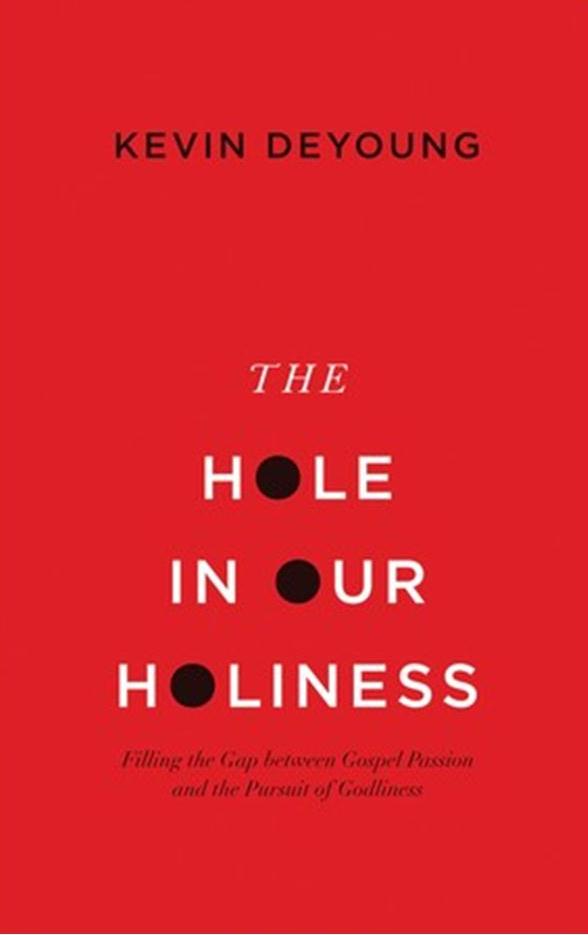
Review of The Hole in Our Holiness

“The hole in our holiness is that we don’t seem to care much about holiness.  Or, at the very least we don’t understand it”. 

That “hole” is what has motivated Kevin DeYoung to set his pen to writing.  The result is a little book entitled The Hole in Our Holiness: Filling the Gap between Gospel Passion and the Pursuit of Godliness.  Many have been waiting this “ruthlessly biblical” treatment of holiness.  And those that attended T4G and heard DeYoung’s message there (which seems to have found its home in chapter six of this book) knew that this book was going to send shock waves throughout the gospel-centered movement. 
The book begins with DeYoung’s defense of his book and explaining his desire to fill the gap that seems to be in the gospel-centered movement.  For the first six chapters DeYoung, with his typical wit and faithful treatment, lobs a few correctives to the gospel-centered movement and slowly begins establishing a case for having a passion for holiness alongside our passion for gospel centrality.  In the last four chapters he begins to make his case practical and explain the biblical categories of union and communion

Union with Christ, says DeYoung is the “irrevocable work of the Spirit”.  He notes that, “nothing can make us a little more or a little less united.”  Compartively, “Communion with Christ…can be affected by sin and unresponsiveness to God’s grace”.  For all of our emphasis on union with Christ, DeYoung wants to see the church also have a passion for pursuing deeper communion with Christ.  And that is the central theme and purpose the book.

My Take:

I’m a little lost at how to review this.  If these chapters were separate blog posts from Kevin’s blog, DeYoung, Restless, and Reformed, then I would have probably linked to almost everyone of them in my Today in Blogworld feature.  By themselves each one is tremendous.  Kevin is a tremendous writer and it shows throughout this book.  He has a way of making you laugh, punching you in the gut, applying the gospel, and then making you laugh again as you close the book up and go about living your life all the while having been profoundly changed throughout. 

There is nothing in this book that leaves me shaking my head and saying, “whoa, this dude has gone off the deep end”.  The correctives that he mentions are needed and helpful.  Personally, I appreciate him saying, “It’s not wrong for a sermon to conclude with something we have to do.” (54)  And I further agree with him that those of us within the gospel-centered movement can without an equal emphasis on holiness end up “confused, wondering why sanctification isn’t automatically flowing from a heartfelt commitment to gospel-drenched justification”.  (91)

So why am I confused in how to review this?  Mainly because this is a book review and not a review of several separate blog posts put together.  In my opinion the book is confused as to its audience and overall purpose. 

I think had DeYoung decided he wanted to only write a book about the hole in the gospel-centered movement and our lack of emphasis and promotion of holiness then it'd have been better.  Or even if he wanted to write a book simply on holiness and how it comes about.  But I think he tried both and it didn't seem to fit together. Honestly, it reads kind of like an associate pastor that finally gets to preach and decides to try preaching 4 sermons in the time frame of 1. 

That is why I am conflicted.  If you were to ask me, “What is the main thesis of the book” I think I would say that DeYoung believes that there is a hole in our gospel and that we need to start emphasizing personal holiness as well as gospel passion.  And as he points out that hole in the gospel he wants to fill it with a robust theology of holiness.  The book is an attempt to point out the hole and then fill it. 

But does he do it? 

Time will tell.  Part of me wants to say that the book is awesome and one of the better books written in the last couple of years.  But the other part of me wonders if it is just a bunch of really awesome truths and statements that wind up simply jarbled around in my skull but not as life transforming as they could have been had I been given a few pegs to hang them on. 

Part of me does not even want to mention that criticism.  The book is superb for the most part and I would feel comfortable putting it in the hands of anyone in our congregation.  It is, as Piper says on the back cover, “ruthlessly biblical”.  And I would never discourage anyone from buying a book that is ruthlessly biblical.  There are whole paragraphs in the book that inspired me, encouraged me, convicted me, and drove me to re-examine ways that I say things.  The book has proven helpful for me.  I’m simply left wondering if the lack of cohesiveness and confused audience will get in the way of leaving a lasting impact. 

At the end of the day, though, I would highly recommend this book.  It’s possible that the lack of cohesiveness is a problem with my brain and not Kevin’s typewriter.  He’s a tremendous author, speaker, and seems to be a humble man of God.  So, I’d be happy to chalk the fault up entirely to myself.  And I would greatly encourage you to shuck out 10 bucks and get a copy for yourself

You can buy it here.

Monday, September 10, 2012

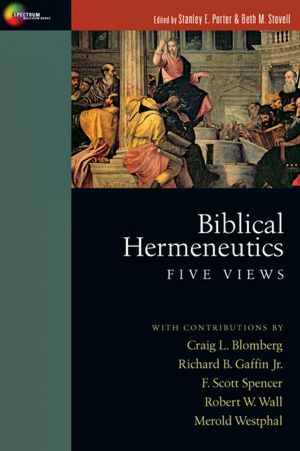
Quick Review of Biblical Hermeneutics: Five Views

“Hermeneutics” sounds like the training program that Ivan Drago endured in Rocky IV.  Though it at times seems a laborious as Drago’s training, hermeneutics actually has to do with interpretation.  The most basic definition of it is, “the science and art of textual interpretation”.  Though you may not be familiar with the word, every one has a hermeneutic.  Some might be sloppy.  Some might be erroneous and start from the wrong foundation.  And some might be helpful.  But everyone has a hermeneutic.

When we consider biblical hermeneutics the text that we are attempting to faithfully interpret is the Bible.  If given one text (especially one of the more difficult ones)and ten people, you are likely to come up with ten somewhat different interpretations or at least different applications.  Why is that?  The answer is hermeneutics. 

In Biblical Hermeneutics: Five Views, five different scholars explain their hermeneutical approach to the Scriptures.  Craig L. Blomberg defends what is known as the Historical-Critical/Grammatical approach.  This is the approach that most of our readers are probably most familiar with.  F. Scott Spencer defends the Literary/Postmodern approach, which as you can tell from it’s title is a somewhat newer approach.  Merold Westphal considers the Philosophical/Theological approach.  Richard B. Gaffin Jr. defends the Redemptive-Historical approach and Robert W. Wall helps the reader understand the Canonical approach to hermeneutics. 

The book begins with a helpful introduction from the editors: Stanley Porter and Beth Stovell.  The introduction considers the trajectories in biblical hermeneutics.  It also offers questions that need to be answered when attempting to outline your own hermeneutic. 

This offering in the Spectrum series is formatted a little differently than the others.  Typically an author will present his view and then those from the other views will then critique his/her viewpoint.  In this book each author defends his view.  Then in the second part of the book he responds/critiques the other views. 

The book closes with Porter and Stovell offering a synthesis of the five views.  This is a theme that seems to resound throughout the book.  As other reviewers have noted this book is not quite the same as other Spectrum books.  Though each having a different emphasis and maybe a different starting point these views are not for the most part true alternatives.  As Porter and Stovell show in the conclusion there is a way to synthesize and use each of these methods to have a faithful hermeneutic.

My Take

One of the most helpful things about this book is that each scholar is given the task of applying his method to Matthew 2:13-15.  The reader is then able to see how the differing hermeneutical starting points yields differing interpretations and thus differing applications. 

I also appreciate that each of these perspectives can offer a little more insight into doing hermeneutics.  It might be helpful for really deeper study to consider a text from each of these perspectives. 

The book is probably most helpful for those already involved in the study of hermeneutics.  I probably would not even suggest it as an introductory book for a college course on hermeneutics.  But for advanced students that have spent a good amount of time in the field of hermeneutics it is an interesting read.  One can actually use information used in this book to understand how other scholars and biblical interpreters give some of the interpretations that they do. 

It would be an interesting read for all, though quite laborious for those not already introduced to the world of hermeneutical discussions.  Serious students of hermeneutics will need to consider this book.  Those that are merely dabbling in the field would benefit but may benefit more from more introductory level books.

You can buy it here

LinkWithin

Related Posts Plugin for WordPress, Blogger...