Showing posts with label sanctification. Show all posts

Monday, July 8, 2013

The Gospel’s Root Work and Axe Work

Apparently one is not supposed to plant a Magnolia tree close to the house. As first-time home buyers my wife and I were not aware of this tip. We liked looking out our bedroom window and seeing the beautiful flowering magnolias. That is until our basement wall started to crack.

This past week—when I was supposed to be on vacation—I spent my evenings killing and uprooting a Magnolia tree. I decided to do this in a three stage process. Stage one is chopping down the tree and leaving a 3 foot stump*. Stage two is to dig a hole around the tree until I expose and then kill those dastardly roots. Stage three is to rent several horses, badgers, cattle, Sherpa's, and anything else I can find to pull the tree out of the hole.

While planning my lumberjacking festivities I started thinking a little about how this magnolia tree relates to sanctification. Specifically gospel-driven sanctification.

So, I’ve got this porn problem”

A young man is in my office confessing his struggle with pornography. I know that the fundamental answer to his problem is the gospel. I also know that there are a few root issues that are likely causing his struggles with pornography. As we dig deeper we are likely to discover that his identity is found in sexual conquest and not in Christ. Those things must be dealt with.

All that is true, but do you want to know what my first advice to this young man will be (especially if he is a believer)? I will tell him…

“Dude, you need to stop looking at porn. Right now. This instant”.

Sometimes you’ve got to kill the visible tree (porn addiction) before you can start digging out the roots (idolatry). I fear that sometimes, with all of our talk of gospel-motivated obedience, we miss something crucial; namely, actual obedience. I like the way Kevin DeYoung put it:

Without [the biblical emphasis of effort], we’ll be confused, wondering why sanctification isn’t automatically flowing from a heartfelt commitment to a gospel-drenched justification. We’ll be waiting around for enough faith to really ‘get the gospel’ when God wants us to get up and get to work (Phil 2:12-13). Because when it comes to growth in godliness, trusting does not put an end to trying. (Deyoung, The Hole in Our Holiness)

You aren’t denying the gospel by grabbing the axe of effort and chopping down the tree of lust. At this point you might not even be dealing with root issues or motivations, all you know is that porn is bringing guilt and pain and you want it to stop. Don’t overcomplicate sanctification, grab the axe and start chopping.

What if I just leave the stump?

The problem with this passive—though gospel-sounding—approach to sanctification is that it spends all of its time and effort on uncovering roots and never chops. You’ve got to kill sin when you see it.

The other end of the pendulum, the Pharisee, is just as deadly. The pharisaical approach to sanctification chops down the visible without dealing with the root system. I’m not an expert on trees but I believe it is correct that if I don’t also sever the roots they will continue to grow (maybe even eventually sprouting another tree out of my stump).

You cannot just chop down the tree, leave a stump, and assume that the job is done. You’ve got to dig and get to the root of the issue. Otherwise you might outwardly tackle your pornography problem but your misplaced identity will lead you to bow to some other god.

Here is my point. If you and I are sinning we need to grab an axe and deal with it. The gospel is what causes us to grab an axe and get to work. And the gospel also causes us to grab a shovel and start digging out roots. But we must never confuse the gospel’s axe work with gospel’s root work. They aren’t the same but they are both necessary to our sanctification.

--

*I should also mention that I did this with an axe and not a chainsaw. I tell you this just so you picture me as a true hardcore lumberjack…beard and all.

**In case you wonder why I would put a picture of an awkward guy awkwardly cutting down a big tree, it is intentional. Our attempts at grabbing an axe and hacking away at sin is often awkward and ugly. But it’s holy work.

Saturday, April 27, 2013

Is Dat Funny?

hannah “Is dat funny”, says my daughter as she dances on the table after being told for the fourteenth time that we don’t dance on the kitchen table.

Part of me wants to laugh with her. But the other part of me is a little frustrated that we’ve told her a million times not to do this particular activity and yet she still wonders whether or not mommy and daddy will let it slide and laugh it off.

I want to say to her, perhaps rather loudly, “No honey it is NOT funny because it is outright disobedience. Mommy and Daddy will never laugh at you disobeying us. It’s just NOT funny”. In my finer moments I stay composed and calmly help her to see that it’s not all that funny because we’ve asked her to not stand on the table, then I try to redirect her towards things that actually are funny.

I see myself in my daughters actions.

I love making people laugh—and I’m discovering that she does too. Yet I’m beginning to wonder if maybe somehow she’s picked up a little of her daddies twisted sense of humor.

Let no corrupting talk come out of your mouths, but only such as is good for building up, as fits the occasion, that it may give grace to those who hear. –Ephesians 4:29

This one has been a battle for me. I’ve always had a weird sense of humor—and for years before Christ captivated my heart it was pretty vulgar. I’m the guy that not only crosses the line but crosses the line and spanks it. (Hopefully that statement wasn’t doing that). Or at least I was that guy, the Lord has transformed my wit over the years.

Yet, I still struggle.

At times I foolishly assume that just because something is funny that the Lord is slapping his knee up in heaven and going to give my words a free pass. It’s the humor clause. And so I say something really dumb and I’m like my daughter saying, “Is dat funny, God”?

No, son, it’s not. It’s disobedience and disobedience is never funny…

--

*Just as a side note, my daughters disobedience is somewhat excusable. She’s not even quite three yet. She’s still trying to learn the ins and outs of humor. But that’s not the case with me. My “is dat funny?” moments are far less excusable.

Also isn’t my daughter about the cutest thing you’ve ever seen?

Thursday, March 14, 2013

When Sanctification is Like a Blind Man Describing Colors

This is a blind dude trying to describe color:

Do you ever feel this way about trying to put on the righteousness of Christ? I know I do.

The “taking off” stuff seems easier to me. “Let no corrupting talk come out of your mouths”…okay I know what that looks like. I’ve done “corrupting talk”. I have a list that describes corrupting talk. I know what it looks like to stop it.

“…but only such as is good for building up, as fits the occasion, that it may give grace to those who hear”. This is more difficult. How do I know what “building up” looks like if I came from a culture of death that only tears down?

There are some deep-seated sins that seem to be attached to my identity. Some things seem really difficult to tear down. But there are some things that seem impossible to build up, because its like a blind guy trying to describe color. I have a big empty spot in my heart where sin is being ripped out but righteousness has not yet been erected in its place.

Yet I hope…

I have hope for this emptiness because I serve a God who calls light out of darkness. I serve a God who “calls into existence the things that do not exist”. I know that God is teaching me righteousness in places that I’ve never lived it before. I know that God is not only healing my blindness but he is also teaching me how to see.

And he mostly does this through his church. God has placed people in my life to help me live in color.

If you are like me—at times feeling so damaged and empty that positive redemption seems impossible—know that there is hope. God creates beauty out of ashes and he calls into existence that which was nothing. You have hope. Surround yourself with people that live in color.

If you live in color it is a necessity that you seek out those that are learning to see. We need your eyes.

Wednesday, September 12, 2012

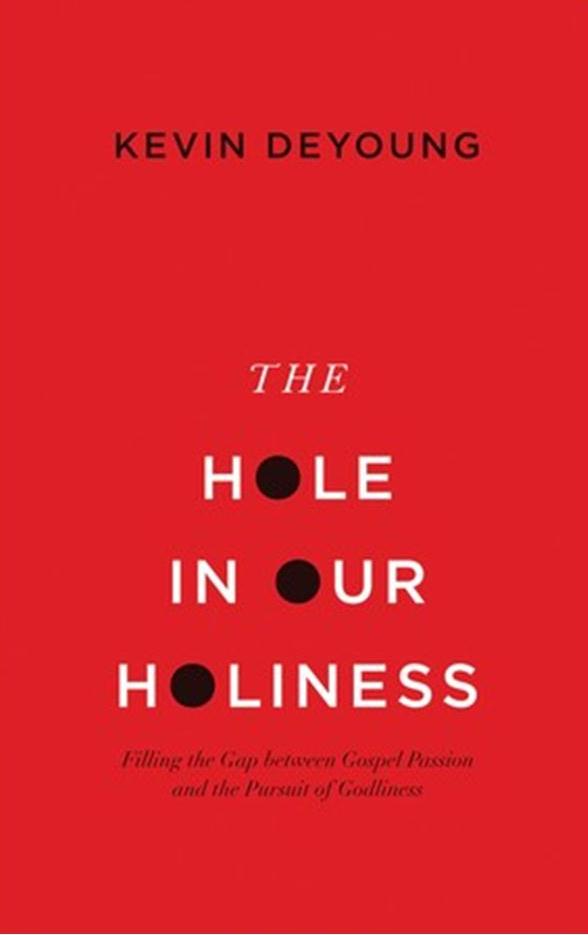
Review of The Hole in Our Holiness

“The hole in our holiness is that we don’t seem to care much about holiness.  Or, at the very least we don’t understand it”. 

That “hole” is what has motivated Kevin DeYoung to set his pen to writing.  The result is a little book entitled The Hole in Our Holiness: Filling the Gap between Gospel Passion and the Pursuit of Godliness.  Many have been waiting this “ruthlessly biblical” treatment of holiness.  And those that attended T4G and heard DeYoung’s message there (which seems to have found its home in chapter six of this book) knew that this book was going to send shock waves throughout the gospel-centered movement. 

The book begins with DeYoung’s defense of his book and explaining his desire to fill the gap that seems to be in the gospel-centered movement.  For the first six chapters DeYoung, with his typical wit and faithful treatment, lobs a few correctives to the gospel-centered movement and slowly begins establishing a case for having a passion for holiness alongside our passion for gospel centrality.  In the last four chapters he begins to make his case practical and explain the biblical categories of union and communion

Union with Christ, says DeYoung is the “irrevocable work of the Spirit”.  He notes that, “nothing can make us a little more or a little less united.”  Compartively, “Communion with Christ…can be affected by sin and unresponsiveness to God’s grace”.  For all of our emphasis on union with Christ, DeYoung wants to see the church also have a passion for pursuing deeper communion with Christ.  And that is the central theme and purpose the book.

My Take:

I’m a little lost at how to review this.  If these chapters were separate blog posts from Kevin’s blog, DeYoung, Restless, and Reformed, then I would have probably linked to almost everyone of them in my Today in Blogworld feature.  By themselves each one is tremendous.  Kevin is a tremendous writer and it shows throughout this book.  He has a way of making you laugh, punching you in the gut, applying the gospel, and then making you laugh again as you close the book up and go about living your life all the while having been profoundly changed throughout. 

There is nothing in this book that leaves me shaking my head and saying, “whoa, this dude has gone off the deep end”.  The correctives that he mentions are needed and helpful.  Personally, I appreciate him saying, “It’s not wrong for a sermon to conclude with something we have to do.” (54)  And I further agree with him that those of us within the gospel-centered movement can without an equal emphasis on holiness end up “confused, wondering why sanctification isn’t automatically flowing from a heartfelt commitment to gospel-drenched justification”.  (91)

So why am I confused in how to review this?  Mainly because this is a book review and not a review of several separate blog posts put together.  In my opinion the book is confused as to its audience and overall purpose. 

I think had DeYoung decided he wanted to only write a book about the hole in the gospel-centered movement and our lack of emphasis and promotion of holiness then it'd have been better.  Or even if he wanted to write a book simply on holiness and how it comes about.  But I think he tried both and it didn't seem to fit together. Honestly, it reads kind of like an associate pastor that finally gets to preach and decides to try preaching 4 sermons in the time frame of 1. 

That is why I am conflicted.  If you were to ask me, “What is the main thesis of the book” I think I would say that DeYoung believes that there is a hole in our gospel and that we need to start emphasizing personal holiness as well as gospel passion.  And as he points out that hole in the gospel he wants to fill it with a robust theology of holiness.  The book is an attempt to point out the hole and then fill it. 

But does he do it? 

Time will tell.  Part of me wants to say that the book is awesome and one of the better books written in the last couple of years.  But the other part of me wonders if it is just a bunch of really awesome truths and statements that wind up simply jarbled around in my skull but not as life transforming as they could have been had I been given a few pegs to hang them on. 

Part of me does not even want to mention that criticism.  The book is superb for the most part and I would feel comfortable putting it in the hands of anyone in our congregation.  It is, as Piper says on the back cover, “ruthlessly biblical”.  And I would never discourage anyone from buying a book that is ruthlessly biblical.  There are whole paragraphs in the book that inspired me, encouraged me, convicted me, and drove me to re-examine ways that I say things.  The book has proven helpful for me.  I’m simply left wondering if the lack of cohesiveness and confused audience will get in the way of leaving a lasting impact. 

At the end of the day, though, I would highly recommend this book.  It’s possible that the lack of cohesiveness is a problem with my brain and not Kevin’s typewriter.  He’s a tremendous author, speaker, and seems to be a humble man of God.  So, I’d be happy to chalk the fault up entirely to myself.  And I would greatly encourage you to shuck out 10 bucks and get a copy for yourself

You can buy it here.

Friday, June 15, 2012

Faithful Fathers Make War

And if your hand causes you to sin, cut it off. It is better for you to enter life crippled than with two hands to go to hell, to the unquenchable fire. And if your foot causes you to sin, cut it off. It is better for you to enter life lame than with two feet to be thrown into hell. And if your eye causes you to sin, tear it out. It is better for you to enter the kingdom of God with one eye than with two eyes to be thrown into hell, ‘where their worm does not die and the fire is not quenched.’ (Mark 9:43-48 ESV)

When dads don’t take sin serious they make the Savior look less than precious.  Faithful fathers will take sin seriously by making war on the flesh.  Christ is more precious than feet, hands, eyes, and anything else we could value.  Yet if we treat our sin as worthy of protection and hide them from the penetrating gaze of the jealous God we communicate to our children that God is less than these. 

Dads, make war!

Sunday, May 27, 2012

The Gospel or Leprosy?

The Gospel hurts worse than having a leprous heart.  I know that in the end it hurts far worse to have a heart deadened to God.  But this side of redemption having a heart sensitive to the Spirit and fighting sin hurts.  It hurts when the gospel rips idols out of my heart.  It hurts when I am fully exposed.  It hurts when the gospel will not allow me to hide (from God or neighbor).  It hurts when the gospel makes me face things I would rather not.  The gospel hurts.
Leprosy on the other hand—you don’t feel a thing.  Of course this means that you are also deadened to beauty.  You cannot really feel kisses.  You cannot really feel a warm embrace.  Sunsets are ignored.  Food tastes bland.  Life feels dull.  But leprosy doesn’t hurt; or at least it doesn’t appear to at the moment.

So do I believe Jesus enough to let the gospel hurt?  Or will I try to put on a leprous heart?

----

This one was from the archives.

Monday, December 19, 2011

The Cleveland Browns and Christian Sanctification

Yes, being a Browns fan is a form of suffering—and suffering does tend to lead to sanctification.  But that is not the point here…

Yesterday, I listened to the Browns blow another winnable game to the Arizona Cardinals.  The Browns record this season is a deplorable 4-10.  Truth be told, however, if it were not for a few bonehead plays they could just as easily have a luck 8-9 wins.  (They are not good, they are not even close to a playoff team—but given their schedule this year they aren’t quite as bad as 4-10 would have us believe). 

The problem that I see with the Browns (and have noticed this problem for the past 3-4 years) is that rather than playing to win the Browns seem to be playing to “not lose”.  That is a subtle difference but it is huge; both in football and in life. 

One of the things that I have to do as a Browns fan is around week 12 or 13—when the Browns are already out of the playoff hunt—I pick a new team to cheer for.  I do not abandon the Browns I just become like every other Browns fan and wait for next season.  This year I am rooting for another underdog; namely, the Detroit Lions. 

Yesterday was a great comparison.  Down 27-21 with only a little time left in the game the Lions confidently and fearlessly put the game in the hands of Matthew Stafford and Calvin Johnson.  They marched down the field and won the game 28-27.  They were playing to win.

A few hundred miles East in Tempe Arizona the Browns and Cardinals were tied up at 17 with under two minutes left.  The Browns had the ball backed up deep in Arizona territory.  The Browns—as has been the case for most of the year—played to not lose.  They ran the ball, had a few dink and dunk passes that they probably hoped they would get luck on, and then ended up punting.  They eventually blew it in overtime having squandered what was once a 17-7 lead.  Why?  They played conservative and tried to “hold the lead”.  Same junk that has been happening all year.

Running to Win the Prize

What does this have to do with Christian sanctification?  In 1 Corinthians 9:24-27 the Apostle Paul says this:

Do you not know that in a race all the runners run, but only one receives the prize? So run that you may obtain it. Every athlete exercises self-control in all things. They do it to receive a perishable wreath, but we an imperishable. So I do not run aimlessly; I do not box as one beating the air. But I discipline my body and keep it under control, lest after preaching to others I myself should be disqualified.
(1 Corinthians 9:24-27 ESV)

In other words “race to win”.  You don’t get a prize for just showing up.  As David Garland notes, “they are to run as if their life depended on it.  It does”.  Many professing Christians are like the Browns, they are doing just enough to not lose the race.  Perhaps running aimlessly hoping that somehow they can blow enough time off the clock that they have a couple more points than the other team.  In the same way many believers do just enough (at least in their mind) to keep God happy—just enough to get them into heaven. 

That’s not the way Paul talks about living the Christian life.  Yes, I believe that we are held by grace and that none can snatch us out of the loving hands of Jesus.  But also firmly believe that the Scriptures teach the necessity of grace-driven effort in the Christian life.  Here Paul is saying we need to run to win the game and not to merely not lose. 

What does it look like to race to win?  Fundamentally, it is a daily grabbing hold of Jesus and resting in and enjoying everything that He has already purchased.  But it is a daily battle to believe the promises of God and to find satisfaction in the pleasures of God over and against all those fleeting pleasures that would turn our eyes away from the prize; namely, Jesus the Christ. 

So fight the fight of faith today as one that is trying to win the race and not merely not lose it.

For more on this I would suggest reading Tom Schreiner and A.B. Caneday’s excellent work The Race Set Before Us.  Or perhaps you would enjoy Dr. Schreiner’s more accessible work Run to Win the Prize

Saturday, March 26, 2011

Learning Letters and Gospel Sanctification

My son is learning to write his letters.  Some he has mastered better than others and some are simply unrecognizable. 

He has a little book that we use as a guide (also a program on his LeapFrog has been helping).  This little book has a letter that he observes, then he traces it, and then to the right he tries it on his own. 

isaiah letters

I realize that my son’s letter writing skills are a picture of sanctification.  Christ is the guide (the letter in its correct and perfect form).  What my son does in freehand is his attempt to copy the guide.  My life is a reflection of that.  As I fix my eyes upon Christ, his character and his person, my life sometimes looks like Isaiah’s letter “f” or “m”.  Still imperfect but looking more like the guide.  And sometimes there is a ton of work that still needs to be done, like Isaiah’s letter “k” or “g”.

But there is another thing to learn from this.  Check out Isaiah’s letter “R” when he isn’t focusing on his guide:

isaiah r


Notice the difference?  That’s what happens in my life when I try to live in holiness apart from my model.  Of course in reality Jesus is much more than simply a guide; He wraps His life around my little hands’ pursuit of holiness. 

----
For this idea I’m indebted to Stuart Scott in his book The Exemplary Husband: A Biblical Perspective

Tuesday, March 22, 2011

What To Do When the Gospel Confronts You

A couple months ago I quoted this gem from Wesley Hill:

The gospel resists the fallen inclinations of Christian believers.  When we engage with God in Christ and take seriously the commands for purity that flow from the gospel, we always find our sinful dreams and desires challenged and confronted. 

In other words it is impossible to be comfortable in the Christian life.  As long as there is still sin in my life, God is still holy, and as long as God he is committed to me, then it will be impossible for me to be comfortable. 

God, through His gospel, is always confronting my fallenness.  And my fallenness is constantly running from the gospel and attempting to hide in darkness or build a life of mock holiness.  The sin in me cannot stand the Lord’s blazing holiness.  And the Spirit within me cannot stand my wretched wickedness.  Who do you think is going to win that one? 

So, then the gospel is constantly confronting us. 

And when that happens I can do one of three things.  I can change the gospel, I can claim the gospel, or I can allow the gospel to change me and claim me.  Ultimately, if I am a believer, the gospel will win.  I know that I will still die with sin in my life; but Christ is greater.  But in the here and now will I live a life of redemption or rebellion?  Will I experience now what Christ has already purchased? 

Change the Gospel

This option is very attractive.  My plain ol’ ESV outreach Bible has some 900 pages worth of material that I can twist, distort, and shape to fit whatever heresy my wicked heart wants to promote.  Every heretic has his verse and every rebel can find Scripture to justify wickedness.  (That’s scary).

Not only can I find refuge in my distorted view of Scripture but I can also find a community that will make me feel good about myself.  I’m certain there are plenty people that are living in the same delusion—and we can gather together as a merry band of Scripture-twisting gospel dodgers.  If you need it you can find any false prophet telling you “peace, peace”; even when there is no peace. 

So if I want, I can change the gospel and the nagging of the gospel will be quiet for a season. 

Claim the Gospel

When the gospel confronts me one option is to claim a cheap grace.  This is also very attractive because it’s a half truth.  At this point I’m claiming the promises of the gospel but ignoring the conditions and the demands of the gospel. 

Hiding behind cheap grace has its perks.  You can feel forgiven and stay comfortable with a rebellious heart at the same time.  I’m certain that the accuser would be more than happy to help us hide our sin behind a false gospel for a good 80 years before he exposes it, for the sake of accusation, when we stand before Jesus.  (And that’s scary).

So if I want, I can claim the gospel in part and hide behind a cheap grace.  As long as I feel forgiven it doesn’t matter if I really am, does it?

Be Changed, Be Claimed

The other option, and the only fitting option, is to actually believe the gospel.  When the gospel confronts me I can agree with God that my sin is odious, live in the power of the resurrection, and rest in the merits of Christ. 

To be claimed is what Paul is referencing in Galatians 2:20. 

I have been crucified with Christ. It is no longer I who live, but Christ who lives in me. And the life I now live in the flesh I live by faith in the Son of God, who loved me and gave himself for me.
(Galatians 2:20 ESV)

I belong to Jesus.  My old idolatrous heart has no claim to my life.  My desires now must be his desires.  So when the gospel confronts my idolatrous heart I—through the power of the resurrection—turn from idols and cling to Christ.  This also means that I am hidden in Jesus; I have a new identity.  I am adopted, forgiven, justified, cleansed, made holy, etc. etc.  And all of this because of the identity of Christ.

Being claimed by the gospel inevitably leads to being changed and transformed by the gospel. 

And this is why the gospel is constantly confronting me.  Even though I occasionally attempt to change the gospel to fit my idolatry the Spirit doggedly pursues me, chastises me, bruises me; whatever it takes.  He is radically committed to me and WILL bring about my holiness.  The gospel wins.

And occasionally I try to claim the gospel and hide in cheap grace.  Jesus NEVER lets me get away with that.  He breaks through the facade.  He conquers my spiritual self-righteousness, lays me bare, and calls me to hide in His powerful and costly grace. 

---

For a great article on gospel repentance check out this article by Tim Keller.

Tuesday, December 7, 2010

When Keswick Meets Calvin

One of the charges often leveled against Calvinism is that it hinders growth in holiness.  It is often asked, “If God is going to bring his elect to maturity then why bother engaging in spiritual disciplines”?  It is thought that if Calvinism is taken to its logical conclusion then why bother with holiness.  Reformed folk like John Samson rightly disagree with and don’t understand this charge

I have heard this mentioned a few times recently and just scratch my head in wonder about it. One great example are the Puritans, who were strong Calvinists and yet were driven by a desire for holiness. But some see this as a contradiction in terms. Where they get this, I do not know.

Allow me to try to answer that from my own journey.  I grew up (spiritually speaking) in a Baptist church that was strongly revivalistic.  I also had a good does of Pentecostal teaching along with a steady diet of Keswick theology.  Early on in my walk with Christ one of my favorite books was Andrew Murray’s Absolute Surrender.  Some of these quotes were underlined in my copy:

The condition of God's blessing is absolute surrender of all into His hands.

When God has begun the work of absolute surrender in you, and when God has accepted your surrender, then God holds Himself bound to care for it and to keep it. Will you believe that? In this matter of surrender there are two: God and I-- I a worm, God the everlasting and omnipotent Jehovah. Worm, will you be afraid to trust yourself to this mighty God now? God is willing. Do you not believe that He can keep you continually, day by day, and moment by moment?

Say: "Lord God, not a word upon my tongue but for Thy glory, not a movement of my temper but for Thy glory, not an affection of love or hate in my heart but for Thy glory, and according to Thy blessed will."

I firmly believed that if I wanted my life to “count for God” then I had to have absolute surrender.  I wanted (probably somewhat selfishly) for God to use me to do great things.  I desired revival.  I desired a deep experience with God.  I wanted what my heroes (at that time) experienced.  Men like Finney, Moody, and other revivalists.  I wanted the intimate “talking together” type of relationship with God that I heard my favorite preachers on television speak about.  And I knew this would come from absolute surrender.

The only problem is that I could never seem to absolutely surrender.  There was always something I was hanging on to.  There was always some residual sin.  I never could have absolute surrender or perfect faith.  So like a donkey pursuing a carrot I sought experience after experience, hoping that something would click.  I wanted to find the key to this whole Christian life. 

Somehow my disenchantment actually led me towards Reformed theology.  Hearing of a great God that would bring about my holiness was welcome news.  Inevitable faith was what my heart had been longing for.  So, the pendulum swung.  I stopped focusing so much on the “let go” aspect of my faith and started focusing on the “let God”. 

The result? 

I became spiritually dry.  I stopped worrying about spiritual disciplines so much.  Yeah, my “Calvinism” had stunted my growth in holiness.  I know now that it was not my “Calvinism” it was my wrong headed understanding of sanctification matched with my new found doctrines of grace.  In other words, when Keswick meets Calvin the result is deadly. 

Calvinism, rightly understood, should not lead to stunted growth.  But Calvinism (or any other system) that is not firmly rooted in the gospel will inevitably lead to frustration and a lack of true growth. 

This all came to a head in my bath tub in Hannibal, MO.  I was in a deep and dark time of the soul.  I felt as if I was on the precipice of rejecting the faith.  Not just Keswick.  Not just Calvinism.  But the whole darn thing.  Then it clicked.  The beauty of the gospel was awakened in my mind, heart, and soul.  And just like John Bunyan I felt chains come off my legs.  Indeed I came to find that my righteousness is found totally in Christ and him alone. 

Keswick theology may call this having a crisis, surrendering absolutely, and trusting in Christ alone.  Perhaps.  A Calvinist would say that all of this was the sovereign working of God bringing about inevitable growth in holiness.  I am inclined to agree.  But all I know is that my desire for holiness was a sham until Jesus rescued me in that bath tub.  The gospel awakened my heart. 

And now I’ll put my trust in absolute Jesus not my absolute surrender. 

Monday, October 18, 2010

Gossip or Concern

When is it gossip and when is it legitimately sharing a concern?

Wayne Mack provides a helpful outline in his book, Your Family, God's Way, that I will tweak into question form:

  1. Have biblical attempts been made; but failed to resolve the difficulties?
  2. Is your motivation for sharing a sincere desire to get help?
  3. Are you sharing with those that actually can (and will) furnish godly counseling and solutions?
  4. Will the information be helpful to others in a preventative, protective, or restorative way?

Wednesday, September 22, 2010

The Empty Famish of Letting Go

I was going through some of my books the other day and came across a book that pretty heavily influenced me when I was first a believer: Brother Lawrence's Practice in the Presence of God. I thought I'd give it a quick look.

It's interesting to see some of the things I underlined 8-10 years ago. It's also interesting to see how much my theology has changed since then. When I first read this book I ate it up. Now I think I vomit it out. Okay, maybe that was a little strong. You'll have to forgive me. Reading back over this helped me to see where some of my serious frustrations and doubts came from early on in my Christian walk.

What Brother Lawrence means by “practicing God’s presence” is to be in a state of constant conversation and communion with the eternal God.  Which I’d never say is a bad thing.  It’s all of the muck around it that caused me problems.  Take this quote for example:

“I still believe that all spiritual life consists of practicing God’s presence and that anyone who practices it correctly will soon attain spiritual fulfillment.  To accomplish this, it is necessary for the heart to be emptied of everything that would offend God.  He wants to possess our hearts completely.  Before any work can be done in our souls, God must be totally in control.

Where Spiritual Fulfillment is Found

Do you see any “red-flags”? 

First, notice where “spiritual fulfillment” is found.  It’s not in the finished work of Christ.  Spiritual fulfillment, if I read him correctly, is something that is to be attained.  This type of theology breeds a discontentment that always seeks for a “deeper level” and a “deeper experience and fulfillment”.

The New Testament picture is that our fulfillment has been purchased.  We already have it.  The Christian life is about living in what is already purchased.  There is an earth-shattering yet subtle difference between battling to enjoy all that Christ already purchased and battling to attain an opportunity that Christ made possible. 

The Means of Attaining

Second, notice the means for attaining this spiritual fulfillment.  “The heart needs to be emptied of everything that offends God.”  If he is speaking to an unbeliever then I could more quickly embrace this, but he is not.  For Brother Lawrence if we want to see God working in our lives and experience His presence, then God must be totally in control. 

That sounds so good doesn’t it?  It sounds even like something Jesus would say:  “If anyone would come after me, let him deny himself and take up his cross and follow me.”  Let God have everything, totally surrender, and then you will see God move in your life. 

Here’s the problem, though, unless God IS working you will not totally surrender--you will not give God everything.  Such a thing is not a precursor to God moving…it IS God moving! 

The Soul-Crushing Effects

Perhaps you could say that I simply misread and misapplied this “Christian classic”.  That could be.  But this book—along with many other similar books—was a negative shaping influence on me. 

For the first couple of years of my Christian walk I was always striving to reach that next level.  I lived frustrated and never able to be satisfied in Jesus.  It practically ran me crazy.  I wanted to be “sold-out” “on fire” all of those other things.  I also wanted other people to be those things.  But I never could attain it.  I never could get myself to “totally surrender”.  The only thing I surrendered was any hope that I’d ever be able to “experience God” how I wanted to.

Then the gospel happened.  Psalm 103 rocked my world.  My eyes opened up and I saw that Christ already had purchased everything.  Of course my battle was still intense.  Now I have to fight to take hold of what Christ has already done.  But, as I think David Platt has said, I fight from victory and not for it.  Huge difference. 

If you’ve been famished by this “let go and let God” stuff, I encourage you to feast on the gospel.

------

If this topic peaks your interest a really neat resource that I hope to purchase soon is this book by Andy Naselli.  Or you can check out some of his online resources here.

Thursday, July 29, 2010

Lawful but Hurtful in Abuse

John Newton writes a sketch of the believer’s temper.  The entire letter is worthy of your consideration but I though this particularly helpful:

Satan will not often tempt a believer to gross crimes—our greatest snares and sorest conflicts are usually found in things lawful in themselves—but hurtful to us by their abuse, engrossing too much of our time, or of our hearts, or somehow indisposing us for communion with the Lord. The Christian will be jealous of anything which might entangle his affections, dampen his zeal, or straiten him in his opportunities of serving his Savior.

What are areas in your life that are “lawful in themselves” but “hurtful by their abuse”? 

For me I think certain entertainments like television and video games are the obvious ones.  The less obvious ones are spending an inordinate amount of time reading Christian books to the neglect of Scripture and prayer.  Surfing the internet and blogging—even if with an intention of doing it for the glory of God—can “engross too much of my time”. 

This letter is very helpful, you can read the entire thing here

Tuesday, June 8, 2010

Our Battle with Sin Illustrated

I’m a visual person.  So this little cartoon by Josh Harris is a great tool to visualize our battle with the flesh: Feeding the Flesh

It is an excerpt from his “theological autobiography” Dug Down Deep.  I haven’t gotten to read it yet, but hope to have it read and reviewed by the end of summer.

LinkWithin

Related Posts Plugin for WordPress, Blogger...