Showing posts with label Dr. Schreiner. Show all posts

Tuesday, April 24, 2012

One Reason Tom Schreiner is My Favorite Professor @SBTS

Not only is Tom Schreiner a faithful pastor he is also one of the best scholars of our day. Yet, perhaps his best quality is that he models grace and humility in his teaching and preaching. I am happy to have Dr. Schreiner as one of my professors. But his preaching, teaching, and writing skills are no match for his awesome rapping skills.

(HT: Denny Burk)

Monday, December 19, 2011

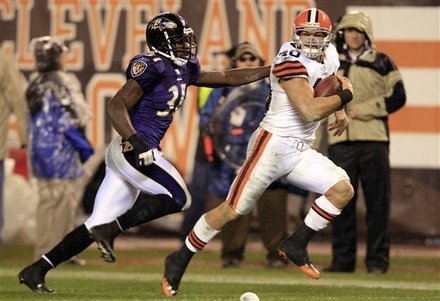
The Cleveland Browns and Christian Sanctification

Yes, being a Browns fan is a form of suffering—and suffering does tend to lead to sanctification.  But that is not the point here…

Yesterday, I listened to the Browns blow another winnable game to the Arizona Cardinals.  The Browns record this season is a deplorable 4-10.  Truth be told, however, if it were not for a few bonehead plays they could just as easily have a luck 8-9 wins.  (They are not good, they are not even close to a playoff team—but given their schedule this year they aren’t quite as bad as 4-10 would have us believe). 

The problem that I see with the Browns (and have noticed this problem for the past 3-4 years) is that rather than playing to win the Browns seem to be playing to “not lose”.  That is a subtle difference but it is huge; both in football and in life. 

One of the things that I have to do as a Browns fan is around week 12 or 13—when the Browns are already out of the playoff hunt—I pick a new team to cheer for.  I do not abandon the Browns I just become like every other Browns fan and wait for next season.  This year I am rooting for another underdog; namely, the Detroit Lions. 

Yesterday was a great comparison.  Down 27-21 with only a little time left in the game the Lions confidently and fearlessly put the game in the hands of Matthew Stafford and Calvin Johnson.  They marched down the field and won the game 28-27.  They were playing to win.

A few hundred miles East in Tempe Arizona the Browns and Cardinals were tied up at 17 with under two minutes left.  The Browns had the ball backed up deep in Arizona territory.  The Browns—as has been the case for most of the year—played to not lose.  They ran the ball, had a few dink and dunk passes that they probably hoped they would get luck on, and then ended up punting.  They eventually blew it in overtime having squandered what was once a 17-7 lead.  Why?  They played conservative and tried to “hold the lead”.  Same junk that has been happening all year.

Running to Win the Prize

What does this have to do with Christian sanctification?  In 1 Corinthians 9:24-27 the Apostle Paul says this:

Do you not know that in a race all the runners run, but only one receives the prize? So run that you may obtain it. Every athlete exercises self-control in all things. They do it to receive a perishable wreath, but we an imperishable. So I do not run aimlessly; I do not box as one beating the air. But I discipline my body and keep it under control, lest after preaching to others I myself should be disqualified.
(1 Corinthians 9:24-27 ESV)

In other words “race to win”.  You don’t get a prize for just showing up.  As David Garland notes, “they are to run as if their life depended on it.  It does”.  Many professing Christians are like the Browns, they are doing just enough to not lose the race.  Perhaps running aimlessly hoping that somehow they can blow enough time off the clock that they have a couple more points than the other team.  In the same way many believers do just enough (at least in their mind) to keep God happy—just enough to get them into heaven. 

That’s not the way Paul talks about living the Christian life.  Yes, I believe that we are held by grace and that none can snatch us out of the loving hands of Jesus.  But also firmly believe that the Scriptures teach the necessity of grace-driven effort in the Christian life.  Here Paul is saying we need to run to win the game and not to merely not lose. 

What does it look like to race to win?  Fundamentally, it is a daily grabbing hold of Jesus and resting in and enjoying everything that He has already purchased.  But it is a daily battle to believe the promises of God and to find satisfaction in the pleasures of God over and against all those fleeting pleasures that would turn our eyes away from the prize; namely, Jesus the Christ. 

So fight the fight of faith today as one that is trying to win the race and not merely not lose it.

For more on this I would suggest reading Tom Schreiner and A.B. Caneday’s excellent work The Race Set Before Us.  Or perhaps you would enjoy Dr. Schreiner’s more accessible work Run to Win the Prize

Wednesday, August 10, 2011

Eliminating the Tithe: Magnifying Christ and Mission a Response to Les Puryear

I don’t typically respond to other people’s articles, and I try to stay out of controversy.  Hopefully I do not regret responding here, but Les Puryear seems to be a reasonable man and if there were any discussion I think it would be cordial. 

Puryear recently posted an article on what is wrong with the SBC.  Number two on the list (in no particular order) was “preachers and Seminary professors who teach that the biblical principle of storehouse tithing is not valid today.”  He followed up that article with one this morning accusing those that “eliminate the tithe” as “jumping through hermeneutical hoops to dismiss biblical teaching”.

Here I am not so much going to respond to the discussion of tithing specifically but what I believe is a faulty hermeneutic that drives Puryear’s conclusions. 

In his recent article there is one particular statement that stuck out to me:

I do not agree that we should ignore the Old Testament and obey only New Testament commands. If so, then we would be throwing out more than half of the Bible!

He follows that up with citing 2 Timothy 3:16-17, Psalm 119:105, and Matthew 5:18 to show the danger of ignoring the OT commands. 

If the purpose of the Old Testament is to give us a rule book of commands then I would be more apt to agree with Puryear’s conclusions.  But if the purpose of the Old Testament is to point to Christ (in all of its shadows, sacrifices, etc.) then the Old Testament is not thrown out simply because we no longer adhere to certain laws within the Old Testament. 

In this article three things are listed that are no longer valid: “dietary laws, the ceremonial law, and the sacrificial system”.  Certainly Puryear would not argue that we are “throwing out” most of the Torah just because we see it fulfilled in Jesus. 

As Tom Schreiner has aptly pointed out in his work on Christians and Biblical Law, “the tithe is irretrievably tied to the old covenant, which is no longer in force”.  We do not pay regular tithes to the Levites and to the priests.  All believers are now priests.  Do we then pay tithes to one another?  To truly follow the tithe we must live in the Old Covenant; and that is Schreiner’s point. 

But What About Jesus in Matthew 23?

One of Puryear’s points is that Jesus DOES teach tithing in the New Testament.  In Matthew 23 he tells the Pharisees that they should have tithed.  Their problem is that they were neglecting other matters like justice, mercy, and faith.  But the tithing part they got correct.  Jesus does not rebuke them for tithing in fact he affirms them for it. 

But it is worth noting, again as Schreiner does, that “his positive words about tithing were directed to Pharisees who lived under the old covenant”.  Schreiner then goes on to point out that Jesus also “commended offering sacrifices in the temple (Matthew 5:23-24), but no one today thinks such would be advisable if the temple were rebuilt.”

Tithing and Missions

Count me then as one of those that is a problem within the SBC.  I know that many fear that if this teaching would progress…where we no longer required a tithe in our churches…then an already strapped financial church would be buried.  Furthermore, God would not be please because we would be “robbing God” as it says in Malachi. 

I must admit that does cause me to suggest these things with trepidation.  But might I suggest that it may be possible (hear my trepidation) that mandating the tithe is actually hurting our churches.  Inspired by a question from David Platt’s book, Radical, I asked myself the hard question: what would be different if rather than asking how much can I spare I start asking how much will it take?  (Read that article: here)

Is it possible that many people give their minimum 10% (and we know statistically we often fail to do this) when the cause of missions combined with the way that God has financially blessed us would actually necessitate a much larger sacrifice?  Again what would happen if we did not have a fixed 10% that is the expected amount—but instead we began asking “how much will it take”? 

My contention is that we do not “throw out half the Bible” by not mandating a storehouse tithe.  Rather we magnify the beauty of Christ in saying that He has fulfilled the Old covenant and has now set in its place a blood-soaked new covenant that comes with a non-negotiable call to love one another.  Such a call actually necessitates that we live MORE sacrificially than a tithe and not less**. 

**I am not here accusing Puryear of teaching something akin to only giving a minimum and not giving over and above the tithe. 

Tuesday, December 14, 2010

Review of ZECNT Commentary on Galatians by Thomas Schreiner

Perhaps my favorite professor at SBTS is Dr. Tom Schreiner.  He is extremely wise but is also exceedingly humble.  In his classes I not only learn about the text that we are studying, I also learn what it means to be a gracious pastor, expositor, and writer.  Obviously, then, I was excited for the opportunity to review this book.  I received it free from Zondervan in exchange for a review. 

The particular copy that I received is the Zondervan Exegetical Commentary on the New Testament: Galatians.  The ZECNT is a new commentary series designed with pastors and students in mind.  It is not bogged down by overly technical details, nor is it a simple running commentary.  The ZECNT is unique. 

Each Bible passage has addresses seven primary components: Literary context, main idea, translation and graphical layout, structure, exegetical outline, explanation of the text, and theology in application. 

Probably the most unique feature of the ZECNT is the translation and graphical outline section.  Dr. Schreiner has his students do something very similar in all of his classes.  These are helpful ways of seeing the flow of a passage and how all of the different propositions relate to one another.  It is encouraging to see these in commentaries.  This is probably the most helpful treatment of biblical passages that I have seen in a commentary. 

If you are looking for a really in-depth commentary the ZECNT is only going to scratch the surface.  But if you are looking for something to provide a “feel” for the passage, or if something to help place the text in its literary context, then the ZECNT will be the commentary for you. 

Specifically, this commentary on Galatians is wonderful.  I did not have time to read through all of it but what I did was phenomenal.  I also have the advantage of having sat through Dr. Schreiner’s classes and I know how trustworthy he is as an expositor.  You may not agree with all of his conclusions but you will certainly have a clear understanding of his position.  In my opinion Schreiner is definitely one of the top 5 bible commentators in our day (perhaps the best on Paul). You will richly benefit from this volume.

Who is this commentary for?  Schreiner writes in the preface that this is “especially for pastors and students who want some help with the Greek text”.  And he is certainly right.  Those with a knowledge of Greek and some seminary training will probably be the ones that benefit the most from these commentaries.  But I do not think those without formal education will be hopelessly lost.  There may be some things that are unfamiliar to those without training (like calling something a “gnomic aorist”), but these are not so prominent that you would get lost. 

I highly recommend these commentaries for any student of the Bible.  Especially this commentary on Galatians by Dr. Schreiner. 

Rating: 5 out of 5 stars

You can buy the Galatians commentary for under 20 bucks at Amazon .  That is a GREAT price for a commentary like this!

LinkWithin

Related Posts Plugin for WordPress, Blogger...