Showing posts with label Bible. Show all posts

Friday, August 9, 2013

Why Is It Always Revelation(s) That They Want to Study?

So, this unchurched guy comes in my office and tells me that he has started reading the Bible. I’m excited but I almost know what he’s going to say next.

I pause and wait for him to articulate what I know is coming…

The silence is broken. And my assumption is correct. He has chosen to begin his study in Revelations. (It is of course mandatory that you call it Revelations instead of Revelation when you pick this as your first book).

And I sit and wonder why anyone would begin with arguably the most difficult book in the entire canon of Scripture to begin his study. I assume Hollywood, coupled with our fixation on the world blowing up, is largely to blame. Yet I wonder if there isn’t another, not so obvious reason, why folks choose difficult Old Testament passages or Revelation to begin their study. Perhaps a hidden Jesus is safer and more attractive.

Deal With Jesus Directly

So, I counseled this confused looking fella as I normally do. I told him to stop his reading in Revelation and take up the Gospel of Mark. That probably sounds like I’m saying that Mark is better than Revelation and that I’m encouraging people to be red-letter Christians only. Not the case.

Let’s be honest and confess that this dude is doing everything backwards anyways. It shouldn’t just be him and Jesus alone in a room with an open Bible. He needs the church. He needs to study God’s Word alongside of God’s people. That’s ideal.

But he’s likely to insist on continuing as a lone ranger; and this largely because He hasn’t yet been reconciled to God and henceforth other believers. So if he must study the Bible on his own I want him to deal with Jesus directly. Not through shadows. Not through allegory. Just the bare Jesus of the Gospels.

Let him deal with Christ and be haunted by the Nazarene. Let him figure out how Mary’s son can calm a raging sea with the word of His mouth. Cause him to be confronted with the screams of the crowd saying, “Crucify him”. And leave him with the centurion’s confession, “Truly this man was the Son of God”.

He must be confronted and transformed by this Jesus. Then maybe he’ll get his tail in church and gather with other believers where we can start working through the Old Testament and Revelation.

Thursday, June 20, 2013

How My Wife and I Are Changing Our Devotional Times

My wife and I are changing the way that we do devotions together. For one, we want to be more faithful in actually reading the Scriptures and praying through them. With two young children, ministry, and a host of other things we have had a difficulty blocking out time to spend together in the Word.

Secondly, we have developed an unhealthy pattern. We have a tendency to bond in negative things. This means that when we interact with the Scriptures we talk more about how we blow it than we rejoice in the provision of Christ to meet our weaknesses. I have not led well in making our devotions life-giving.

I want this to change.

For an undetermined amount of time we are going to study the Scriptures for the sole purpose of worshipping together. No questions. No focusing on our sins or successes. Simply worship. With every text we are going to make it our aim to feast on the beauty of God.

This practice is largely inspired by this quote by John Newton.

“I hope what you find in yourself by daily experience, will humble you—but not discourage you.

For if our Physician is almighty—our disease cannot be desperate. Our sins are many—but His mercies are more. Our sins are great—but His righteousness is greater. When our sins prevail, remember that we have an Advocate with the Father, who is able to pity, to pardon, and to save to the uttermost!

It is better to be admiring the compassion and fullness of grace which is in our Savior—than to dwell and pore too much upon our own poverty and vileness.”

Pray for us. Pray that the Lord would cause us to worship together, and that he would give us eyes to see Him.

Tuesday, May 14, 2013

Jews Didn’t Have Coffee Mugs

Okay I cannot prove that the ancient Hebrews did not have coffee mugs. But I do know that if they did they would not put Bible verses on them the same way that we do.

If I paint Philippians 4:13 in eye black and go out and play a tremendous game of church league softball, you know the statement that I’m making. I’m saying “I can do all things [like kick your tail in softball] through him who strengthens me.” End quote.

That is not the case with the way that the New Testament writers would quote the Old Testament. When Jesus says from the Cross, “My God, my God, why have you forsaken me” He is reciting a Psalm and calling to mind that entire Psalm. In the same way when Paul quotes Habakkuk 2:4 and says, “the righteous shall live by faith” he is thinking of the entire argument of Habakkuk.

This should revolutionize the way that we study our Bibles. When you read something in the New Testament (or even in the Old Testament) that has an allusion to a prior passage these guys aren’t just proof texting; they are proof-storying. They are thinking of the entire context of the passage that they are quoting.

What this means for Bible study (and for sermon prep for us preachers) is that when we discover a passage that has an earlier allusion we had better go back and pick up the entire argument of the passage cited. We do that because this is what the inspired author (say Paul) is doing when he is quoting it. He’s not just reminding us of that sweet passage on our coffee mug, he’s telling us a story.

Example:

The best example of this is probably Jesus’ use of Psalm 22 from the cross. Psalm 22 was a lament for the innocent sufferer. It perfectly fits Jesus’ situation. When He cries out “My God, my God, why have you forsaken me?” He is thinking of the entire Psalm. A Psalm which actually points to the vindication of the sufferer.

Does this mean that Jesus was not forsaken by the Father? Not necessarily. Or does this mean that Jesus does not feel the full weight of an innocent one enduring suffering? Absolutely not. If anyone could rightly cry out Psalm 22 it is Jesus. And he feels the full weight of every sentence. But we should remember that it’s not only the cry of dereliction (v1) that Jesus feels, but also the notes of hope that resound throughout the passage.

Jesus will be vindicated. He knows this. While he might feel abandoned—and the full weight of abandonment—He is also trusting in the God who vindicates the innocent. He knows the end of the story.

When he cries out Psalm 22:1 he isn’t doing that because he remembered that verse in AWANA and feels like that verse fits. Nor is Matthew putting it on his lips because he thinks it fulfills verse 1 of Psalm 22. Jesus is crying Psalm 22:1 (and Matthew frames his 27th chapter around that Psalm) because he is telling the story of the entire Psalm.

Lesson:

When you see a verse quoted don’t assume that they quoted verses the same way that we do. Consider the entire context of the Old Testament passage that is quoted. And pack all of that into the one verse that they are quoting. When someone that lived in the age of Jesus quoted a verse they were thinking of the entire passage and it’s argument. We should do the same.

Sunday, March 10, 2013

One Reason Why Movie Theaters Are Packed But Your Bible Study Isn’t

Why do people who pile into movie theaters on a Friday evening complain that the Bible is boring on a Sunday morning?  One reason, and I stress ONE reason, is that we have not rightly been convinced that the Bible is a compelling story. 

If our view of Scripture is akin to Basic Instructions Before Leaving Earth then I doubt very seriously that we will be compelled to open its pages.  At least not until something goes wrong.

I’m one of those guys that attempts a project without the instruction manual. Key word in that sentence is “attempts”. I typically read them after the project is “finished” and I’m holding an extra part in my hand. Or I consult a week or so later when the whole thing topples in on itself because that extra piece really wasn’t an extra piece.

If we view the Bible like an instruction manual then we won’t pick it up until we have significant trouble in our lives. And even then it likely will be misread; rather than seeing Christ you’ll see “answers”. In fact any answer will often do. Occasionally, we consult this instruction book just to reassure ourselves that we are doing just fine in our project. Then we go back to building our piece of junk and don’t consult the manual again until the wheels fall off.

Do you realize how hard it is to convince people to find Life in the Scriptures when this is our view?  Or to convince them to attend your Bible study? It’s like trying to convince people that if they want to really enjoy food they should become acquainted with their refrigerator’s manual of operation.  That’s just silly. 

What if instead we started viewing it as a compelling story told by the Creator of the universe or as a drama that is acted out and then explained by God about God?  (I’m indebted to Michael Lawrence for that thought). 

I’m convinced that a good number of people piling into movie theaters on a Friday night are doing so because they are looking for story.  Not everyone mind you.  But story is powerful.  And we have the most compelling story ever told—the story that all stories comes from—but we’ve decided to sell it as an instruction booklet. 

So, please…Let’s stop it!

--

Originally posted here.

Friday, February 8, 2013

Quick Review of A Mouth Full of Fire

I thought about preaching through Jeremiah once. Then I tried to outline it. I decided I would postpone that Jeremiah series for a time when it made a little more sense. After reading A Mouth Full of Fire: The Word of God in the words of Jeremiah, I might be a little closer to a Jeremiah series.

Andrew Shead attempts to unify the book of Jeremiah around the central theme of “the word of the Lord”. Shead believes that it is best described as “the story of what happened when the word of the Lord came to Jeremiah”. And as we listen to this story it helps us shape our own doctrine of the word of God. This book, then, serves as both a discussion on Jeremiah and a discussion on the doctrine of the word of God.

The book begins with an attempt to defend his thesis and outline the suitability of Jeremiah to give us a solid theology of the word of God. He then goes about structuring Jeremiah. After engaging in these introductory matters, Shead, then shows how his argument bears on our doctrine of the Word. He looks at the Word and speaker, Word and hearers, Word and power, and finally the Word and permanence. He closes the book with a “conversation” with Karl Barth.

My Take

I got a great deal out of this book. It helped me to think through Jeremiah and read it more cogently. Furthermore, Shead does a great job of defending his thesis. I’m convinced that he is correct in his theme of Jeremiah. If I ever do preach through Jeremiah I will be sure to go back to Shead and structure the book accordingly.

What is most helpful in this book, in my opinion, is the distinction that is made between “word” and “words”. His chapter on The Word and Speaker was very beneficial to me. I write and speak the Word frequently. His statement that, “a prophet is made by God into a word-shaped person” hauntingly shows that you really cannot separate the messenger from the message.

Should You Buy It?

The book will not be for everyone. It is written in the middle of a scholarly discussion on the nature of the word of God. If you aren’t already introduced into that conversation it might be a little difficult to get brought up to speed. However, the book is not so pedantic that a casual reader couldn’t pick it up and benefit.

Those most likely to benefit from this book would be someone that is studying the doctrine of the word of God. This needs to be part of that study. Furthermore, someone attempting to study or preach through Jeremiah would benefit greatly by giving this book at least a perusal. Shead helps outline Jeremiah in a way that I haven’t really seen before. It is profoundly helpful if given to the right audience.

Purchase A Mouth Full of Fire today.

Monday, January 21, 2013

A Week Without Google: Reflections

Last week I did the unthinkable; I refused to use Google. Each day I posted a couple of reflections and a list of some of the things that I wanted to search for but could not. Here they are:

Day One
Day Two
Day Three
Day Four and Five

Now that you’ve not clicked those links, here are my reflections on a week without Google.

Humility

I discovered last week that my greatest use for Google is to keep myself from looking like a moron.
There were a few classes that I failed to pay attention to in school. Like those kind of important ones like English and Grammar. I am still not the best at grammar. Because of this I forget basic punctuation rules and at times I have no clue what a certain word or phrase even means. Google does for me what I failed to allow my elementary school teachers to do for me; namely, teach grammar and help me not look quite as dumb.

I remember in grade school first learning language and at times totally butchering it. I can recall the embarrassment of singing a song with horribly wrong lyrics. Or arguing a fact for hours until we could find an Encyclopedia somewhere or ask someone’s grandpa. That was in the days before Google. Now we just search for it and don’t have to have egg on our face for singing, “Excuse me while I kiss this guy” instead of “excuse me while I kiss the sky”. By the way you can Google the worst misheard song lyrics and find this hilarious site.

There is a humility that comes from not knowing all of these facts. There is something refreshing with being able to say, “I have no idea if I should use a colon here”.

Information Addicts

I have become an information addict. I found myself desiring information and not being able to know the answer in only a few seconds. I don’t think I ever got to the point of twitching but there were some searches that I really wanted to make. Today I can barely remember those questions that had to be answered and I am sure that my life isn’t worse because of it.

Bare information is becoming more powerful in our day than actually knowing something. I can do a quick search about the 14th president and find out who that is. But I’ll probably have to do that same search six months from now because I never really knew who the 19th president was—I only pretended like I did. Searching for the 14th president is simply an information fix and the high wears off after about a day and we totally forget that information. But try actually doing a little research on that 14th President (whoever that dear chap might be—I’d guess Millard Fillmore but I think I’m wrong) and you’ll never forget him.

Time Wasting
My list of “searches I wanted to do” consisted of about 30 minutes each day of things that would have consumed my time. These were things that I did not need to know but because I am an information addict I thought I needed a fix. It was nice to not chase a rabbit trail and start thinking about The Shot Heard Round the World and baseball in the 1950’s.

These things are interesting. Occasionally an article might have spawned from one of these rabbit trails. More than likely I would have just filled my cranium with useless Jeopardy trivia.

Google and Bible Study
I was actually quite surprised that I did not use Google (or want to use Google) for Bible study as much. Perhaps that was the case because I was made privy to my shortcutting problem thanks to an article I wrote a few months ago.

I did find myself at times wanting to search for something before trying to figure it out on my own. By the end of the week I had already started thinking on my own more than instinctively turning to Google. I am convinced that there are times when we ought to be querying the text instead of doing a Google search.

The Benefit of Google
There are great benefits in Google. It helps with illustrations when I only have a partial thought in my head—Google helps fill it out with facts rather than my own assumptions about what happened in history. It also helps when I think of an article but totally forgot it’s location.

There are things that need to be researched that are not time wasters. There is information that legitimately is helpful to know. It is my desire in the future to start filtering these searches a little better. I want to ask myself, “Do I really need to know this?”

Finally, it does help to not make stupid punctuation and word choice errors. Though it is humbling to make dumb mistakes for all the world (or your 300+ followers) to read, it can also be counter-productive to not fix those mistakes. People stop reading whenever something looks really sloppy. It’s probably best not to get bogged down with too much grammar/punctuation type issues in a blog post, but you probably ought to be certain to get a title correct.

The Forthcoming Zombie Apocalypse

Yes, I will be able to survive. And not because I have done a Google search for how to survive a zombie apocalypse. But mostly because I spent the week watching the Discovery channel show The Colony and also because I have learned how to live without Google.
As a counterpoint, though, I believe my brain has gotten more lively and fruitful without just quickly Google searching. Therefore, it might be more tasty and appealing to zombies. I’m not sure. Maybe I should do a few Google searches to prepare myself just in case.

Monday, January 14, 2013

A Week Without Google

A few months ago I wrote on an article called The Googlization of Bible Study. Here I lamented the shortcutting that was happening to my Bible study. At the time I considered doing a little experiment to see how indebted I really am to Google. I put it off until now. This week I am doing it:

ONE WORK WEEK WITHOUT GOOGLE*

I am primarily concerned with the way that Google has impacted my personal Bible study, my sermon preparation, and the things that I do as a pastor. I want to see the influence that it has. Therefore, I will keep this confined to a work week. That means that if I am at home and Isaiah asks me a crazy question about the length of a frogs tongue we can Google it. But if that question pops in my skull at work I can’t.

Starting at 8:00 AM this morning I will not use Google during my work week. This experiment will end at 5:00 PM this Friday.

There will be three permissible uses of Google:

  1. Google Reader (I have to be able to check this for my Today in Blogworld feature or else it would take most of my day to sift through all the pages)
  2. Blogger or other Google platforms like YouTube. (I use Blogger to blog).
  3. Pictures for the devotional I am writing for Isaiah or for blog articles. Because I am finishing up the Colossians devotional that I am giving Isaiah for his birthday this week, I will still need to search for clipart and pictures. I will allow myself to do that. And also for blog articles.

Goals:

My main goal is to discover how indebted I am to Google in personal Bible study and other work related things. I want to discover how Google has shaped the way that I think. I will post a reflective piece within the next couple of days.

At around 5:00 every day I will post an article that will probably be quite humorous on all of the things that I wanted to search on Google. I might also share a couple of stories about the crazy ways I had to figure something out because I could not use Google.

It should be an interesting week. But I might be better equipped to survive the forthcoming zombie apocalypse because of this little experiment. Only time will tell.

----

*Obviously, I’m just using Google as the example but I will not simply be switching to Yahoo or Bing or any other search engine to serve in its place.

Tuesday, January 1, 2013

Why I Use the ESV

It’s the New Year. People are beginning Bible reading plans afresh. In order to get motivated for a new start, some people like to buy new Bibles and/or use new translations for their Bible reading plan. If that is you allow me to suggest you use the ESV in 2013. (This also serves as an answer to the frequent question I get; which Bible should I use).

When I explain to people why I believe the ESV is the most helpful English translation I use a little illustration. If I had this chart hand I would use it too:

I say if the NASB (New American Standard Bible) had a child with the NIV (New International Version) and the kid was more like it’s dad than it’s mom it would be the ESV. What I mean by this is that it takes the best of the father (word-for-word faithfulness) but is less wooden and reads more like it’s mother.

I love the NASB for it’s faithfulness to the biblical text. Seldom when I am really going in depth in a Bible study will I say, “I think the NASB is way off here”. But it doesn’t translate well. It’s more difficult to preach with and to memorize. In my opinion it is too wooden of a translation. It misses some of the idioms.

The NIV (and also the NLT) is very easy to preach and memorize. It makes for a much easier read. But there are quite a few times that I will shake my head at what the NIV did with a text. That is not to say that you cannot trust your NIV Bible if that is what you use. There isn’t anything that will make you think that Jesus’ name was Clem and the gospel message is a guide to following a comet into another world. It’s faithful—but not as faithful to the original word-for-word as I would prefer.

So, I like their child—the ESV. In my mind it takes the best of both worlds.

“What about the HCSB?” (Holman Christian Standard), my SBC friends with a suit will ask. I like the HCSB. And if I were going to share the same illustration I would say that if the NASB and the NIV had a baby and the child was more like it’s mother but still had prominent characteristics of the father it’d be the HCSB. At the end of the day I prefer the ESV because I’m not a fan of momma’s boys*.

So pick up a copy of an ESV. Or get their tremendous Study Bible and get to reading in 2013.

---

*I think I just sacrificed any shot at ever holding a position within the SBC by calling the HCSB a “momma’s boy”.

Wednesday, November 7, 2012

The Googlization of Bible Study

Yes, “googlization” is a word.  If you don’t believe me Google it.  Googlization refers to the rapid spread of Google, the internet king.  It’s affecting my brain.  And it’s affecting my Bible study.  That scares me. 

A couple of days ago I was reading through a particularly difficult passage of Scripture.  Five or six years ago I had tiny personal library and internet access that was slower than a turtle on Nyquil*.  When I came to a difficult section in Scripture I was forced to chew on it for awhile.  I had to think through it and pray through it and then write something out and make my best guess.  Then after about 15-20 minutes my page finally loaded and I was able to test whether or not I was a heretic. 

Now, I don’t need that chew time.  If I have a problem I simply Google it.  And it’s making me dumberer.  If I have an intellectual problem I tip my hat to Mr. Google and get an answer.  Very quickly.  I read through some sort of answer and then move on.  The problem with this, though, is that I have an answer but I do not own that answer. 

Google disseminates information.  That’s great and helpful…when what you need is information.  But the vast majority of what I need in personal Bible study and even sermon preparation is not information.  I need the Spirit of God to enliven the Word of God and transform my heart.  I need to chew on a text and sweat through it.  Google gives me too quick of an out.  It shortcuts my labor.  And as a result it shortcuts my ownership of the truth as well as my heart. 

Therefore, I am going to intentionally not Google unless I chew first.  I am determined to use Google primarily as a fact-checker instead of a fact-giver.  I want to think on my own.  I want to wrestle with passages of Scripture and not cheat by eating the fruit of somebody else’s labor.  I’m convinced that the best worship comes from the labor of scrapping with a text of Scripture instead of simply reading about some other dudes battle with that same text. 

Google is a poor replacement for the Holy Spirit. 

---

*In case you are curious I have never actually given Nyquil to a turtle.  But that doesn’t mean I never will.  I’ve just never owned a turtle nor have I ever heard one sneeze.

Friday, November 2, 2012

Jared, What If My Legs Don’t Work To Get In the Tent?

On Wednesday I linked to what I consider a very helpful piece by Jared Wilson on the lame excuse of “I’m Not Much of a Reader”.  In his article he used this metaphor:

Imagine I showed you a tent across the yard. You can see a glow emanating from its zippered door. “Inside that tent,” I said, “is God himself. He has something to say to you. You just have to go inside the tent, and the God of the Universe will reveal the mystery of the ages to you.” And then imagine you were to say, “I’m not much of a walker. I prefer sitting to walking.”

One of our readers commented that the article seemed a little one sided, asking, “What if you really don't learn that way? What if the word doesn't come alive to you unless you are hearing it preached? What if you struggle with illiteracy or have a limited vocabulary?”

Those are very real struggles and I don’t think Jared is dismissing them.  The majority of Jared’s post is really dealing with “I don’t want to” more than “I can’t”.  But I think he also astutely cuts through some of the excuses that people make.  Often “I can’t” is code for “I don’t want to”. 
Extending the Metaphor

So I took a little liberty and added something to Jared’s metaphor.  Again, imagine that someone told you that “God Himself is inside that tent and will reveal the mystery of the ages to you”.  Unfortunately, though, you cannot walk.  It’s not that you prefer sitting to walking.  It’s that you legitimately cannot put one leg in front of the other and walk to that tent.  What then? 

Here is where I think Jared’s metaphor is so valuable; it helps to expose the truth behind those excuses.  If someone told you that the God of the Universe were in that tent across the street but you couldn’t walk there, I guarantee that if you really desired to get in that tent you’d use any means necessary to do it.  You would be calling up that 1-800 number on television and ordering yourself a Rascal.  You’d barrel roll if you had to.  You would even call somebody that you couldn’t stand and ask them for a ride.  You would do whatever it took to get in that tent. 

The question really is, “Do you want to get in that tent?”  You don’t have to repent because it is toil.  But repentance might be necessary if you’re using lame legs as an excuse to not get into that tent. 

Jared’s not saying that people need to be Bible scholars or even to read chapters per day.  He’s saying that if you really value the Lord you’ll do whatever it takes to get in the tent.  For some people “getting in the tent” might mean reading two verses and chewing on them all day.  For other people “getting in the tent” might be learning to master Philippians in the Greek language.  But for either person the goal isn’t to see how much of the Word you can master.  The goal is to get into the tent and have the Lord and His Word master you, no matter what it takes to get in there.  

Saturday, June 9, 2012

One Way to Hide a Bible

I read this today in Benjamin Franklin’s autobiography:

This obscure family of ours was early in the Reformation, and continued Protestants through the resign of Queen Mary, when they were sometimes in danger of trouble on account of their zeal against popery. They had got an English Bible, and to conceal and secure it, it was fastened open with tapes under and within the cover of a joint-stool. When my great-great-grandfather read it to his family, he turned up the joint-stool upon his knees, turning over the leaves then under the tapes. One of the children stood at the door to give notice if he saw the apparitor coming, who was an officer of the spiritual court. In that case the stool was turned down again upon its feet, when the Bible remained concealed under it as before.

I can’t help but wonder what would happen if people in our little community were told that they couldn’t read their Bibles.  Would it increase our Bible reading? 

Friday, January 13, 2012

What If You Couldn’t Read Your Bible?

I’m from Perry, Missouri.  Less than 1,000 people are housed in her city limits.  Few of them anything but White Anglo-Saxons.  Most of them perhaps not sure what an Anglo-Saxon is; that’s not to insult my hometown—merely to say that in an agrarian society, like Perry, knowing what an Anglo-Saxon is really doesn’t matter.

I share all of that to say that my exposure to people of different languages and nationalities for the first 18 years of my life was pretty minimal.  Then I went to college.  Even here “they” were not normal.  Most of my college was made up of white folk.  But my college was also attempting to have a good soccer team, so they turned to Argentina.  The basketball program turned to Croatia (I think it was Croatia). 

That was frustrating.  Having to converse with someone that only spoke broken English was frustrating.  Then there were those students that only spoke a few English words.  A language gap is ridiculously difficult to overcome.  It makes everyone involved feel a little stupid and a little embarrassed. 

Fast forward a few years and I am still struggling with foreign languages.  I still can’t speak much Spanish.  (Although my time working in the kitchen at the Chick-Fil-A helped me learn a few more Spanish words—though I’m certain they shouldn’t be repeated.)  I don’t know Italian, French, Russian, or any other language.  I can maybe speak Pig Latin.  And I’m presently trying to learn Greek and Hebrew. 

This semester I am learning Hebrew.  I do not know any of the letters.  I haven’t a clue of a single word.  As I look at a Hebrew Bible my mind cannot comprehend what I am about to learn.  And I’m getting a little anxious.  Then a though occurred to me, “wouldn’t it really stink to be a believer in England in the 1400s.”

They had never heard the Bible in their own tongue.  Before William Tyndale in 1526 these words were never on the tongues of the English peoples:

Behold the lamb of God
I am the way, the truth, and the life
For thine is the kingdom and the power and the glory
Seek, and ye shall find
With God all things are possible
In him we live, move, and have our being
Looking unto Jesus, the author and finisher of our faith
Behold, I stand at the door and knock
The spirit is willing, but the flesh is weak
For my yoke is easy and my burden is light
Fight the good fight*

Unbelievable.  Thinking about this makes this video take on even greater weight.  I weeped the first time I watched it; slightly undone as I watch it again:

I’m thankful to have a Bible in my native tongue.  I’m encouraged to see this video and rejoice with these brothers and sisters in Christ, that they too have a Bible in their native tongue.  I’m also exhorted to continue the work.  There are still thousands of people groups—millions of people—that do not yet have a Bible in a language that they can see, hear, or speak. 

Tyndale, prayed that the Lord might open the King of England’s eyes so that he would get the Bible in English.  I’m praying that the Lord may open our eyes that we might not flit away our time and resources on non-eternals.  I’m praying that the Lord may open our eyes so that we spend less on dog food and more on missions (instead of the other way around). 

--

*I am indebted to David Teems for that list.  (I will review his biography on Tyndale in a few weeks). 

Monday, June 20, 2011

Michael Scott and the Reading of Scripture

This is one of my favorite quotes from The Office (sorry for the quality):

Do you ever feel this way after reading Scripture? 

Sometimes the word feels like somebody “took my heart, and dropped it into a bucket of boiling tears”.  Then I turn to another Scripture and it feels like it “is hitting my soul in the crotch with a frozen sledgehammer”.   Then my third reading in Scripture “starts punching me in the grief bone”. 

Conviction hurts.  And the Holy Spirit is fond of using the Word to bring conviction.  Indeed “the word of God is living and active, sharper than any two-edged sword…all are naked and exposed to the eyes of him to whom we must give an account”. 

Though that is on occasion my experience I am convinced that it may NOT be the right way for a believer to read the Scriptures.  Yes, Scripture brings conviction; but it is never meant to stop there.  If my reading of Scripture feels like a frozen sledgehammer to the crotch then chances are I am not applying Jesus. 

Consider what Paul says in Romans 15,

“For whatever was written in former days was written for our instruction, that through endurance and through the encouragement of the Scriptures we might have hope”. 

God’s Word is not meant to merely punch us in the grief bone.  The Scriptures are meant to give us hope because they are meant to point us to Jesus—who is Himself our Hope. 

Monday, December 27, 2010

The Necessity of Personal Wrestling

It is no secret that Bible-knowledge within the church is at an alarmingly low rate.  The obvious reason is that people are simply not reading their Bibles.  But what is ironic is that while Bible knowledge is decreasing Christian book sales are actually rising.

You would think that people’s Bible knowledge would be increasing if they are reading Christian books.  But it is not.  Perhaps, because many of the “Christian” books that they are reading are not grounded in Scripture but more self-help and worldly philosophy.  That is probably one of the main reasons. 

But I think there is another reason.  And it is one that pastors have to be certain not to foster, or be guilty of themselves.  What I am referring to is the danger of a second-hand faith.  Andrew Fuller saw the danger in this years ago when he said*:

“Truth learned only at second-hand will be to us what Saul’s armor was to David; we shall be at a loss how to use it in the day of trial.” 

This is why Fuller (and you can see the most any great expositor followed this pattern) soaked himself in the Scriptures before even consulting his commentaries.  Fuller knew the importance of owning the text himself.  He knew that he needed to wrestle with the text before he consulted “experts”. 

There are those in our day who would run with this and NEVER consult commentaries.  They face an equal danger of prideful self-sufficiency.  But there are also many that do not take up the text themselves and wrestle with it.  And hence, they are biblically ignorant, and they fight every day without the sword they have been given. 

So, read the Scriptures for yourself.  Wrestle with the text.  And THEN get some help in understanding…

-----

From (Paul Brewster; Andrew Fuller: Model Pastor-Theologian, p46)

Tuesday, December 14, 2010

Review of ZECNT Commentary on Galatians by Thomas Schreiner

Perhaps my favorite professor at SBTS is Dr. Tom Schreiner.  He is extremely wise but is also exceedingly humble.  In his classes I not only learn about the text that we are studying, I also learn what it means to be a gracious pastor, expositor, and writer.  Obviously, then, I was excited for the opportunity to review this book.  I received it free from Zondervan in exchange for a review. 

The particular copy that I received is the Zondervan Exegetical Commentary on the New Testament: Galatians.  The ZECNT is a new commentary series designed with pastors and students in mind.  It is not bogged down by overly technical details, nor is it a simple running commentary.  The ZECNT is unique. 

Each Bible passage has addresses seven primary components: Literary context, main idea, translation and graphical layout, structure, exegetical outline, explanation of the text, and theology in application. 

Probably the most unique feature of the ZECNT is the translation and graphical outline section.  Dr. Schreiner has his students do something very similar in all of his classes.  These are helpful ways of seeing the flow of a passage and how all of the different propositions relate to one another.  It is encouraging to see these in commentaries.  This is probably the most helpful treatment of biblical passages that I have seen in a commentary. 

If you are looking for a really in-depth commentary the ZECNT is only going to scratch the surface.  But if you are looking for something to provide a “feel” for the passage, or if something to help place the text in its literary context, then the ZECNT will be the commentary for you. 

Specifically, this commentary on Galatians is wonderful.  I did not have time to read through all of it but what I did was phenomenal.  I also have the advantage of having sat through Dr. Schreiner’s classes and I know how trustworthy he is as an expositor.  You may not agree with all of his conclusions but you will certainly have a clear understanding of his position.  In my opinion Schreiner is definitely one of the top 5 bible commentators in our day (perhaps the best on Paul). You will richly benefit from this volume.

Who is this commentary for?  Schreiner writes in the preface that this is “especially for pastors and students who want some help with the Greek text”.  And he is certainly right.  Those with a knowledge of Greek and some seminary training will probably be the ones that benefit the most from these commentaries.  But I do not think those without formal education will be hopelessly lost.  There may be some things that are unfamiliar to those without training (like calling something a “gnomic aorist”), but these are not so prominent that you would get lost. 

I highly recommend these commentaries for any student of the Bible.  Especially this commentary on Galatians by Dr. Schreiner. 

Rating: 5 out of 5 stars

You can buy the Galatians commentary for under 20 bucks at Amazon .  That is a GREAT price for a commentary like this!
Thursday, December 9, 2010

7 Ways To Interpret the Bible Like a Pharisee

1. Make the text about something other than Jesus

2. Force the text to fit into your pre-made theological mold

3. Do not bother to consider whether your implications and applications have an organic relationship with the text. 

4. Exalt the literal (wooden) over the literary (story).

5. By all means bypass the heart

6. Get caught up in speculation, making the Bible about answering your questions.

7. Read yourself wrongly into the text.  Example: Rather than seeing yourself like Cain, interpret the text as if you are Abel. 


Perhaps, in the next few days I’ll expound upon these…

Wednesday, November 10, 2010

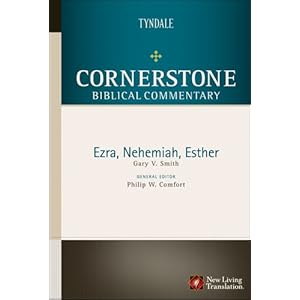
Review of CBC Ezra-Nehemiah, Esther

Commentaries come in all different styles.  There is the more technical variety, like the NIGTC.  Then there is also the more pastoral commentaries, like the Pillar Commentary series.  Finally, there are those that tend to be more devotional. 

Gary V. Smith’s commentary on Ezra-Nehemiah and Esther, which I received from Tyndale to review, falls into the latter.  It is based off of the New Living Translation and it’s goal is to: “…provide students, pastors, and laypeople with up-to-date, evangelical scholarship on the Old and New Testaments.”

It would have been much easier to have review this commentary if I were preaching through Ezra-Nehemiah and Esther.  That is typically when I get the most use out of a commentary.  However, I did spend some time perusing and interacting with the commentary. 

The format of this commentary is very easy to follow.  Each section provides the biblical text (NLT), a short section of notes, and then an overall commentary on the textual unit.  The notes are similar to what you would find at the bottom of a study Bible.  The commentary is typically short and succinct and provides a helpful summary and a few points of application. 

Is it helpful?

That is probably the most important question to ask of a commentary.  To answer this question of the Cornerstone Biblical Commentary series it depends on who is reading it and for what purpose. 

If a pastor is really trying to wrestle with a text and discover all the nuances, and discussion surrounding a passage this probably is not the best commentary.  However, if a pastor is looking to get a “feel” for the text then this commentary would be very helpful. 

I think this commentary would be MOST helpful to a Sunday school teacher.  It goes into just enough depth to get a good grasp on the meaning but not so much that you have to be bogged down by technical arguments.  The notes will support the teacher in writing a lesson, or adding meat to the pre-packaged variety.  The commentary will provide a few application points to really place the text into our every day lives. 

If you are looking for something technical this is not it.  But for a basic, yet deeper, understanding of the Scriptures this series (and this particular volume) will assist you in your studies.  You can buy it for only 22.79

Tuesday, July 27, 2010

Review of Let the Reader Understand by McCartney and Clayton

Author: Dan McCartney and Charles Clayton

Pages: 378pgs

Publisher: P & R Publishing

Price: 11.55

Genre: Biblical Interpretation/Hermeneutics

Quick Summary:

This book looks like it may be written as an introduction to hermeneutics, but I am not certain that it actually is written as such. The first chunk of the book is dedicated to the foundation of hermeneutics: presuppositions. Then the history of interpretation and the grammatical historical method is explored. Finally on page 180 the actual practice of interpreting the Bible is explained.

This is the second edition and it has been updated to “address postmodern approaches”.

What I Liked:

This book is a somewhat difficult read, especially for an introduction. However, it is also a very helpful read. I would not suggest it for those new to hermeneutics but it’s a pretty solid resource for those already familiar with the discipline. The section on presuppositions is worth the price of the book. This book was required reading for my Hermeneutics course in seminary and it was one of the more enjoyable books that I read for that class—but it is a pretty difficult read.

God really used this book to open up my eyes to the importance of reading each Scripture in light of its literary genre. It also helped me to understand certain presuppositions that I take into reading a text and how to not allow those to dictate the meaning of the text. This was a really helpful resource for me.

What I Disliked:

It’s plugged on the back as a “readable introduction to biblical interpretation”. It is readable but I’m not so sure it is easily understandable. There are some pretty serious technical discussions as well as sections that require heavy thinking. I’m just not sure this is really a good introductory book.

Should You Buy It?

If you have to look up the term “hermeneutics” then probably not; at least not now. If you are familiar with that term and certain nuances of language, and you are familiar with some of the technical aspects to hermeneutics then this book is definitely for you. It really is a solid resource for the serious student of biblical interpretation. I really want to encourage everyone to eventually read this book, but maybe not to start here. If you are new to the discussion of Hermeneutics then perhaps start with Goldworthy’s According to Plan, Fee's New Testament Exegesis , or even Virkler's Hermeneutics . Get yourself familiar with the topic and then tackle this book—it will be well worth the effort.  Buy it for 11.55.

Rating: 3.2 out of 5 stars

Wednesday, June 30, 2010

40 Questions on Biblical Interpretation

One of my favorite professors so far has been Dr. Robert Plummer.  Few people could make an 8:00 Greek class exciting.  Dr. Plummer is one of those few people.  He has a noticeable passion for Jesus and teaches in a humble and edifying way.  So even though I have yet to read this book I wholeheartedly recommend Dr. Plummer’s new book: 40 Questions About Interpreting the Bible

Dr. Plummer was recently on Dr. Mohler’s radio show, it’s worth a listen

Saturday, June 26, 2010

Don’t Drown in Biblical Illiteracy, Get on the Arc

An amazing resource for any serious Bible student is Biblearc.com.  If you are unfamiliar with arcing then head over to bible arc and check it out.  I will warn you, arcing is a huge brain strain, but the payoff is wonderful. 

A new part of Bible Arc is Arc Blogs.  I would highly recommend learning how to arc (for the full experience you should pay 10 bucks and join) and then journeying through these Arc Blogs.  It will assist your Bible study and really help to make the Bible come alive. 

For more on this check out the DG annoucement.  Or watch this video:

LinkWithin

Related Posts Plugin for WordPress, Blogger...