Showing posts with label biblical interpretation. Show all posts

Friday, August 9, 2013

Why Is It Always Revelation(s) That They Want to Study?

So, this unchurched guy comes in my office and tells me that he has started reading the Bible. I’m excited but I almost know what he’s going to say next.

I pause and wait for him to articulate what I know is coming…

The silence is broken. And my assumption is correct. He has chosen to begin his study in Revelations. (It is of course mandatory that you call it Revelations instead of Revelation when you pick this as your first book).

And I sit and wonder why anyone would begin with arguably the most difficult book in the entire canon of Scripture to begin his study. I assume Hollywood, coupled with our fixation on the world blowing up, is largely to blame. Yet I wonder if there isn’t another, not so obvious reason, why folks choose difficult Old Testament passages or Revelation to begin their study. Perhaps a hidden Jesus is safer and more attractive.

Deal With Jesus Directly

So, I counseled this confused looking fella as I normally do. I told him to stop his reading in Revelation and take up the Gospel of Mark. That probably sounds like I’m saying that Mark is better than Revelation and that I’m encouraging people to be red-letter Christians only. Not the case.

Let’s be honest and confess that this dude is doing everything backwards anyways. It shouldn’t just be him and Jesus alone in a room with an open Bible. He needs the church. He needs to study God’s Word alongside of God’s people. That’s ideal.

But he’s likely to insist on continuing as a lone ranger; and this largely because He hasn’t yet been reconciled to God and henceforth other believers. So if he must study the Bible on his own I want him to deal with Jesus directly. Not through shadows. Not through allegory. Just the bare Jesus of the Gospels.

Let him deal with Christ and be haunted by the Nazarene. Let him figure out how Mary’s son can calm a raging sea with the word of His mouth. Cause him to be confronted with the screams of the crowd saying, “Crucify him”. And leave him with the centurion’s confession, “Truly this man was the Son of God”.

He must be confronted and transformed by this Jesus. Then maybe he’ll get his tail in church and gather with other believers where we can start working through the Old Testament and Revelation.

Monday, June 10, 2013

Do We Need to Wait for the Spirit?

Let’s imagine that you are attempting to do an in-depth study on the book of Acts. Today you are going to tackle Acts 1:1-5. You find yourself studying and applying Acts 1:4;

And while staying with them he ordered them not to depart from Jerusalem, but to wait for the promise of the Father… –Acts 1:4

Clearly from this text we see that Jesus’ charge to his disciples—prior to his ascension and after his resurrection—was to stay in Jerusalem and wait for the Spirit before they took the gospel to the ends of the earth. So how do you apply this passage? What does this mean for the church of the 21st century?

The most obvious lesson for us to learn is that it is vital for us to wait on the Holy Spirit before doing things. The disciples needed the Spirit’s power before they were able to complete the mission of proclaiming the gospel in Jerusalem, Judea, Samaria, and to the ends of the earth. We too would be fool-hearted to launch into mission without the Spirit’s powerful presence.

The Problem

The biggest difficulty with the above interpretation is that what Luke has written here is meant to be descriptive and not prescriptive. He’s telling his readers what happened, not what his readers ought to do in response. In fact if you keep reading through Acts you will discover that the apostles did receive the Holy Spirit at Pentecost. And what is even more astounding is that when Gentiles become followers of Jesus they too receive the gift of the Spirit.

This means that the condition which Jesus mentioned in Acts 1:4 has already been fulfilled—always and forever. Therefore, believers do not need to sit around and wait for the “Spirit to come” before they engage in mission. He already has come.

The way, then, that we apply Acts 1:4 is to realize that the Spirit is vital to our mission. But we do not stop there. We celebrate the fact that Jesus has kept His promise and we have the indwelling Spirit. We have the Spirit that is needed to engage in the mission of Christ.

This isn’t permission to launch into out own missions, doing so upon a whim. This is permission to boldly engage in Christ-exalting mission because we know the Spirit is always present when Christ is exalted.

A Lesson

This little illustration shows why it is important to always read a text in its context; not only it’s immediate context but also read a text within it’s place in God’s unfolding story or redemption. If we fail to do this we will apply passages wrongly. We will find ourselves praying for things that God has already provided.

You and I don’t need to “wait on the Spirit” in the same way that the early apostles did. So let’s get busy.

Tuesday, May 14, 2013

Jews Didn’t Have Coffee Mugs

Okay I cannot prove that the ancient Hebrews did not have coffee mugs. But I do know that if they did they would not put Bible verses on them the same way that we do.

If I paint Philippians 4:13 in eye black and go out and play a tremendous game of church league softball, you know the statement that I’m making. I’m saying “I can do all things [like kick your tail in softball] through him who strengthens me.” End quote.

That is not the case with the way that the New Testament writers would quote the Old Testament. When Jesus says from the Cross, “My God, my God, why have you forsaken me” He is reciting a Psalm and calling to mind that entire Psalm. In the same way when Paul quotes Habakkuk 2:4 and says, “the righteous shall live by faith” he is thinking of the entire argument of Habakkuk.

This should revolutionize the way that we study our Bibles. When you read something in the New Testament (or even in the Old Testament) that has an allusion to a prior passage these guys aren’t just proof texting; they are proof-storying. They are thinking of the entire context of the passage that they are quoting.

What this means for Bible study (and for sermon prep for us preachers) is that when we discover a passage that has an earlier allusion we had better go back and pick up the entire argument of the passage cited. We do that because this is what the inspired author (say Paul) is doing when he is quoting it. He’s not just reminding us of that sweet passage on our coffee mug, he’s telling us a story.

Example:

The best example of this is probably Jesus’ use of Psalm 22 from the cross. Psalm 22 was a lament for the innocent sufferer. It perfectly fits Jesus’ situation. When He cries out “My God, my God, why have you forsaken me?” He is thinking of the entire Psalm. A Psalm which actually points to the vindication of the sufferer.

Does this mean that Jesus was not forsaken by the Father? Not necessarily. Or does this mean that Jesus does not feel the full weight of an innocent one enduring suffering? Absolutely not. If anyone could rightly cry out Psalm 22 it is Jesus. And he feels the full weight of every sentence. But we should remember that it’s not only the cry of dereliction (v1) that Jesus feels, but also the notes of hope that resound throughout the passage.

Jesus will be vindicated. He knows this. While he might feel abandoned—and the full weight of abandonment—He is also trusting in the God who vindicates the innocent. He knows the end of the story.

When he cries out Psalm 22:1 he isn’t doing that because he remembered that verse in AWANA and feels like that verse fits. Nor is Matthew putting it on his lips because he thinks it fulfills verse 1 of Psalm 22. Jesus is crying Psalm 22:1 (and Matthew frames his 27th chapter around that Psalm) because he is telling the story of the entire Psalm.

Lesson:

When you see a verse quoted don’t assume that they quoted verses the same way that we do. Consider the entire context of the Old Testament passage that is quoted. And pack all of that into the one verse that they are quoting. When someone that lived in the age of Jesus quoted a verse they were thinking of the entire passage and it’s argument. We should do the same.

Sunday, March 10, 2013

One Reason Why Movie Theaters Are Packed But Your Bible Study Isn’t

Why do people who pile into movie theaters on a Friday evening complain that the Bible is boring on a Sunday morning?  One reason, and I stress ONE reason, is that we have not rightly been convinced that the Bible is a compelling story. 

If our view of Scripture is akin to Basic Instructions Before Leaving Earth then I doubt very seriously that we will be compelled to open its pages.  At least not until something goes wrong.

I’m one of those guys that attempts a project without the instruction manual. Key word in that sentence is “attempts”. I typically read them after the project is “finished” and I’m holding an extra part in my hand. Or I consult a week or so later when the whole thing topples in on itself because that extra piece really wasn’t an extra piece.

If we view the Bible like an instruction manual then we won’t pick it up until we have significant trouble in our lives. And even then it likely will be misread; rather than seeing Christ you’ll see “answers”. In fact any answer will often do. Occasionally, we consult this instruction book just to reassure ourselves that we are doing just fine in our project. Then we go back to building our piece of junk and don’t consult the manual again until the wheels fall off.

Do you realize how hard it is to convince people to find Life in the Scriptures when this is our view?  Or to convince them to attend your Bible study? It’s like trying to convince people that if they want to really enjoy food they should become acquainted with their refrigerator’s manual of operation.  That’s just silly. 

What if instead we started viewing it as a compelling story told by the Creator of the universe or as a drama that is acted out and then explained by God about God?  (I’m indebted to Michael Lawrence for that thought). 

I’m convinced that a good number of people piling into movie theaters on a Friday night are doing so because they are looking for story.  Not everyone mind you.  But story is powerful.  And we have the most compelling story ever told—the story that all stories comes from—but we’ve decided to sell it as an instruction booklet. 

So, please…Let’s stop it!

--

Originally posted here.

Sunday, February 17, 2013

7 Ways to Interpret the Bible Like a Pharisee

I made this list awhile back and hoped to return to it. Over a year later here I am. Here are 7 ways that the Pharisees seemed to interpret the Bible.

1. Make the text about something other than Jesus. In John 5:39 Jesus accused the Pharisees of searching the Scriptures to find eternal life but failing to see Jesus in them. Reading the Old Testament (or the New) to find something other than Jesus is to misread their intention.  

2. Force the text to fit into your pre-made theological mold. In Mark 2:18-28 Jesus faces the hot button issues of his contemporary Judaism; namely, fasting and the Sabbath. They had a pre-conceived idea of who the Messiah was going to be. They expected him to fit their mold. By using an illustration of new wine and old wineskins Jesus teaches them that He doesn’t fit into a pre-made mold. He must speak for Himself. The same is true of the inspired Scriptures.

3. Do not bother to consider whether your implications and applications have an organic relationship with the text.  In Matthew 7 the Pharisees are bent out of shape because the disciples were eating with “defiled” hands. This Mark tells us was because they were following the tradition of the elders. They are trying to convict Jesus of breaking the Mosaic Law but he isn’t. He’s breaking their implications and applications of the Mosaic Law. Application which obviously did not have an organic relationship with the text. Our implications and application of the Scripture ought to have an organic relationship to the meaning of the text.

4. Exalt the literal (wooden) over the literary (story). You see this one whenever the Pharisees laugh at Jesus saying he is going to tear down the temple. And when Nicodemus scoffs at a man entering into the womb a second time. Both of these were Old Testament themes that should have been picked up if they were reading it like a story. But instead they continued to read things in a literal and wooden fashion. Not that we don’t take the Scriptures literally. Nor should we engage in some sort of wild allegorical interpretation. But the overall story ought to drive our literal reading.

5. By all means bypass the heart. This is perhaps the most common critique of the Pharisees. In Jesus’ woes against the Pharisees in Matthew 23 center on the heart. It is clear that when the Pharisees read the Scriptures they were looking for an outward way of living and did not address the heart. Jesus helps us to see that what really matters is the heart. And our hearts are far more wicked than the religious might outwardly display. To get to the heart will show our desperate need for Christ in every sphere of life.

6. Get caught up in speculation, making the Bible about answering your questions. The fact that the Pharisees had lengthy books arguing about things so tedious that it’d make those how-many-angels-dancing-on-a-pin guys chuckle a bit. We see this even in the gospel accounts when they frequently come up to Jesus asking questions about speculation.

7. Read yourself wrongly into the text.  Example: Rather than seeing yourself like Cain, interpret the text as if you are Abel. You can see this evidenced in the Pharisee and the tax collector. The Pharisee is the winner. When he reads himself into a text he’s the hero. They are the guys that wouldn’t have shed the blood of the prophets (Mt. 23) yet they are partially responsible for slaying the son of God.

Now, that’s how the Pharisees did it. Do you see yourself in their interpretive methods? I know I can see myself there. Let us search the Scriptures with the hopes that they’ll point us to Christ and stir up our hearts to worship. Above all may we be more concerned with being mastered by the Word Himself instead of our own mastery of the word of God.

Monday, February 4, 2013

The End of Biblical Theology

About five years ago I was introduced to the discipline known as biblical theology. It is a way of reading the Scriptures as a narrative whole. Biblical theology seems to be the “in” thing right now. I am glad about that. I also appreciate statements like this:

One would hope that when biblical theology is grasped as a way of thinking about the God of the Bible, which in turn generates a way of reading the Bible, ‘biblical-theological’ Old Testament preaching will not so much ‘tell the gospel story’ as ‘tell the gospel-shaped God’. The proper end of biblical theology is not narrative but theology.

Those are words from Andrew G. Shead in his book A Mouth Full of Fire: The Word of God in the Words of Jeremiah. It is an interesting book that I intend to review on Friday.

What are your thoughts on Shead’s statement? Is the “proper end of biblical theology” not a narrative but theology?

Tuesday, January 1, 2013

Why I Use the ESV

It’s the New Year. People are beginning Bible reading plans afresh. In order to get motivated for a new start, some people like to buy new Bibles and/or use new translations for their Bible reading plan. If that is you allow me to suggest you use the ESV in 2013. (This also serves as an answer to the frequent question I get; which Bible should I use).

When I explain to people why I believe the ESV is the most helpful English translation I use a little illustration. If I had this chart hand I would use it too:

I say if the NASB (New American Standard Bible) had a child with the NIV (New International Version) and the kid was more like it’s dad than it’s mom it would be the ESV. What I mean by this is that it takes the best of the father (word-for-word faithfulness) but is less wooden and reads more like it’s mother.

I love the NASB for it’s faithfulness to the biblical text. Seldom when I am really going in depth in a Bible study will I say, “I think the NASB is way off here”. But it doesn’t translate well. It’s more difficult to preach with and to memorize. In my opinion it is too wooden of a translation. It misses some of the idioms.

The NIV (and also the NLT) is very easy to preach and memorize. It makes for a much easier read. But there are quite a few times that I will shake my head at what the NIV did with a text. That is not to say that you cannot trust your NIV Bible if that is what you use. There isn’t anything that will make you think that Jesus’ name was Clem and the gospel message is a guide to following a comet into another world. It’s faithful—but not as faithful to the original word-for-word as I would prefer.

So, I like their child—the ESV. In my mind it takes the best of both worlds.

“What about the HCSB?” (Holman Christian Standard), my SBC friends with a suit will ask. I like the HCSB. And if I were going to share the same illustration I would say that if the NASB and the NIV had a baby and the child was more like it’s mother but still had prominent characteristics of the father it’d be the HCSB. At the end of the day I prefer the ESV because I’m not a fan of momma’s boys*.

So pick up a copy of an ESV. Or get their tremendous Study Bible and get to reading in 2013.

---

*I think I just sacrificed any shot at ever holding a position within the SBC by calling the HCSB a “momma’s boy”.

Tuesday, December 4, 2012

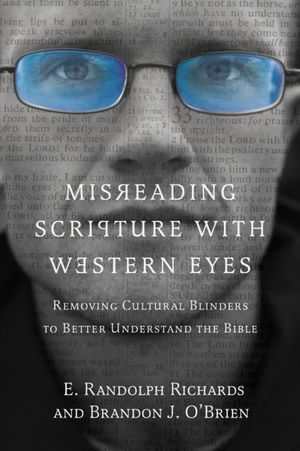
Review of Misreading Scripture with Western Eyes by Richards and O’Brien

Awhile back a fake news story made the rounds that went something like this:

A woman came home to find her husband in the kitchen, shaking frantically with what looked like a wire running from his waist towards the electric kettle. Intending to jolt him away from the deadly current she whacked him with a handy plank of wood by the back door, breaking his arm in two places. Until that moment he had been happily listening to his iPod.

Stories like this are believable because we have all had the experience of things turning out quite differently than how we first perceived them. According to E. Randolph Richards and Brandon J. O’Brien that same phenomena often plagues our bible study. They believe that “some of the habits that Western readers bring to the Bible can blind us to interpretations that the original audience and readers in other cultures see quite naturally”. (15)

This claim is not novel. Every book on biblical interpretation, worth any mention at all, will tell you that we must always be aware of our presuppositions. Richards and O’Brien have written a book, Misreading Scripture With Western Eyes, to expand upon this thought and to “offer readers an opportunity to identify and address our cultural blinders”. (15)

The book is divided into three sections. In the first section the authors look at three cultural issues that are obvious and above the surface: mores, race and ethnicity, and language. The next section looks just below the surface at the not so obvious western presuppositions: individualism and collectivism, honor/shame and right/wrong, and time. In the final section the authors probe the depths and look deep below the surface at presuppositions that most Westerners will not even recognize: rules and relationships, virtue and vice, and finding the center of God’s will.

O’Brien and Richards both have experience in cross-cultural missions. Their experience helped them to see the Bible with a new set of eyes. Each chapter ends with a few pointers from the authors on how to cultivate more cultural sensitivity in our Bible reading. Their goal is not to give a methodology or to give us the right process for reading the Bible; as “methodologies are the products of culture” as well. Their goal is to offer advice instead of a checklist.

My Take with a Concern

I thoroughly enjoyed reading this book. Even though I disagree with a few of their suggested interpretations I now find myself reading Scripture with more informed eyes. If nothing else this book has served to raise a red flag in my mind every time I think I have Scripture mastered. It reminds me to pause and consider whether my interpretation might be solely cultural.

Another thing that I appreciate about this book is that the authors are evangelicals. I have read books like this in the past that exalted presuppositions to such a spot that the reader was wondering if there was even such a thing as truth left. Truth is knowable. I further appreciate that the authors acknowledge that a Western reading of a text may not be wrong simply because it is Western, nor is one correct because it is Eastern.

There are a few statements in the book that left me scratching my head. In particular I had a difficult time with their chapter on honor/shame and their chapter on rules and relationships. I agree with their overarching point; that the world of the Bible is more concerned with honor/shame than right/wrong. But after reading that chapter I couldn’t help but think that perhaps this “new set of eyes” has caused them to make the pendulum swing too far the other way.

In the chapter on rules and relationships the authors seem to take a subtle shot at forensic justification. They acknowledge that “there is nothing wrong with the doctrine” but fear that it “casts our connection to God in terms of rules, not relationship". (173) They go on to give the example of Paul who “doesn’t seem to address the theology” of the Corinthians but instead the “status of their relationship”. In my opinion they are creating a false dichotomy here.

I disagree that Paul does not “seem to address [the Corinthian] theology”.

That seems to be precisely the point that he is making. Their relational issues are theological problems. Yes, Paul makes relational appeals. But he does so while teaching a robust theology centered on the foolish gospel. Richards and O’Brien ask “does relationship ever trump theology” (173). The answer to that question seems to be “what theology” are we talking about? It was “theology” that caused John to say, “If anyone comes to you and does not bring this teaching [theology], do not receive him into your house or give him any greeting”. Rules and relationships aren’t contrary enemies. They are friends reconciled on the cross of Christ. Let’s not separate what God has joined together.

Having said that, this book will undoubtedly be one of my top 12 books of 2012. It has been a refreshing read. Apart from a few caveats I would recommend this book to anyone. I think it would strengthen their Bible reading. Some books like this could foster doubt in the novice Bible reader. Richards and O’Brien, thankfully, write in such a way to actually add confidence to the Word of God.

Should You Buy It?

I recommend it. Every serious Bible student would benefit from reading this book. Pastors ought to consider it’s claims as well. I believe such a book would greatly aid in sermon preparation. If nothing else perhaps it will humble us. There are questions to ponder at the end of each chapter which would make this an interesting book to read in a community of believers, perhaps while reading through a book of Scripture.

You can purchase it at Amazon for under $10.

Friday, November 2, 2012

Jared, What If My Legs Don’t Work To Get In the Tent?

On Wednesday I linked to what I consider a very helpful piece by Jared Wilson on the lame excuse of “I’m Not Much of a Reader”.  In his article he used this metaphor:

Imagine I showed you a tent across the yard. You can see a glow emanating from its zippered door. “Inside that tent,” I said, “is God himself. He has something to say to you. You just have to go inside the tent, and the God of the Universe will reveal the mystery of the ages to you.” And then imagine you were to say, “I’m not much of a walker. I prefer sitting to walking.”

One of our readers commented that the article seemed a little one sided, asking, “What if you really don't learn that way? What if the word doesn't come alive to you unless you are hearing it preached? What if you struggle with illiteracy or have a limited vocabulary?”

Those are very real struggles and I don’t think Jared is dismissing them.  The majority of Jared’s post is really dealing with “I don’t want to” more than “I can’t”.  But I think he also astutely cuts through some of the excuses that people make.  Often “I can’t” is code for “I don’t want to”. 

Extending the Metaphor

So I took a little liberty and added something to Jared’s metaphor.  Again, imagine that someone told you that “God Himself is inside that tent and will reveal the mystery of the ages to you”.  Unfortunately, though, you cannot walk.  It’s not that you prefer sitting to walking.  It’s that you legitimately cannot put one leg in front of the other and walk to that tent.  What then? 

Here is where I think Jared’s metaphor is so valuable; it helps to expose the truth behind those excuses.  If someone told you that the God of the Universe were in that tent across the street but you couldn’t walk there, I guarantee that if you really desired to get in that tent you’d use any means necessary to do it.  You would be calling up that 1-800 number on television and ordering yourself a Rascal.  You’d barrel roll if you had to.  You would even call somebody that you couldn’t stand and ask them for a ride.  You would do whatever it took to get in that tent. 

The question really is, “Do you want to get in that tent?”  You don’t have to repent because it is toil.  But repentance might be necessary if you’re using lame legs as an excuse to not get into that tent. 

Jared’s not saying that people need to be Bible scholars or even to read chapters per day.  He’s saying that if you really value the Lord you’ll do whatever it takes to get in the tent.  For some people “getting in the tent” might mean reading two verses and chewing on them all day.  For other people “getting in the tent” might be learning to master Philippians in the Greek language.  But for either person the goal isn’t to see how much of the Word you can master.  The goal is to get into the tent and have the Lord and His Word master you, no matter what it takes to get in there.  

Tuesday, October 30, 2012

3 Tips for Reading Scripture With Cultural Sensitivity

I am guessing that every student has experienced the unwelcome feeling of receiving a test and having no clue which answer to circle.  I remember one particular test that I took in high school that I simply used as an excuse to pay homage to AC/DC.   I didn’t know a single question—or even really look to see if I knew a single question—but I still managed to pull out a respectable F instead of an absolute zero. 

In his book, Misreading Scripture with Western Eyes, Randy Richards tells of his experience in Indonesia.  Richards tells how a number of students left questions unmarked.  When probed as to the reason that they did not even make a guess the students replied, “I didn’t know the answer”.  Richards wondered why they didn’t just circle something, that way they would at least have a 25% chance of getting it correct.  To this they responded, “What if I accidentally guessed the correct answer?  I would be implying that I knew the answer when I didn’t.  That would be lying!” 

Richards confesses that his “American pragmatism had been winning out over my Christian standard of honesty”.  He, and coauthor Brandon J. O’Brien, use this story to remind us of the benefit of looking at the world through a different set of eyes.  Without their eyes we might be ignorant of the blindness of our own.  There are undoubtedly, cultural mores that we simply assume. 

So, how can you read the Scripture with cultural sensitivity?  Richards and O’Brien suggest three things:

  1. Begin with yourself.  Pay attention to your instinctive interpretations.  Ask three questions of the text.  First, “Clearly, this passage is saying (or not saying) ______ is right/wrong.  Second, Is (that issue) really what is condemned?  Thirdly, Am I adding/removing some elements? 
  2. Look for clues in the text you’re reading.  For example in Luke 6:1-9 the Sabbath is mentioned six times.  Clearly that is the focus of the text not eating or healing. 
  3. Read the writing of Christians from different cultures and ages.  In other words read Scripture with a different set of eyes than your own. 

Just because something is read through Western eyes does not necessarily mean it is wrong. In the same way just because someone from a different culture adopts a different interpretation it does not mean that they are correct and we are wrong; either way seeing something with a new set of eyes enriches our own Bible study. 

I have benefited from the work of Richards and O’Brien and I believe you would too.  (I hope to give a full review of this book within the next couple of weeks) 

Monday, October 29, 2012

Where is Jesus in Judges 19?

I find myself reading through Judges 19 this morning and my heart absolutely breaking.  The story is one of the inhospitality and wickedness of the men of Gibeah.  Just as in the story of Sodom the men of the city desire to have sexual relations with a male visitor of the city.  Instead of allowing them to devour his guest, the Levite, the hospitable sojourner throws out the Levites concubine and “they knew her and abused her all night until the morning”.

The story ends with dead concubine grasping at the threshold of her masters door.  Actually, though her life ends there her story does not.  This Levite proceeded to take her body and cut it up into twelve pieces—one for each of the tribes of Israel.  This provoked a great civil war against the tribe of Benjamin. 

I cannot read this story without using a little imagination and thinking through the horrors of that night for this concubine.  Just days before she was in her father’s house enjoying his hospitality.  Now she endures the horrors of a world gone bad.  She is the victim of “everyone did what is right in his own eyes”. 

After reading through the story I had a chilling thought.  How would I preach this text?  Even more difficult of a question—how would I preach Christ from this text? 

Where is Jesus in Judges 19?

Nowhere.  And that is the problem. 

The book of Judges is a massive downward spiral of rebellion.  The books major theme is that “there is no king” and so “everyone did what was right in his own eyes”.  Even in Judges 19 we see the sojourner telling these “worthless men” to “violate” and “do with [my virgin daughter and this concubine] what seems good to you”.  Apparently, what seemed good to them was a night of rape and abuse. 

The purpose of Judges is to show how desperately the people needed a king.  Better still, the people  needed a righteous king that would lead people into true worship of Yahweh.  The immediate context of Judges 19 shows that the people have committed horrible religious apostasy.  This is reflected not only in this cruel case of rape but also in the lack of hospitality.  God created man to live in a loving community that reflected the Trinitarian unity.  This is the exact opposite of that.  Rather than experiencing the self-sacrificial love of the Trinity--what Tim Savage calls a “perpetual flow of boundless affection”--people in the book of Judges were self-centered and did what they figured would benefit themselves. 

Judges shows what happens when man is left to do what is right in his own eyes.  As the book of Judges closes the reader is left longing for this righteous king.  Where is the King?!?! 

We know through the rest of the Old Testament that the Israelites were eventually led by kings.  Some of them righteous and some of them worthless.  David was the best king that was a man after God’s own heart.  But even David had failures.  David was but a pale image of the glory that would be found in one of his sons; namely, King Jesus. 

Dominated by the Empty Chair

In his book, Reforming Marriage, Douglas Wilson makes the argument that the husband finds himself in “inescapable leadership”:

He cannot successfully refuse to lead. If he attempts to abdicate in some way, he may, through his rebellion, lead poorly. But no matter what he does, or where he goes, he does so as the head of his wife.

Some homes are “dominated by the empty chair at the table”.  In the same way Christ holds a position in the Scriptures of “inescapable leadership”.  Please do not read more into my point than I am attempting to make.  What I am saying is that everything in the Scriptures are about him.  When you see him present in the Gospels it is obviously about Jesus.  But even in places like Judges 19 the passage is dominated by the “empty chair”.*

The text screams out for rescue.  The dead concubine, with her hand grasping the threshold, cries out for rescue as well as justice.  That will not come through an earthly king.  Only when Christ the King comes will Judges 19 find an answer.  For he is ushering in a kingdom not only of perfect community (marked by hospitality) but also a kingdom that protects and cares for women instead of throwing them into the hands of worthless men. 

---

*I am not for one second attempting to say that Christ has some how abdicated his leadership and that he is as a deadbeat father or husband.  I am only using the power of the “empty chair” to show how even in his absence the Lord Jesus dominates the Scriptures.

Friday, October 19, 2012

In Defense of a Christ-Centered Hermeneutic OR A Reply to Dr. Eric Hankins

Yesterday, Dr. Eric Hankins wrote a piece for SBC Today concerning The Gospel Project (TGP) and Christ-centered homiletics.  Hankins, recently read the dissertation of Dr. Jason Allen.  Allen, is the new president of MBTS.  Hankins was intrigued because Allen’s dissertation was on contrasting human author-centered hermeneutics of Walter Kaiser with that of the Christ-centered homiletics of Edmund Clowney and Sidney Greidanus.  Hankins was actually surprised that Allen sided with Kaiser and “is calling into question the conventional wisdom of ‘Christ-centered’ hermeneutics”. The point of the article seems to be to question the hermeneutic behind TGP. 

It will be my argument that it is not The Gospel Project’s hermeneutic that Dr. Allen is critiquing.  At the end of the day he might.  I do not know.  But I am going to make the argument that the Christ-centered hermeneutics that Hankins critiques is nothing that I have been exposed to, nor is that which he critiques the Christ-centered hermeneutic that is present in TGP. 

I will readily admit that my exposure to Greidanus and Clowney is limited.  I am also fairly limited in my exposure to Kaiser.  Perhaps that is why what Hankins said seems nothing like the Christ-centered hermeneutic that I employ and it sounds nothing like that which I find in The Gospel Project.

The claims that are foreign

Hankins takes several jabs throughout this piece.  They seem to be directed towards the Reformed community.  Caught in the crossfire of these jabs are the writers and editors of The Gospel Project.  I will highlight a few of these jabs.

Hankins refers to those that “pry texts out of context to put in theological presuppositions”.  While I am certain that there are those out there and even those that employ a Reformed Christ-centered hermeneutic I have not been widely exposed to that.  In every class that I have taken and every book that I have read on this topic it is continuously drilled in us to keep the text in its context.  At Southern to accuse someone of eisegesis is like accusing someone with musical taste of being a Justin Bieber fan. 

Dr. Hankins then proceeds to say that such eisegesis will insure that “every text might preach Calvinism”.  That is simply a ridiculous claim.  Sadly, some Calvinists are guilty of this.  But that which I have been exposed to in Christ-centered homiletics and within the pages of TGP such a claim is insulting. 

Throughout the article it is implied that those that use such a hermeneutic are not concerned with taking seriously authorial intent.  At one point he even accuses of “ignoring authorial intent” and “allegorical manipulation”.  Again, everything that I have been exposed to make a huge deal out of the original authors intention.  Goldsworthy, Wellum, Schreiner, and a host of others within the movement abhor allegorical manipulation. 

Lastly, Hankins accuses Matt Chandler of saying that the story of David & Goliath “has nothing to say about faithful living”.  I watched the video three times and did not find Chandler saying that.  Or even implying that.  He is not saying that the Bible is NOT to be used to discern how to live.  What he is saying is that the Bible is not fundamentally a to be sued to discern how to live.  There is a difference between those two statements.  And that is Chandler’s point in the David & Goliath video. 

What Hankins critiques in this article is not the Christ-centered hermeneutic that I am familiar with.  Nor, do I believe that it is that which is employed by the writers and editors of The Gospel Project.  Might some of the writers have been influenced by Greidanus & Clowney?  Perhaps.  But by and large I see them being more influenced by Criswell, Spurgeon, Broadus, and others.  In fact I see the vision of The Gospel Project something similar to the methods employed by those like Dr. Stephen Wellum.

In Defense of a Christ-Centered Hermeneutic

Stephen Wellum argues for interpreting Scripture through three horizons.  The first is the textual horizon.  This is where the interpreter attempts to discover what the original author is seeking to communicate in their texts.  Authorial intent and meaning is the first horizon. 

The second horizon is that of the epochal horizon.  Here the interpreter attempts to read the text in light of where it is in redemptive-history.  This assumes that Scripture is a progressive revelation.  This is not seeing the Bible as made up of different plans or epochs but that there is a unity within Scripture and revelation unfolds in time.  The key here is to see intertextual relationships and to “read texts in light of what has preceded them in reference to God’s redemptive actions and plan”.   

The third, and final, horizon is that of the canonical horizon.  If we are to take serious what the Bible actually is (a unified story) then it demands that we view it in its canonical context.  Therefore, every text ought to be understood in relation to the entire Canon of Scripture.  Wellum argues that “to interpret a given text of Scripture in its linguistic-historical, literary, redemptive-historical, and canonical context”. 

The argument being made for those promoting Christ-centered hermeneutics is that in some form or fashion the central motif of Scripture is the activity of God in providing redemption through His gospel.  Regardless, of how specifically it is worded the argument of those promoting such a hermeneutic are saying that Christ is the center of the revealed Word and everything points to Him (and his redemption) in some form or fashion. 

Exodus 23:19

One commenter on Hankins’ article asked how in the world Exodus 23:19 could be applied to Christ.  I doubt that I would ever choose this as a single passage to preach on, but if for some strange reason I did, here is in sum how I would point it to Christ. 

First, we have to consider the original context (the textual horizon).  Moses’ original intention is quite simple.  Don’t boil a young goat in its mothers milk.  Why did he say that?  Some believe that it had to do with not participating in a Canaanite magical practice.  Others see that it’s a reversal of the created order.  As noted in the ESV Study Bible, “the young goat should drink its mother’s milk and gain life from it, not be cooked in it”.  So, simply put in the text Moses’ intention is to tell the Israelites not to do this particular thing because it inverts the created order. 

But that commandment doesn’t come from nowhere.  It’s found in the middle of a story… 

Secondly, we have to consider its epochal context.  This command is originally given to the Israelites.  We know from the Exodus accounts that the Lord is calling Israelite out from among the Egyptians and other peoples for the sake of blessing them but also as a means to proclaim Himself to the nations.  Part of this means that they must live different from the rest of the world.  So, if this is a Canaanite magical practice then they need to model the ways of YHWH and not the feeble Canaanite gods that really are no gods.  If this is because of an inversion of the created order (which I think it is) then the Israel is to be an accurate representation of the God that redeemed them.  The God that redeemed them out of Egypt is a God that values created order.  Children should be cared for and nurtured by their parents.  As image-bearers of a loving Father this was to be reflected in the redeemed  community. 

But the story doesn’t stop with Moses and the Israelites.  It points to something far greater…

Lastly, we consider its canonical context.  The Israelites were to be image-bearers.  Even down to reflecting God in the way that they boiled goats.  Everything they did in their community was to reflect the Lord.  But as we know from the Bible they did not do that.  We also know that all of humanity is called to be image-bearers.  And just like the Israelites we also fail to accurately reflect God.  We choose instead to worship and serve creation instead of the Creator.  We follow Adam’s suit, as did the Israelites, in spreading our own sinful and rebellious images to the nations. 

Thankfully, Christ came.  Christ is the true Israel.  Christ is the second Adam.  He does what Adam, Israel, and we could not do.  He accurately represents God.  He perfectly obeys the Lord.  Humanity likes to invert the created order.  If our hearts were pure that command would not need to be there.  But it is, because our hearts tend to love what we should hate and hate what we should love.  Christ came to overturn that.  Christ came to provide redemption. 

If I were preaching this sermon (again I doubt I would) then I would be more full in my explanation of what Christ has done.  I would also probably discuss how because of Christ we reflect Him differently in our community than we do in these specific Israelite community laws.  But I provide this here just so that you can see how using these three horizons you can preach a Christ-centered sermon from that text. 

Would Moses be ticked off about that and say, “That’s not what I meant in that text?”  I doubt it.  Because I was faithful to his original command.  I also placed it within its progressive story.  And lastly I showed how Christ fulfilled the command.  Moses wouldn’t be upset by that—he’d be astounded that the One that they were looking for accomplished every piece of the Law even down to reflecting God in the way goats are boiled. 

Monday, September 10, 2012

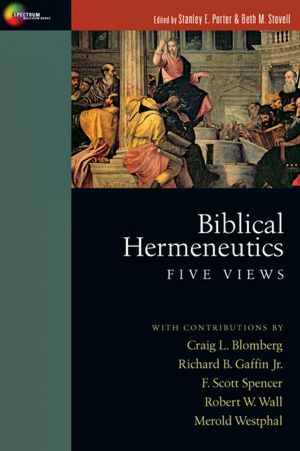
Quick Review of Biblical Hermeneutics: Five Views

“Hermeneutics” sounds like the training program that Ivan Drago endured in Rocky IV.  Though it at times seems a laborious as Drago’s training, hermeneutics actually has to do with interpretation.  The most basic definition of it is, “the science and art of textual interpretation”.  Though you may not be familiar with the word, every one has a hermeneutic.  Some might be sloppy.  Some might be erroneous and start from the wrong foundation.  And some might be helpful.  But everyone has a hermeneutic.

When we consider biblical hermeneutics the text that we are attempting to faithfully interpret is the Bible.  If given one text (especially one of the more difficult ones)and ten people, you are likely to come up with ten somewhat different interpretations or at least different applications.  Why is that?  The answer is hermeneutics. 

In Biblical Hermeneutics: Five Views, five different scholars explain their hermeneutical approach to the Scriptures.  Craig L. Blomberg defends what is known as the Historical-Critical/Grammatical approach.  This is the approach that most of our readers are probably most familiar with.  F. Scott Spencer defends the Literary/Postmodern approach, which as you can tell from it’s title is a somewhat newer approach.  Merold Westphal considers the Philosophical/Theological approach.  Richard B. Gaffin Jr. defends the Redemptive-Historical approach and Robert W. Wall helps the reader understand the Canonical approach to hermeneutics. 

The book begins with a helpful introduction from the editors: Stanley Porter and Beth Stovell.  The introduction considers the trajectories in biblical hermeneutics.  It also offers questions that need to be answered when attempting to outline your own hermeneutic. 

This offering in the Spectrum series is formatted a little differently than the others.  Typically an author will present his view and then those from the other views will then critique his/her viewpoint.  In this book each author defends his view.  Then in the second part of the book he responds/critiques the other views. 

The book closes with Porter and Stovell offering a synthesis of the five views.  This is a theme that seems to resound throughout the book.  As other reviewers have noted this book is not quite the same as other Spectrum books.  Though each having a different emphasis and maybe a different starting point these views are not for the most part true alternatives.  As Porter and Stovell show in the conclusion there is a way to synthesize and use each of these methods to have a faithful hermeneutic.

My Take

One of the most helpful things about this book is that each scholar is given the task of applying his method to Matthew 2:13-15.  The reader is then able to see how the differing hermeneutical starting points yields differing interpretations and thus differing applications. 

I also appreciate that each of these perspectives can offer a little more insight into doing hermeneutics.  It might be helpful for really deeper study to consider a text from each of these perspectives. 

The book is probably most helpful for those already involved in the study of hermeneutics.  I probably would not even suggest it as an introductory book for a college course on hermeneutics.  But for advanced students that have spent a good amount of time in the field of hermeneutics it is an interesting read.  One can actually use information used in this book to understand how other scholars and biblical interpreters give some of the interpretations that they do. 

It would be an interesting read for all, though quite laborious for those not already introduced to the world of hermeneutical discussions.  Serious students of hermeneutics will need to consider this book.  Those that are merely dabbling in the field would benefit but may benefit more from more introductory level books.

You can buy it here

Tuesday, March 20, 2012

Luther on Wrongly Reading the New Testament

“It has become a deplorable custom that the Gospels and the Epistles are treated like law books, in which one is to learn what we are to do, and in which the works of Christ are presented as nothing but an example held before one’s eyes.  Wherever this errant opinion remains within the heart, there neither gospel nor epistle can be read usefully and in a Christian way; such readers remain nothing but heathen,  as before.”

Luther rightly sees that all of the imperatives (do this!) are grounded in the indicatives (Christ did this).  Reading the New Testament any other way is to read it sub-Christianly. 

------

On a lighter note, if you are looking for a great way to insult friends consider the Luther Insult Generator

Wednesday, March 7, 2012

Review of How to Read the Bible Through the Jesus Lens

Part of God’s calling on my life is to teach students how to read the Bible.  Occasionally, I will have some students that desire to learn how to do Bible studies, write sermons, and do other types of ministry.  Inevitably, in both these endeavors I find myself consistently telling them to make sure that Jesus is the hero of every text.  That is a question I ask of my own preaching and one that I hope to instill in the lives of students that God has entrusted me with. 

One of the difficult things in this endeavor is to have a Christ-focus in various Old Testament passages.  It can be rather difficult for the beginning Bible reader to discover how exactly Christ is found in Leviticus, the conquest of Canaan or other passages.  Even in some New Testament passages it can be easy to apply the imperatives (do this) without first putting on the Jesus lens (indicatives). 

Michael Williams’ new book, “How to Read the Bible through the Jesus Lens” is written to help beginning Bible readers learn how to use a Jesus lens in reading all of the Scriptures.  The book covers all 66 books of the Bible in four pages each.  Every section has a short summary of the book with a helpful statement of the books major theme.  A memory passage is also highlighted as well as a few “hook questions” to give each chapter staying power.  Williams also applies the Jesus lens to the books major theme and then dives into a few contemporary implications. 

What you are getting with this book is a brief, popular level (though not shallow), introduction to the Bible.  This book is written for beginning Bible students with the hopes of “avoiding the dry, data-intensive introduction to the Bible” that most introductions fall into.  Here you will get a simple and concise theme for each book and then be shown how the books overall thrust can be read with a Jesus lens. 

I figured one of the best places to give the book a trial run would be the book of Job.  Here Williams views the theme of the book as being the truth that “God is active in areas and realms beyond our understanding”.  In response to this theme, Williams encourages the reader to use the book of Job to “see God at work in our suffering”.  When we put on our Jesus lens we see that Christ gives us the “ultimate picture of the righteous sufferer as he accomplishes God’s saving purposes” (71). 

How To Use This?

With every book that I read and review I try to determine who would benefit from reading the book.  With this particular book I know that the audience will be those that are relatively new to reading the Bible (or perhaps those new to trying to reading it in a Christ-centered way).  As I went through this book I tried imagining one of my students that is newer to reading Scripture.  How would he use this book?  Would it be beneficial?  What disciplines would reading through this book cultivate in his walk with Christ? 

I picture a new believer opening up his Bible to Job.  The only Bible that he has is just a simple pew Bible with very little “helps” inside of it.  There is no introduction to his copy of Job, but he did just pick up a copy of this Jesus Lens book.  Before he begins reading Job he reads through this book.  He learns here that the book of Job is about suffering—and suffering that doesn’t seem to make sense.  From the beginning pages he knows that Job will be exhorting him to trust in God even when it seems really dark.  He will find—through picking up his Jesus lens—that Christ is not only a model for enduring suffering but is the one by whom we are able to endure suffering and the one in whom suffering is ultimately conquered. 

My Take

Part of me really likes this idea.  I am in absolute agreement that we should read the Bible “through a Jesus lens”.  I also welcome a simple and easy to read introduction to not only this practice but also to books of the Bible.  I love being able to hand someone a quick reference that will help them see how to apply a “Jesus lens” to the book of Job, or Nehemiah, or any other book in the Bible.  So, part of me loves this idea.

The other part of me is…something.  I’m really not certain what word to call it.  Disappointed?  That’s too strong.  Cynical?  Yes, but that probably doesn’t apply here.  Whatever word you want to call it I question whether this book will actually accomplish what it intends to do.  I do not think it is myopic (that means narrow focused) to read everything through a Jesus lens.  But what I do think might be myopic is applying the Jesus lens only to the books major theme. 

Job has more gospel in it than simply that “God is active in areas and realms beyond our understanding”.  There is more to it than that Christ is the ultimate righteous sufferer and that He is in the business of making all things right even when we do not see His hand.  I agree with all of this theologically, and I even agree that these truths you can find in Job.  But what about what we can learn through Job about Christ-centered counseling?  What about the truth that Christ is the instrument by which God’s proclamations in Job 38-41?  There is so much more that a Jesus lens enlightens than could be covered in four pages. 

So again I’m…still can’t find the word.  I love the idea.  I love the practice.  I even like the simplicity of this book.  I just wonder if the fact that each book is only given four pages will be training readers to be a tad too myopic in their reading of Scripture.  Does it really train them to read through a Jesus lens or does it train them to read the Bible through a meta-narrative?  Both are crucial, but they are different.

Should You Buy It?

If you have been reading the Bible for years and already practice reading the Bible through a Jesus lens you may not find a ton of help here.  It’s not really written for you.  But you could buy it and give it to a new believer.  Even with my reservations I do heartily recommend this book for new Bible readers.  Do not attempt to make this book a stand alone or even the definitive book on teaching someone “how to read the Bible through the Jesus lens”. 

You can buy the book here.  And you really should.  Williams is a really good writer and he packs some in depth stuff into a really short section.  He does it, though, in a way that is not “heady” but it is written on a popular and very helpful level.  You will benefit from the book. 

---

I received this book free from Zondervan in exchange for a review.  This review is also part of a Blog Tour that you can check out here.  Read the other reviews because other reviewers focused on other books of Scripture. 

Thursday, September 1, 2011

7 Questions with Rob Plummer: Author of 40 Questions About Interpreting the Bible

Yesterday I reviewed Dr. Plummer’s book.  In the review I noted that “Hermeneutics (biblical interpretation) should be accessible to everyone.”  I also noted that Plummer’s book is both “satisfying and accessible” to student and layperson alike.  If you aren’t convinced yet that you ought to purchase this book, Dr. Plummer’s first answer should convince you. 

1. How is this book different from other books that deal with biblical interpretation?

Each book has a $100 bill hidden inside it.  Readers should be sure to order one right away.  But seriously, the book deals concisely with all the major questions related to interpreting the Bible - canon, text transmission, inerrancy, the goal of interpretation, Christo-centric interpretation, interpreting various genres of Scripture, current trends in hermeneutics, etc.  I discuss each issue in a brief "bite size" chunk of five to ten pages.  Also, reflection questions conclude each chapter.  And, many additional free resources (powerpoint files, quiz questions, etc.) are available at www.robplummer.com

2. What was the most difficult aspect of writing this book?

Making the text both scholarly and accessible.  I wanted it to be used as a seminary textbook but also understandable to any curious layperson.

3. What is the most frequent mistake that people make in biblical interpretation?

Failing to respect the inspired author's intent.  In his day, Calvin spoke of misinterpreters of Scripture as persons who put a "wax nose" on Scripture and turned it whatever way they wished.  In our day, people continue to do the same.

4. In your opinion what is the most dangerous trend in biblical interpretation?

Within the Theological Interpretation of Scripture (TIS) movement, some interpreters openly embrace meaning which is not flowing from the inspired author's intent. Of course, TIS is quite diverse, so others aligned with this movement are doing good work.

5. Imagine that I am a high school student on a bus with you. I find out that you teach a class on Biblical Interpretation. With only about 3 minutes before I have to get off the bus, I ask “how do I understand the Bible?” How do you respond?

With only three minutes, I think I would want to challenge that high school student to read the Scriptures because it is there that God speaks to us.  I would likely tell the story of how my mom taught me to read through the Bible once a year when I was 13 years old and the huge difference it has made in every area of my life.  I might turn to Psalm 119 and read some portions.  Then, for more practical questions of interpretation, I likely would refer them to my book.

6. I know that bad exegesis is never funny, but pretend for a second that it is. What is the funniest…or should I say…worst experience that you have had with bad exegesis?

Ah . . . there are so many stories.  I once asked a prominent minister what he was going to preach on the next day.  He told me that he had all the jokes and stories worked out, but that he just had to add the other content. I laughed because I thought he was kidding.  But, the next day when I heard him "preach" on the passage, it was mainly a string of random jokes and anecdotes.  A.T. Robertson once said, "I've heard sermons that if the text had had a cold, the sermon would certainly not have caught it."  I can relate.

7. Since I am in your New Testament 1 class I have to ask…who is your favorite student in New Testament 1? Okay, you don’t have to answer that. Serious question—If your opponents weren’t “with the Lord” who would win in a wheel-barrow race on the seminary lawn--A.T. Robertson and E.Y. Mullins or Rob Plummer and Albert Mohler?

I'm definitely betting on the Mohler-Plummer team.  (that is, if Southern Baptist are allowed to bet)

Thanks to Dr. Plummer for agreeing to do this interview. 

In response to question seven: I know that Dr. Plummer is a runner, but Dr. Mohler is not known for his athletic prowess.  Furthermore, E.Y. Mullins had a pretty solid beard and we all know that beards give superpowers.  So, I’m thinking this race may be a close one.  If Southern Baptist’s bet I might take Dr. Plummer up on this one. 

Again be sure to check out Dr. Plummer’s website: robplummer.com 

Also if you do not have it yet you can purchase the book here: 40 Questions About Interpreting the Bible.

Wednesday, August 31, 2011

Review of 40 Questions About Interpreting the Bible

My Bible is in English”, said my infuriated listener. 
The week prior I had preached one of my first sermons; it was on the birth of Jesus, and in this sermon I had mentioned that our typical manger scene is probably not quite accurate.  I had, apparently, ruined this dear ladies image of Christmas.  The pastor informed me that I had “stirred up a hornet’s nest”. 

In my youthful vigor and ignorance I assumed that I could simply explain to her the context of the passage, the Greek terms (which I didn’t know well myself), and a few historical facts and she would understand and not want to punch me in the kidney. 

I quickly discovered that I had indeed entered into a hornet’s nest.  She did not want a lesson on biblical interpretation.  She wanted to know why this young whippersnapper was blowing up her Christmas. 

In all honesty her methods of biblical interpretation was atrocious.  My pride was worse.  I would have done everything a million times different now.  I would have been less concerned with showing off my fancy book learnin’ and more concerned about loving her and gently teaching biblical truth. 

She didn’t want a hermeneutics lesson.  She needed one.  (And so do I).  But she didn’t want one.   In fact one of the great needs in the church today is a better understanding of hermeneutics. 

Unfortunately, many believe that hermeneutics is something you catch on a mission trip to a third world country.  That is because many of those that teach hermeneutics often insist on using technical terms that relates more to academia than those cracking open their Bible’s within the church.  As a result sound hermeneutics are often relegated to the halls of academia and the average lay-person is left to sift through his Bible on his own.  This only widens the gap between "preacher” and “pew”. 

Summary

Hermeneutics (biblical interpretation) should be accessible to everyone.  This is what motivates Dr. Robert Plummer’s latest book 40 Questions on Biblical Interpretation.  As Plummer states in the introduction, “my goal [is] to be accessible without being simplistic and scholarly without being pedantic”. 

Through these 40 questions Plummer discusses issues of canon and criticism, as well as issues of interpretation and meaning.  About sixty percent of the book is given to interpreting various literary genres: parables, prophecy, letters, poetry, etc,.  The final five questions provide a brief interaction with interpretive issues in recent discussion. 

Each question is given about 6-10 pages for a brief yet thorough answer.  At the end of each chapter the reader will find helpful reflection questions and also a few books and resources for further study.  The reader, then, is not left with only six pages but also questions to provoke thought and helpful resources to assist with continued study of the topic at hand. 

Analysis

I have had Dr. Plummer for three classes now and I have enjoyed everyone of them.  Few professors could make at 8:00am Greek class exciting—Dr. Plummer does.  His obvious passion for Jesus and desire for edifying the church bleeds through in these pages.  Occasionally the reader will even catch glimpses of Plummer’s humor and wit.  (Who else has a New Testament professor that quotes Spinal Tap?) 

In the past when people have asked me for a book on helping them study the Bible better I have scrambled to find one.  I know there are really solid books on hermeneutics but they are typically so bogged down with technical language and scholarly discussion that they remain unhelpful to the person not familiar with the jargon and ongoing debates within academia.  Then there are also those books that are written on a popular level but really do not provide as solid of help in biblical interpretation.  Now that Dr. Plummer has written this book I know of at least one resource that I can hand them. 

He deals with many of the questions that people in the pew are asking; but he does not stop there, he also deals with questions students will face.  Plummer manages to deal with both types of questions in such a way as to be both satisfying and accessible. 

If you have questions about biblical interpretation, or you want to hone your skills in interpreting God’s Word, you will find this book helpful.  For twelve bucks you cannot find a better resource.  Furthermore, Dr. Plummer is making many resources available for free on his website: here.  This book would be ideal for a small group, Sunday school class, or even a resource to assist your children in learning sound bible study methods (especially with these free resources). 

As a pastor I recently taught a series on biblical interpretation on Sunday evenings.  I found myself time and time again going back to Dr. Plummer’s work.  You will use this book as a great reference.  Add it to your library

Monday, June 20, 2011

Michael Scott and the Reading of Scripture

This is one of my favorite quotes from The Office (sorry for the quality):

Do you ever feel this way after reading Scripture? 

Sometimes the word feels like somebody “took my heart, and dropped it into a bucket of boiling tears”.  Then I turn to another Scripture and it feels like it “is hitting my soul in the crotch with a frozen sledgehammer”.   Then my third reading in Scripture “starts punching me in the grief bone”. 

Conviction hurts.  And the Holy Spirit is fond of using the Word to bring conviction.  Indeed “the word of God is living and active, sharper than any two-edged sword…all are naked and exposed to the eyes of him to whom we must give an account”. 

Though that is on occasion my experience I am convinced that it may NOT be the right way for a believer to read the Scriptures.  Yes, Scripture brings conviction; but it is never meant to stop there.  If my reading of Scripture feels like a frozen sledgehammer to the crotch then chances are I am not applying Jesus. 

Consider what Paul says in Romans 15,

“For whatever was written in former days was written for our instruction, that through endurance and through the encouragement of the Scriptures we might have hope”. 

God’s Word is not meant to merely punch us in the grief bone.  The Scriptures are meant to give us hope because they are meant to point us to Jesus—who is Himself our Hope. 

Monday, December 27, 2010

The Necessity of Personal Wrestling

It is no secret that Bible-knowledge within the church is at an alarmingly low rate.  The obvious reason is that people are simply not reading their Bibles.  But what is ironic is that while Bible knowledge is decreasing Christian book sales are actually rising.

You would think that people’s Bible knowledge would be increasing if they are reading Christian books.  But it is not.  Perhaps, because many of the “Christian” books that they are reading are not grounded in Scripture but more self-help and worldly philosophy.  That is probably one of the main reasons. 

But I think there is another reason.  And it is one that pastors have to be certain not to foster, or be guilty of themselves.  What I am referring to is the danger of a second-hand faith.  Andrew Fuller saw the danger in this years ago when he said*:

“Truth learned only at second-hand will be to us what Saul’s armor was to David; we shall be at a loss how to use it in the day of trial.” 

This is why Fuller (and you can see the most any great expositor followed this pattern) soaked himself in the Scriptures before even consulting his commentaries.  Fuller knew the importance of owning the text himself.  He knew that he needed to wrestle with the text before he consulted “experts”. 

There are those in our day who would run with this and NEVER consult commentaries.  They face an equal danger of prideful self-sufficiency.  But there are also many that do not take up the text themselves and wrestle with it.  And hence, they are biblically ignorant, and they fight every day without the sword they have been given. 

So, read the Scriptures for yourself.  Wrestle with the text.  And THEN get some help in understanding…

-----

From (Paul Brewster; Andrew Fuller: Model Pastor-Theologian, p46)

Saturday, December 18, 2010

Matthew 25, James 2, and the Homeless

I have been thinking a little recently about the church’s response to homelessness.  Inevitably a couple of “pretty clear” passages come up when discussing this topic.  One is Matthew 25:31-40 the other is James 2:14-17.  These make it obvious, or so it is thought, that the church is not being faithful to the gospel unless it is feeding the poor, clothing the naked, giving clean water to the thirsty.  But is that really what these texts are saying?

Consider Matthew 25:31-40:

[31] “When the Son of Man comes in his glory, and all the angels with him, then he will sit on his glorious throne. [32] Before him will be gathered all the nations, and he will separate people one from another as a shepherd separates the sheep from the goats. [33] And he will place the sheep on his right, but the goats on the left. [34] Then the King will say to those on his right, ‘Come, you who are blessed by my Father, inherit the kingdom prepared for you from the foundation of the world. [35] For I was hungry and you gave me food, I was thirsty and you gave me drink, I was a stranger and you welcomed me, [36] I was naked and you clothed me, I was sick and you visited me, I was in prison and you came to me.’ [37] Then the righteous will answer him, saying, ‘Lord, when did we see you hungry and feed you, or thirsty and give you drink? [38] And when did we see you a stranger and welcome you, or naked and clothe you? [39] And when did we see you sick or in prison and visit you?’ [40] And the King will answer them, ‘Truly, I say to you, as you did it to one of the least of these my brothers, you did it to me.’
(Matthew 25:31-40 ESV)

There you have it.  If I do not give food, water, and clothes, to my fellow man then it’s just like I rejected Jesus.  I can firmly place myself on the side of the unbelieving community.  But if you notice in verse 40 Jesus says, “one of the least of these my brothers”.  This is talking about how we respond to the needs of believers.  This is not a blanket statement that you can put over all of humanity that says, “if you don’t give money or your home to a homeless guy then you don’t know Jesus”, or its less bold variations. 

Now Consider James 2:14-17:

    [14] What good is it, my brothers, if someone says he has faith but does not have works? Can that faith save him? [15] If a brother or sister is poorly clothed and lacking in daily food, [16] and one of you says to them, “Go in peace, be warmed and filled,” without giving them the things needed for the body, what good is that? [17] So also faith by itself, if it does not have works, is dead. (James 2:14-17 ESV)

This verse is often thought to be saying that if you see somebody that is in need but you don’t meet that need then it is obvious that your faith is dead.  But is that really what this text is saying.  The key word here is, “So also” in verse 17.  This is an analogy.  A well-wish without action is not really a well-wish.  Just like faith without action is dead.  That is what this text is saying.  It may very well be that we can use this analogy and say that if we really want to care for the homeless of the world we will feed them and not simply pray for them.  But this is NOT giving an example of dead faith. 

So, as we continue to look at how we minister to the homeless and broken in our world let’s not do it with a faulty interpretation of these two verses…

LinkWithin

Related Posts Plugin for WordPress, Blogger...