Showing posts with label evangelism. Show all posts

Monday, July 22, 2013

Knock, Knock. Who’s There?

I’ve decided to ask a few people to write occasional articles for me to use at Borrowed Light. Nick Horton is one of those fine souls to agree to do this. He blogs at http://nicholashorton.wordpress.com/and you can follow him on Twitter @NickHorton

I walked towards the first door of the evening. My heart was beating a touch faster. My mouth was dry. I worried about what they would say. How would they take it? Would they shut the door in my face? Turn me down cold? Argue with me? I thought through what I was going to say. Prayed a quick prayer and then…

*knock knock knock*

The door opened. A young woman peered out at us, a bit suspiciously, it seemed.

“Hi, I’m Nick, we’re from First Baptist Church, right over there.” I turned and gestured toward the church, mostly visible a hundred yards away. “Do you have a few minutes to talk? We’re trying to get to know our neighbors.”

“Ok,” she said.

So began my first experience with door-to-door evangelism. Pastor decided we needed to get out of the church building and reach our neighborhood, and beyond that, our city. He was right. Often we retreat within the walls of the church as though it is some fort, a bastion against the world. Us versus them. Is this how it should be?

Christianity lives and dies on the sharing of news. “Gospel” means good news. We have the good news of Jesus Christ’s substitutionary sacrifice for sinners, and His resurrection and offer of eternal life for the same. We have the best news in the world! We have the very words of life; news that applies to everyone without exception.

Yet, we don’t often share it. Why?

Christ commanded that we go and make disciples. Can that happen without sharing the gospel? Paul said in Romans 10:14-15; “How then will they call on him in whom they have not believed? And how are they to believe in him of whom they have never heard? And how are they to hear without someone preaching? 15 And how are they to preach unless they are sent?” Indeed, how will they believe in Him whom they have not heard, if we don’t tell them?

There are many reasons we don’t share the good news. Lets lay our cards on the table and name just a few:

  1. Unbelief. This is really the root of many others. Somewhere in us there is unbelief in the promises of God, His truth, or perhaps His goodness. We are being disobedient. Evangelism is not only for the gifted. Christ made no such distinction in the great commission.
  2. Fear of man. I had this as I walked up to the first door, and still do. We’re afraid of what people will say, that we will be rejected. Perhaps we’re worried they won’t approve of us. Our focus, then, is on our performance. We’re worried we won’t do it right. We’re worried something we say will keep them from Christ. This is selfishness because it’s not about us. Yet, our fears and worries betray our self-centeredness. God draws sinners, not us. (John 6:44) This is not about how awesome we are, how many bible verses we know, or whether we’re the next Billy Graham. This is about God saving sinners using a message communicated by sinners.
  3. Laziness. There are many distractions in life. Technology, TV, movies. Endless gadgets and things to do. It’s not that you can’t ever do those things, but when will you make time to share the gospel? Which master holds sway over your heart?

There will likely never be a time when there isn’t some sense of nervousness, inadequacy, unbelief, rebellion, laziness, fear, or any other number of feelings seeking to derail sharing your faith. The very faith you share is the only thing God has given you to share. Meaning, armed only with our faith in God, we share His gospel.

This is by design. God has removed our performance from His success, which is incredibly freeing. Consider; all you are to do is release the word and leave the results to God. He is faithful. After all, we’re not seeking to win people to us. We’re seeking to win them to Christ.

One day a lady criticized D. L. Moody for his methods of evangelism in attempting to win people to the Lord. Moody’s reply was "I agree with you. I don’t like the way I do it either. Tell me, how do you do it?" The lady replied, "I don’t do it." Moody retorted, "Then I like my way of doing it better than your way of not doing it."

Monday, June 10, 2013

Do We Need to Wait for the Spirit?

Let’s imagine that you are attempting to do an in-depth study on the book of Acts. Today you are going to tackle Acts 1:1-5. You find yourself studying and applying Acts 1:4;

And while staying with them he ordered them not to depart from Jerusalem, but to wait for the promise of the Father… –Acts 1:4

Clearly from this text we see that Jesus’ charge to his disciples—prior to his ascension and after his resurrection—was to stay in Jerusalem and wait for the Spirit before they took the gospel to the ends of the earth. So how do you apply this passage? What does this mean for the church of the 21st century?

The most obvious lesson for us to learn is that it is vital for us to wait on the Holy Spirit before doing things. The disciples needed the Spirit’s power before they were able to complete the mission of proclaiming the gospel in Jerusalem, Judea, Samaria, and to the ends of the earth. We too would be fool-hearted to launch into mission without the Spirit’s powerful presence.

The Problem

The biggest difficulty with the above interpretation is that what Luke has written here is meant to be descriptive and not prescriptive. He’s telling his readers what happened, not what his readers ought to do in response. In fact if you keep reading through Acts you will discover that the apostles did receive the Holy Spirit at Pentecost. And what is even more astounding is that when Gentiles become followers of Jesus they too receive the gift of the Spirit.

This means that the condition which Jesus mentioned in Acts 1:4 has already been fulfilled—always and forever. Therefore, believers do not need to sit around and wait for the “Spirit to come” before they engage in mission. He already has come.

The way, then, that we apply Acts 1:4 is to realize that the Spirit is vital to our mission. But we do not stop there. We celebrate the fact that Jesus has kept His promise and we have the indwelling Spirit. We have the Spirit that is needed to engage in the mission of Christ.

This isn’t permission to launch into out own missions, doing so upon a whim. This is permission to boldly engage in Christ-exalting mission because we know the Spirit is always present when Christ is exalted.

A Lesson

This little illustration shows why it is important to always read a text in its context; not only it’s immediate context but also read a text within it’s place in God’s unfolding story or redemption. If we fail to do this we will apply passages wrongly. We will find ourselves praying for things that God has already provided.

You and I don’t need to “wait on the Spirit” in the same way that the early apostles did. So let’s get busy.

Thursday, June 6, 2013

An Open Letter to @LifeWay

Dearest LifeWay,

I want to begin by saying that I am very pleased with LifeWay. Southern Baptists are blessed to be served by such a great organization. For the most part I believe that you are successful in your mission to be “the best provider of relevant, high quality, high value Christian products and services.”

I am writing you today to discuss one area of curriculum that I believe is lacking; namely, the gospel presentation for VBS. For as long as I can remember LifeWay has used the ABC’s as a gospel presentation. And every year there is a song encouraging kids to admit, believe, and confess.

As the parent of a little boy (5) and little girl (2) I deeply appreciate the simplicity of this gospel presentation. Such a gospel presentation is helpful for my son. The Lord is working on His little heart, and he largely understands the gospel message, but at times he is tripped up on the “what must I do to be saved” part. The ABC’s answer that question.

The ABC’s are a fair and biblical response to the question, “Brothers, what must I do to be saved”. For those asking this question it is helpful for them to even have a memorable song that lays out for them how someone becomes a Christian.

However, I believe the ABC’s by themselves are an inadequate whole gospel presentation. I understand that the "admitting” and “believing” attempts to help children see that they are sinners and that belief in Jesus is necessary. I appreciate this, but it seems forced and minimalistic.

When I share the gospel with children I front load it with gospel proclamation (i.e. God-Man-Christ or Creation-Fall-Redemption). I want children to know who God is, what He requires of us, what sin is and its consequences, and how Christ frees us from sin and restores us to God. That is the good news of the gospel. Admit, believe, and confess is not the gospel. It is the only fitting response to the gospel but is not the gospel itself.  When people understand the gospel and are then asking “what do I do to be saved” that is when I would share with them something like the ABC’s.

It seems that about every year the ABC’s lesson is during the middle of the week. It is assumed that in the material the gospel story will be presented throughout the week in the teaching segments. That is good. However, it reads as if everything is driving towards the response. This should be done. But only if the gospel message has been emphasized.

As it stands, only one part of the gospel—our necessary response—is presented as the gospel. When children and teachers think about the gospel message in VBS they naturally think of the ABC’s. That is what stands out in the VBS material. In my opinion that is backwards. Explaining to people the necessary response to the gospel isn’t the gospel and doesn’t have the promises of gospel power (Romans 1:16) attached to it.

My suggestion is that instead of emphasizing the ABC’s as presentation emphasize the gospel story and train leaders how to use the ABC’s to answer the response question. In other words transfer a Gospel Project method to your VBS literature.

I look forward to seeing how God continues to use LifeWay material for the furtherance of His kingdom.

In-Christ,

Mike Leake

--

A good chunk of this letter is a tweak from this article.

Thursday, May 9, 2013

How to Defend Your Faith Against Secularism

I’ve got a handful of young men that I have the opportunity to disciple. They are on the frontlines in their school. Every day they are sandwiched between cultural Catholicism and the godless presuppositions of secularism. I’m grateful that the Lord is working in the hearts of these young men. Recently they came to my office and asked if I could help them defend their faith.

How I’m going about doing this might seem counterintuitive. My philosophy comes from Charles Spurgeon:
“Defend the Bible? Would you defend a lion? Loose him; and let him go!”…The way to meet infidelity is to spread the Bible. The answer to every objection against the Bible is the Bible.
Rather than focusing on a host of current issues and answers to tough questions my goal will be to teach these students the Scriptures. I want unleash the lion. If these young men are captivated by the God of the Bible then I don’t need to worry about sticky questions destroying their faith.

Furthermore, if the Scriptures really are the means that God uses to bring about conversion I can have confidence that these young men will be used by God to influence their fellow students. They don’t need to enter into endless arguments that are really no more than a smoke screen for the true issue of human rebellion. I want them to know that the chief problem for scoffers isn’t an intellectual problem but a moral one.

Sure we’ll address issues like evolution, human sexuality, and everything else. But these will not happen with the Bible on defense. This will happen with the Bible on offense—unleashed to shake up our lives and draw us to King Jesus. Then humble young men, captivated by Jesus, will be equipped to share the risen Christ in the face of aggressive secularism.

Friends, we don’t need to spend an inordinate amount of time defending the Bible. Let’s simply have the Scriptures do it’s work in our own hearts and keep digging until the Lord rips to shreds every last remnant of sin and unbelief. And while the Lord is doing this let us humbly engage a culture with the unleashed Lion of the Tribe of Judah that is powerful enough to draw any man or woman to Himself no matter how obstinate.

Saturday, May 4, 2013

Suggested Resources on Evangelism and Missions

Our church is beginning a series through Philippians on Advancing the Gospel. Ultimately we learn about evangelism and missions by actually doing evangelism and missions. It’s kind of like fishing—you can read all of the fishing books in the world but until you actually cast a line into the water you’ll never catch a fish. Evangelism is the same way—we can have all of the training in the world and if we never venture out in faith to share the wonders of Jesus, then we’ll never truly be fishers of men.

At the same time there is nothing wrong with being equipped. Here are the best books that I’ve found to equip and inspire believers to do evangelism/missions:

Inspire:

Let the Nations be Glad by John Piper

A Holy Ambition by John Piper

Radical by David Platt

Revival and Revivalism by Iain Murray

The Diary of David Brainerd

Memoirs and Remains of Robert M. McCheyne

Equip:

Tell the Truth by Will Metzger

Evangelism and the Sovereignty of God by JI Packer

The Gospel and Personal Evangelism by Mark Dever

The School of Biblical Evangelism by Comfort and Cameron

Evangelism Handbook by Alvin Reid

Speaking of Jesus by Mack Stiles


What would be on your list?

Monday, April 15, 2013

How Does a Teenager Share the Gospel with Her Unbelieving Parents?

One of the greatest joys (and at times pains) of working with teenagers is whenever students with unbelieving parents come to know Jesus. After only a short time of becoming followers of Jesus, these dear students begin aching for the lostness of their parents. And so they share the gospel with them.

And it gets really ugly.

The gospel is an offense. Period. But it’s perhaps even more of an offense when your arrogant 15 year old is telling her mom how wrong she is about life, the Bible, and her eternal soul. To her this new found “knowledge” doesn’t feel much different than her daughter trying to set her straight in a million other areas in life.

That’s when I get a teenager at my house at 12:30am because she’s convinced that her mom and dad aregoing to hell because they reject the gospel. My heart is grieved for this student. No matter how hard she tries she cannot get her mom to come to know Jesus. She wants to give eternal life to the one that gave her physical life. And so she weeps because mom and dad only gets angry with her when he shares the gospel.

So, how should a teenager share the gospel with her unbelieving parents?

If I am reading my Bible correctly faithful gospel proclamation includes both our life and our lips. It must be spoken (Romans 10) and it must be lived (1 Timothy 4). But that doesn’t have to mean that those two need to be totally balanced.

If you are on a mission trip to the Honduras and you will only see these people for about 10-15 minutes then it probably needs to look like this:

scales.mission

Your lifespan before these people is about as long as a moth in a refrigerator. It isn’t going to last very long. So while you can do little things in that 10-15 minutes to show the gospel, a larger portion of your time ought to be spent in speaking the gospel.

For a teenager it probably needs to look like this:

scales.teen2

That means that you share the gospel more with your life and slide the proclamation in there whenever you can. Joyously doing chores might do more for your parents seeing Christ than you sharing John 3:16. That’s not to demean a teenager sharing Jesus from John 3:16. That is necessary and it needs to be done. But for a teenager your changed life will speak far louder than your new found theological words.

So, how does a teenager share the gospel with her unbelieving parents?

Joyously take out the trash in Jesus’ name.

Friday, April 12, 2013

What to Say to “All-Religions-Are-Basically-the-Same” Dude

“All religions are basically the same” –Captain Humble and Peaceful

When some peace-loving dude “humbly” tells a believer that all religions are basically the same, the believer typically responds with wet pants. That claim scares many of us. It scares us for a couple of reasons. One, we don’t know all religions. This dude seems to have studied even Zoroastrianism. Secondly, this guy seems pretty sure of himself and he also seems like he really loves peace. I don’t want to be seen as some sort of arrogant, war-mongering, and hate-filled meanie pants.

So what do I do?

If I say, “no they aren’t” then I’m opening myself up to not only sound like a narrow-minded bigot, but an uninformed one to boot. After all, the most I know about Zoroastrianism is that Antonio Banderas played him in a movie. So how do I respond? Do I just nod my head and pray for the guy?

One of your fears can be calmed. You don’t have to know all religions to respond to this guy. You just have to know the one absolutely unique gospel. And when I say that I don’t mean the watered down hippie-Jesus version. I meant he God-becoming-man, who carried human sin to a Cross, and screamed over it “It is finished”!

Ask this confident chap share the gospel with you. Or ask him what the message of Christ is. Then, when he fumbles it—and he will fumble it, because no one who really knows the gospel will say that it’s like every other religion—then, you have an opportunity to share the unique claims of Jesus with him.

At this point when (if) you are accused of arrogance, you might lovingly point out his hypocrisy. After all isn’t it a tad arrogant to say that you’ve studied all religions, and you’ve gotten to the core of them, and have seen that they are all the same. Especially, when all these religions themselves proclaim, “No, we aren’t the same and that’s why we are fighting”. It’s just not be honest and frankly its demeaning because it is essentially calling every one with any religious spine at all a complete moron.

Your goal in sharing the gospel with this guy is to get him to actually have to deal with the unique claims of Jesus. Don’t let him hide behind the idea that Buddha, Mohammed, Zorro, Tom Cruise, Oprah, and Jesus all have the same claim on his life. Jesus makes a unique claim. Help this person understand that he either has to be willing to call Jesus a wrong-headed false teacher or surrender his life to Him. He can’t have it both ways and still have any shred of honesty.

Thursday, April 4, 2013

The Coolest Testimony Ever

Every testimony is “cool”. And it’s kind of silly to talk about the coolest testimony ever. But I do believe there is one testimony—one that is yet to happen—that will be the coolest testimony ever.

If I’m reading by Bible correctly, one of the reasons why Christ has yet to return is because not all of those that are going to be saved have been saved yet. I think we see this in part in Matthew 24:14 when Jesus says, “And this gospel of the kingdom will be proclaimed throughout the whole world as a testimony to all nations, and then the end will come.” The end cannot come until the gospel has been proclaimed to all peoples and people from every tribe, tongue, nation, and people have come to Jesus.

I also think this is what Peter is speaking of in 2 Peter 3:9

The Lord is not slow to fulfill his promise as some count slowness, but is patient toward you, not wishing that any should perish, but that all should reach repentance.

It seems to me from the context of 2 Peter that the reason why the Lord has not yet returned is because the Lord is patiently waiting for all that are going to come to repentance to actually come to repentance. If I’m right about this, then I’m picturing in my mind the coolest testimony ever.

--

After sharing the gospel with this woman you ask her if she wants to call upon the Lord in faith and repentance. She says, “yes”, prays a little Psalm 51. You rejoice with her and the next thing you know Jesus is sounding a trumpet, riding upon the clouds coming down to be with His bride forever.

That in my mind will be the coolest testimony ever. The very last one. The one in which we can say of the Great Commission, “It is finished”. I might be a little selfish but I kind of want to be the guy that leads that last person to the Lord. Now every time I share the gospel I’m going to start looking up into the clouds to see if he/she was the one. And if the Lord continues to tarry I’ll know that it’s time to get back to work—going, sharing, and making disciples.

Wednesday, February 27, 2013

One Reason Evangelism & Missions Are Difficult

When I first became a believer I heard a healthy dose of pleas for doing evangelism and missions. Often they came in the form of a skit of some sort that would show the hopeless chap that has not heard the gospel. At the end the speaker would say, “If only someone would take the gospel to them.”

I assumed that most people were not believers simply because they had never heard the gospel. Now don’t hear me wrongly. Those presentations are helpful. Lost people do need to have the gospel proclaimed to them. In fact that is the way that they will come to know Christ. We must take the gospel to lost people. That part is true. What those skits often failed to mention, though, is that a good number of people are not just waiting to hear the good news of Jesus.

Responding in Darkness

When you spend a few minutes in a really dark room your eyes adjust and you get accustomed to the darkness. When some joker throws on the lights…especially after a night of joyous sleep…your first instinct is to kick and scream. You want to tackle the guy that turned on the light. Darkness doesn’t appreciate a light switch being thrown on.

This is what Jesus said in John 3:19,

“And this is the judgment: the light has come into the world, and people loved the darkness rather than the light because their works were evil. For everyone who does wicked things hates the light and does not come to the light, lest his works should be exposed.

The natural response of darkened and depraved hearts is to kick and scream against the gospel. We do not like it’s exposure. We do not agree with its criticism of us. Nor do we agree with it’s entirely selfless solution. Therefore, we naturally want to kick the dude in the groin who throws on the lights.

This is why we should not be surprised that gospel advancement comes through suffering. People in darkness do not want you to turn the light on. No matter how much that darkness is destroying their humanity. Yet, being in the light is the one thing that they need in order to wake up and to actually enjoy eternal life.

Yet…

There are times when God says “let there be light” into a darkened heart. Only then are the scales removed. Only then is the light treasured. When that takes place their posture towards the messenger is changed. What might have started as a lunge toward us is transformed into the loving embrace of a brother or sister.

As the light of the world we are called to be faithful no matter the response. Whether we are met with a kick to the groin or a loving embrace it is our duty to flip on the switch. That’s hard. But it’s the most loving thing to do to awaken sleeping sinners.

Tuesday, January 8, 2013

Does Metro-Focused Missions Square with the Way Jesus Did Ministry?

“Cities are the centers of political power, economic activity, communications, scientific research, academic instruction, and moral and religious influence.  Whatever happens in cities affects entire nations.”  Cities are at the very center of where worldviews are created.  To neglect the cities would be to miss an incredible opportunity to be a redemptive voice in our world today.

That is a quote from missiologist Roger Greenway, with a little commentary from the staff of Kaleo. I agree that we should not neglect the cities. I appreciate the renewed emphasis on reaching the cities. There are many people there that are broken and in need of the gospel. It is imperative that we take the gospel to them. So in what I am about to say please do not think that I am in anyway anti-city missions. I am arguing for a both/and.

My problem is that those who say “do not neglect” the cities very quickly morph into saying, “we must focus on the cities”. Mark Driscoll argues that “cities are of greater strategic importance”. That’s a step up from saying, “don’t neglect the cities”. It’s almost saying “let’s funnel a majority of our resources and efforts towards the cities even if it means at times neglecting the rural areas”.

I understand the logic. There are more people in cities, cities affect entire nations, therefore to maximize our influence we ought to focus on the centers of “political power, economic activity, communications, scientific research, academic instruction, and moral and religious influence.” If we focus on these strategic centers then it will influence places like rural America too.

My Question

The logic of the metro-evangelicals* makes sense, but it leaves me with a question. Did Jesus do ministry this way? Did he focus on the seats of power and expend his energy on transforming the world by transforming the cities?

Jesus spent most of his time with three fishermen. He also spent time with a tax collector and a batch of other no-names. He did minister to the Pharisees and other religious leaders, but he spent more time with prostitutes and other “untouchables” from his culture. He spent even less time trying to win over Rome, which was the culture-shaper of His day. Jesus did ministry the exact opposite of focusing on the cultural transformers of His day.

Again, I’m not saying that the Lord Jesus does not call some people to strategically minister in the larger cities. I believe you can see this in part in the ministry of the apostle Paul. We need to be careful not to neglect the cities. But at the same time let us not pretend that ministering to the cultural elite with the hopes of a trickle-down effect is the biblical way to do ministry.

Arrogance?

In actuality it probably betrays a bit of arrogance to assume that the cities trickle “down” to the rural communities. Are we so confident that rural areas aren’t just as faithfully living out the kingdom of Christ? I know that few people would outright say that people not living in the cities are sub-standard believers/missionaries but such is often implied in some of the more recent material on doing ministry to the city. Why should we assume that more people would be won to Christ and the kingdom more faithfully ushered in if a cultural elite came to Christ than if a rural farmer gets excited about Jesus?

Let us not pretend that the rural communities have already been reached with the gospel. Furthermore, let us not assume that rural communities will eventually be won to Christ when the big-city cultural is won to Christ. There is a great disparity between the two cultures.

As scores of dollars and church planters flock to the cities I want to plead with some that we need focused ministry to both the rural communities and the big cities. We need the gospel to reach places that Starbucks won’t touch. It might be harder for some of us caffeine addicted young-uns to do ministry around a plate of grits instead of a cup of mocha, but the gospel demands that we go wherever lostness is found. I know ministering in the big city is sexier at this stage of missions but there are men and women that spend their day wading in cow manure that need the powerful gospel as well.

Will you consider giving your life to ministering in a community surrounded by cows instead of city lights?

---

*Keith Miller does a tremendous job of explaining the “Metro-Evangelicals” and then asks the question of whether or not they are right.

I also appreciate a recent article by Matthew Spandler-Davison who argues that “as long as there are people in rural communities not being reached by the gospel, we need to revitalize and plant healthy gospel-centered churches there.”

Tuesday, November 20, 2012

Gospel-Colored Katsak For Sale

Last Tuesday I posted a video and invited you to make an illustration using the video. Once again you responded in vast numbers. I have been sifting through these illustrations for an entire week and now today I will post mine. By “sifting through” I mean “waiting for”. Like a naughty boy on Christmas morning my stocking was empty. So, I figured that today I’d share my illustration:

Here is the video:

It is pretty obvious from this video that Mike Rowe is not sold on the glory of a Katsak. People probably still bought the things but only cat lovers and people addicted to QVC. I seriously doubt that anyone was won over by Mike Rowe’s selling of the Katsak. Rowe isn’t sold on the product and so he is unable to sell it.

As I listen to Rowe I can’t help but think about gospel proclamation. Not that the gospel is something that we have to “sell” like a Katsak. But I can’t help but wonder if our confidence in the gospel pales even in comparison to Rowe’s passion in the Katsak.

Thomas Boston once said, “If you believe the wicked shall be turned into hell, and all the nations that forget God, you can not speak to them as if you were telling a story”. I do not think that Boston is talking against storytelling. The Puritans were actually quite good at telling stories and applying the Scriptures to everyday life. What Boston is referring to is a blood-earnestness in our gospel proclamation. 

Rowe is basically saying, “Here is a katsak. I am going to do my best to convince you that it is something worth spending 25 bucks on. Personally, I think it is moronic but it is my job to convince you that it’s not. So look at all these amazing uses for a katsak…”

We had better be more convinced of the power of the gospel than that. We cannot afford to share the gospel like it’s “our job”. You don’t share good news like you sell a katsak. In fact, I very seriously doubt that you will share the news if you value it like Rowe does the katsak. Persecution will shut you up. But if it is truly good news and it has rocked your world then you share it in such a way that far more than QVC addicts are confronted with what you are proclaiming.

Rowe give evidence that convincing and passionate proclamation is not something that you can conjure up on your own. You have to really be convinced of its value. Do you value the gospel? Or is your proclamation similar to Mike Rowe trying to sell a katsak.

Monday, November 12, 2012

From Woe to Go

“Woe is me! For I am lost…”

I had a very embarrassing “date” one time. I went with a group of friends to a bowling alley. No, the fact that I went to a bowling alley wasn’t the embarrassing part. What shamed me was the presence of black lights.

When I left my dorm room I looked pretty fly in my black shirt and Levi’s. However, by the time that I got to the bowling alley and found myself under the hateful glare of those black lights I had somehow developed a horrible case of psoriasis, spilled bleach on my pants, and had a stain on my shirt that looked like Gary Coleman leg wrestling an ostrich.

Black lights have a way of exposing flaws that are hidden in regular lights. Every blemish on my clothes screamed out at the crowd to laugh at me. Now I know that only idiots wear black clothes to an event featuring a black light.

Isaiah the prophet had a similar experience (though intensely magnified) in Isaiah 6. Upon his vision of the “King, the LORD of hosts” Isaiah says “Woe is me! For I am lost”. Before this vision Isaiah probably felt himself to be a pretty good chap with a pretty wholesome tongue. But when he finds himself in the penetrating holiness of Yahweh his sinfulness and inadequacy to be in the presence of the Lord is glaringly obvious. Isaiah feels as if he is being ripped asunder. He cannot get low enough. It seems as if everything within him wants to hide but there is no place to go and so he does the only fitting thing—he pronounces a curse upon himself.

When a sinner, like Isaiah, has a true vision of the splendor and majesty of Yahweh his only one fitting response is brokenness and contrition at the ugliness of his sin.

Thankfully, for Isaiah and us, the story does not end there. The Lord in His grace touches Isaiah’s mouth and says, “Behold, this has touched your lips; your guilt is taken away, and your sin atoned for”. Isaiah is clean. Somehow this sinful prophet is able to now stand in the presence of Yahweh. Isaiah is not only confronted with God’s majesty and splendor and terrifying holiness. He is also confronted with God’s life-changing grace.

“Here am I! Send me”

One verse after Isaiah’s cleansing is his commissioning. Notice that in verse 5 when confronted by the Lord’s holiness Isaiah is groveling upon the floor trying to find some portal to escape. He is undone. He does not want to be seen. He wants to be come nothing, to be annihilated if that is possible.

Now notice Isaiah in verse 8. It seems as if he is like the kid in fourth grade that kept raising her hand saying, “pick me, pick me, pick me”! He wants to be noticed. He wants to be used. That is what grace does. It turns brokenness into bold missional fervor.

Yet, I wonder how many of us act as if we are still living in Isaiah 6:5, “woe is me”. There are at least two reasons why we would not have scores of people in our churches saying “here am I! send me”. One is that our God is not big enough. Missional fervor comes after brokenness before the Lord’s presence. It seems to me that God seldom uses people in mighty ways until people become utterly convinced that there is no way that God could possibly use someone as vile and dirty as them.

The second reason why people aren’t shouting out “Here am I! send me” is because we see sin where God sees grace. Some people are convinced that they are vile and dirty and there is no way that God can use them. And so they sit there saying “woe is me”. But if God has taken away your guilt and your sin has been atoned for, you had better not be saying “woe is me”. You aren’t vile and dirty and unable to be used by God. You are redeemed. Therefore, our only fitting response is “Here am I! Send me”. 

God’s powerful grace turns woe into go.

Tuesday, October 30, 2012

What If Toto IS in Kansas?

I am in the wonderful position of receiving a ton of free books from publishers in exchange for a review.  Lately I have read, or at least skimmed, a good number of books on missions in a “post-Christian” world.  Many of these books are written by guys that are ministering in a bigger city.  They are encouraging us to stop trying to do ministry as if we still live in a “Christian” world.  Just as Dorothy woke up in Oz and discovered that she wasn’t in Kansas anymore, so also churches need to wake up and realize “we aren’t in Kansas anymore”. 

That is really good advice.  Helpful.  Mostly…

Unless you actually do live in Kansas*.  If that is the case such advice is really not helpful because you are being taught how to do ministry for postmodern people living in New York City and not a dairy farmer mending fences.  “Stop doing ministry like you live in Kansas”, is bad advice to some guy that is actually living in Kansas. 

Honestly, this is why I have found many of the modern books on missiology mostly unhelpful.  Very rarely do they offer even a paradigm that I am able to grab and say, “yep, that’d work in my city…I mean town…I mean village”.  If I really want to make use of the ideas I have to do some serious work to adapt them.  Of course this is okay, but if I’m doing so much work perhaps I should cross their name off the front cover and pencil in my own. 

The best of these books will acknowledge that they are not intended to be cookie-cutter solutions but to give principles to apply to your own setting.  The very best of these books will go one step further and actually help you figure out principles to apply in your own setting.  (Ed Stetzer’s Breaking the Missional Code is helpful in this regard).  Unfortunately, a vast majority of them do not offer such encouragement. 

A Black and White Kansas or a Colored Oz

The town in which I minister is weird.  It is largely German Catholic.  Yet those numbers are diminishing.  This is brought on not only by the growing ecumenical Protestant influence but also the growing atheistic population.  Jasper is beginning to feel a little more like a city.  Yet, even still it is surrounded not by suburbs but farmland and other rural communities. 

Jasper, Indiana is not largely a post-Christian community.  It is mostly a culture inundated with what Christian Smith calls a moralistic therapeutic deism.  It is a sentimental, almost folkish, version of Christianity.  But for the most part people still have their address as “Kansas”.  In other words if I went knocking on every door in our neighborhood most people would self-identify as Catholic/Christian. 

Therefore, if our church began treating Jasper, IN like Seattle, WA we would miss the boat.  Seattle, WA is probably rightly labeled “post-Christian”.  The Jasper, Indiana’s of the world are not quite there yet.  (Certainly not the New London, Missouri’s where I ministered before).  This is not to deny that the lure of the city is not present.  The city influences television, music, and many other things that rural people devour on a daily basis.  We are not immune to the post-Christian world of the city.  Yet, we are not there yet nor can we begin ministering as if we are. 

Therein lies my main concern.  Many ministers are being told “you are doing it all wrong by thinking you still live in Kansas”.  They are told that they need to start ministering to the post-Christian world in which they live.  And indeed they need to be prepared for that and that ministry to the city needs to be in their repertoire.  But if they are still living in Kansas then they need to minister like they are in Kansas. 

Listen, if we devote our times to studying the human heart through doing battle with our own we’ll be equipped to exegete any culture.  If we devote our time to knowing the Christ that transcends all cultures we will learn to lovingly proclaim him to people of any culture.  This is not to say there is no value in really attempting to understand the perspective that our neighbors are coming from.  But isn’t that just being a good neighbor and a good listener? 

This may seem overly simplistic but I am increasingly convinced that if we simply concern ourselves with truly loving people and being enamored with Jesus we’ll be able to minister in the black and white world of Kansas and the technicolored world of Oz. 

--

*If you really do live in Kansas I’d offer my condolences. But I will not, because you’d never read them, since I doubt you have the internet yet. 

Monday, September 24, 2012

“I’m Happy With Small Numbers”

Here is an imagined response that sounds very similar to answers that I’ve heard when a pastor/church is asked about their lack of growth. 

“We’ve had 14 people in our church since 1993.  You know some people think that we aren’t faithfully proclaiming the gospel because we have not had a single convert since 1993.  But you know that isn’t true.  You should talk to any of our 14 members.  They’ve got some serious bible knowledge.  They are solid.  And that’s cool with us man because we aren’t about numbers, we want faithful disciples.  We do share the gospel with people but we’ve yet to see results.  Again, we’re okay with that because we aren’t the Lord of the harvest.  When God wants us to have more members He’ll get it done.  Until then we keep doing discipleship and preaching the gospel.” 

I Agree…

I agree with a good amount of what is said in that paragraph.  I agree that faithfulness is not marked by an ACP report.  You can have 4,000 people and be denying the gospel and have 7 people and be faithfully plodding along.  If I look at the ministry of Jesus from a numerical perspective he probably wouldn’t have gotten a plaque for his church office for being one of the top 50 churches in his state. 

I also believe that the Lord of the harvest determines the amount of fruit that we reap in our ministries.  It’s not because of our successful preaching, or witty plans, or even our uber-doctrinally faithful expositions of Scripture and gospel presentations that men and women come to Christ.  It’s because the Spirit infuses a Jesus-drenched gospel proclamation with resurrection power. 

However, I also believe with this imagined response that the Spirit doesn’t always attend gospel preaching with converts.  He might attend it with powerfully hardening sinners a la Isaiah the prophet. 

Furthermore, I agree that the work of ministry is also very much about discipleship.  I do not mock those 14 “really solid” believers.  In fact if these were found in a country in the 10/40 window they’d probably be more celebrated than if they were present in a small town in Georgia.  Wherever faithful disciples are found I rejoice.  Even if their evangelistic efforts are not met with an influx of new disciples. 

But

Theologically I’m in the same camp as the imaginary dude I quoted above.  But…

I think he’s missing something.  A lack of growth isn’t a badge to be worn around.  His “that’s cool with us” attitude seems to fly in the face of Jesus and the little-followed but very faithful prophets that he likes to quote.  I believe that theologically Jesus would agree with everything this chap is saying.  But his response wouldn’t be to say, “that’s cool with me”.  No, his response is different:

“O Jerusalem, Jerusalem, the city that kills the prophets and stones those who are sent to it! How often would I have gathered your children together as a hen gathers her brood under her wings, and you were not willing! See, your house is left to you desolate. (Matthew 23:37-38 ESV)

That’s lament. 

The same thing goes with Isaiah as well as Jeremiah the weeping prophet.  They, as did Jesus, knew that they would often not be received.  And they mourned. 

So enough of this happily patting ourselves on the back because we aren’t like those churches that are all focused on numbers.  Yeah it’s great that we can sleep at night and rest in the sovereignty of God.  It’s wonderful that we know that the results aren’t up to us and that we can measure ourselves by biblical fidelity instead of numbers.  That’s wonderful.  Seriously, it is.  I don’t know how I could do ministry if I didn’t believe that.  But let’s believe these things with tears in our eyes and with a longing that we might be faithful to the gospel AND see a myriad of sinners bow a knee to the beautiful Christ. 

A lack of people coming to Christ is a reason to lament.  And that’s the case even if you are being totally faithful and God in His sovereignty isn’t blessing you with fruit. 

Friday, September 21, 2012

What Destruction from the Almighty Looks Like

During the days of the prophet Joel the people of Judah and Jerusalem are being overtaken by a horrendous locusts plague.  It is as the Garden of Eden before them and “behind them a desolate wilderness”.  The prophet, through the inspiration of YHWH, uses this plight to ask a very probing question to the people of Judah.

If we can’t endure a plague of locusts what would happen if the Almighty was bent on destroying us?  Could we endure?  Who could stand under his fierce wrath?  As Joel says in 1:15, “and as destruction from the Almighty it comes”. 

The Hebrew word for destruction is shadad whereas the Hebrew word for the Almighty is El Shaddai.  When Shaddai become bent on shadad what will happen?  How destructive can El Shaddai be? 

Here is a faint picture of an answer to that question (Someone said there is some language in the film, I can’t hear it, but be cautious):

(HT: Challies)

In response to that video Tony Reinke shared this quote from Jonathan Edwards, “"The torrents of liquid fire that are vomited from the belly of hell, by the mouths of volcanoes, shadow forth what is in hell."

I imagine that if I saw a family member, a friend, a neighbor, or even some random dude on the street plummeting into that abyss I’d do everything in my power to stop him.  I’d beg and plead with him and as it were make sure that he had to trample me in order to throw himself in.  I doubt I’d unmovingly tell him cute stories and anecdotes.  And I’d like to think I wouldn’t stay silent.  Might I remember that very real sinners are plunging themselves into a very real hell that is more fierce than this.

If the Almighty can create something this fierce who can stand when he is bent on destruction? 

Only those who find refuge in the strong tower that El Shaddai has hoisted, namely the all-powerful Jesus, will find safety on that day. 

Wednesday, September 19, 2012

How a Subtle Dualism Robs the Church of Missionaries

D.A. Carson explains a dualistic view of suffering well when he says:

If evil and suffering take place, it is because someone or something else did it.  God not only did not do it, he could not stop it; for if he could have stopped it, and did not, then he is still party to it.

Most Christians would not outright deny God’s omnipotence and theologically resort to dualism.  Yet in the throes of suffering and evil many succumb to a subtle and comfortable dualism.  Every bad thing in your life and every ounce of suffering is attributed to Satan.  And if it’s his fault and his “plan” then the believer is not only correct in resisting but he is commanded to do so.

Therefore, suffering is never part of God’s will.  If given the choice between suffering and peace it becomes a no-brainer that God’s will is the path that is marked by peace and comfort.  Of course it is not quite that black and white.  For many at first we’ll say things like, “Satan’s trying to stop us from following the Lord’s will”, and so we’ll press on for awhile.  But when the suffering plods on and our hearts become ravaged by pain and we begin to give up hope, we begin to wonder if maybe all of this suffering is a sign that we ought to go a different direction.

Such a view will never stare the darkness of a lost world straight in the face and say, “I’ll go” even if the only means of taking the gospel to them is profound suffering.  This subtle dualism that seems to be pervasive here in America is robbing the Church of many missionaries.  May pastors prepare their people and new disciples to expect suffering.  Even to, at times, choose suffering for the cause of Christ.  And may we pastors also be people that will choose suffering instead of resorting to a comfortable dualism.

Here’s a powerful 10 minute message from John Piper:

Tuesday, September 18, 2012

The ABC’s Need a Story

If you have spent any time in Southern Baptist churches (and probably those of other denominations from our shared family tree) and especially VBS, you have undoubtedly heard the ABC’s of salvation.  With every VBS there is usually a little ditty that tells children how they can become followers of Jesus. 

Part of me deeply rejoices in the simplicity of this gospel presentation.  It can be very helpful when the Lord is working on the heart of someone, they understand the gospel for the most part, but they are kind of tripping up on the “what must I do to be saved” part. 

The ABC’s are a fair and biblical response to the question, “Brothers, what must I do to be saved”.  But, in my opinion, it is inadequate as a whole gospel presentation.  It attempts to explain through each of the letters why “admitting” is necessary and who we are “believing” in, which is good, but it seems really forced and minimalistic. 

When I share the gospel with people I try to front load it with the gospel proclamation (i.e. God-Man-Christ or Creation-Fall-Redemption).  In fact the gospel is not our response to the gospel.  Admit, believe, and confess is not the gospel.  It is the only fitting response to the gospel but is not the gospel itself.  When people understand the gospel and are then asking “what do I do to be saved” that is when I would share with them something like the ABC’s. 

I think it is assumed in much of this material that the gospel story will be presented in full throughout the week in the teaching segments.  And that is true.  However, what is emphasized is the response.  The ABC’s is what stands out as the gospel presentation in much of the VBS material. 

That’s backwards. 

Explaining to people the necessary response to the gospel isn’t the gospel and doesn’t have the promises of gospel power attached to it.  So instead of emphasizing the ABC’s as presentation emphasize the gospel story and train the leaders how to use the ABC’s to answer the response question. 

The ABC’s need the gospel story.

Monday, September 17, 2012

Churches Can’t Afford to Think It Is 1600’s England

I had an experience awhile back that was really uncomfortable.  This, I presume good-hearted, chap decided that I needed to accept Jesus as my Lord and Savior.  At this point I had been a believer in Christ for a good 5-6 years and was at this point a youth pastor.  That did not phase him.  He was convinced, through no words or actions of my own, that I must simply be one of those that professed Christ but did not really know him.

Have you ever tried to convince an “evangelist” that you really do know Jesus? 

It was tough.  And in fact a little frustrating.  I appreciate hearing the gospel and I wasn’t offended by him proclaiming it to me.  But what was disconcerting was when he remained undeterred and spent his evangelistic zeal on somebody (me) that really does know Jesus. 

This passionate man comes from an era much different than mine.  In the 50’s and 60’s in the Midwest and Southern US it was almost assumed that everybody went to church.  If you didn’t attend church you must massacre innocent kitties (if they exists) and sacrifice them at your Thursday evening bloodlettings and witch parties.  What kind of person must you be if you don’t attend church?  You must be the most vile, wicked, scum of the earth.  Good decent folk attend church even if they sleep through it. 

The same could be said of England throughout the Puritan era and for years after.  During one stretch of her history you could be fined and even imprisoned for not attending a Church of England service.  Though the laws were more lax by then, in 1782 John Newton would say of his parishioners:

I could wish to be useful to the people who by law are obliged to contribute to my support.  And I have still hopes that some of them will one day know what pertains to their peace.  But if they absent themselves from the church, their places are filled up by others.

Churches in this era were filled with lost people and people that were “mere professors”, just as in our day there are nominal Christians filling the rolls of many churches.  In such a context such sermons as An Alarm to the Unconverted would be expected.  In fact you wouldn’t be a faithful minister to have a host of unbelievers hearing your sermon and you never get around to passionately, faithfully, and evangelistically sharing the gospel with them.

When Church Isn’t Mandatory

Yet what does a church do whenever attendance is not mandatory?  Do you keep preaching evangelistically? 

One strategy is to continue preaching evangelistic messages while you encourage those within your church to bring their lost friends to hear the message.  Such a strategy, often called the attractional model, would require the church to be attractive to the lost world to draw them in to hear the gospel message.

That certainly is a strategy.  And in as much as these churches are faithful to the gospel message and sinners are saved I rejoice.  I’m thankfully that God uses humble servants to invite friends to church where faithful preachers explain the gospel clearly, the Spirit moves and works, and people are converted. 

Personally, I think there is a better option.  Use Sunday mornings to disciple members to “go get ‘em”.  Encourage, edify, and exhort those that are attending by choice to go and tell.  Then have them bring back more believers that can be equipped to live out the gospel and reach the lost. 

I am not in any way saying that a faithful pastor will not consider lost people on a Sunday morning.  You had better preach the gospel every Sunday.  One, because believers need to hear it every day.  Secondly, because God through his grace does bring people into a church building to hear a word from Him.  If they don’t know Christ that word from them is repent and believe in Christ.  The gospel had better be presented every time the church gathers.

Living like it’s 1642

Yet it seems that some ministers might be trying to preach sermons for a Christianized 1612 rather than a postmodern and unChristian 2012.  If you live in such a context a large portion of the people in your church are probably there because they are believers.  Yet, if you continue to pretend that it’s 1612 and the people are there because it is mandatory and they are just mere professors you will be starving sheep and not equipping them to reach the lost. 

In other words, we had better be discipling our people and not have a ministry of telling our choir they need to get saved every Sunday.  Tell them how the gospel rocks their life and empowers them to proclaim the gospel to those that need to come to Christ.  And I would just about bet that if the gospel truly informed our communities and people were faithfully discipled some of those mere professors would be so weirded-out by authentic Christianity that they’d either leave altogether or be jolted into knowing a real relationship with Jesus.

Preach to your congregation.

Wednesday, August 29, 2012

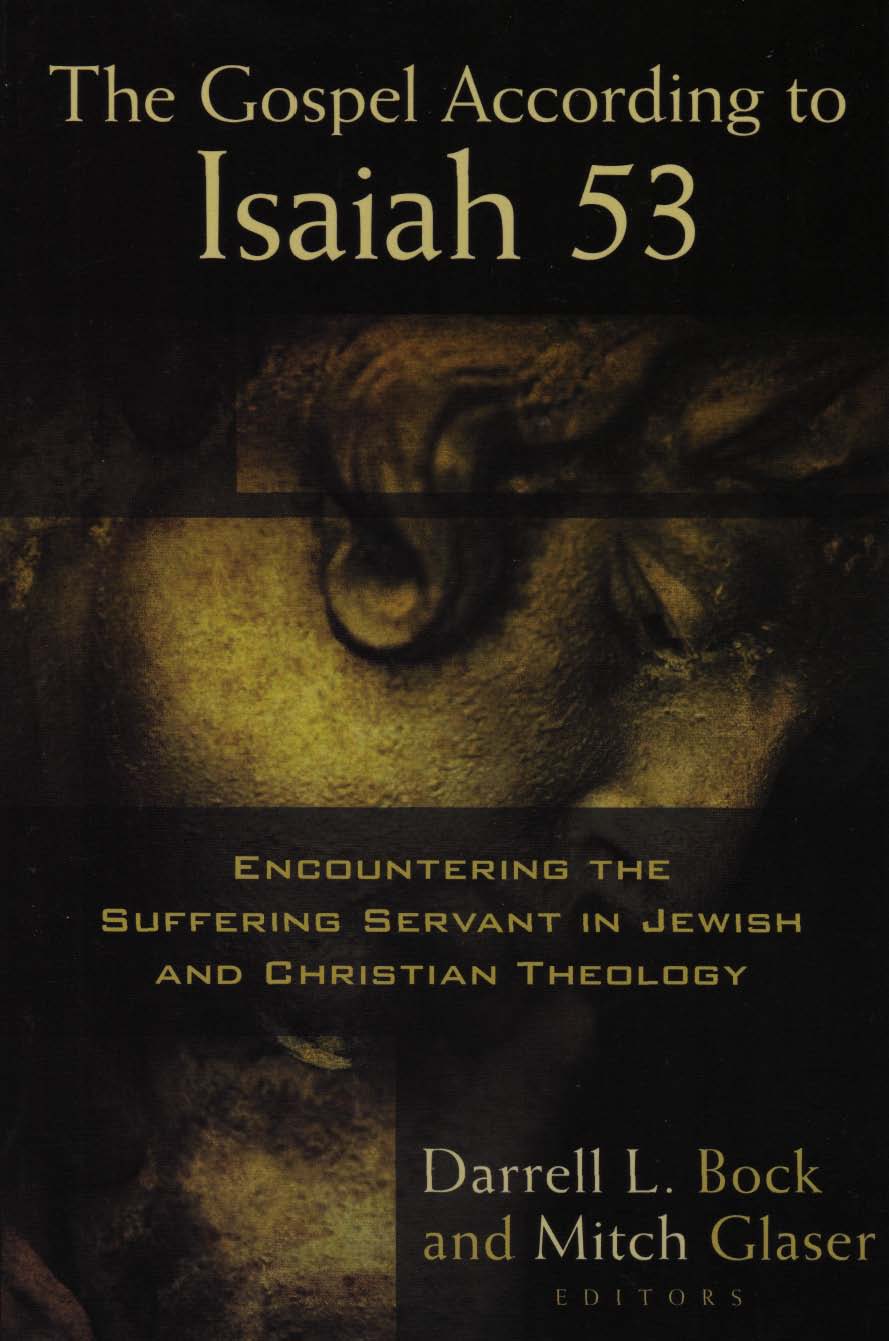
Review of The Gospel According to Isaiah 53

Isaiah 53 is a phenomenal passage.  As I read through it I wonder how anyone could possibly not see Jesus in this passage.  Actually it is a passage that God has used “more than any other portion of Scripture…to lead Jewish people to himself.” (22)

Yet even though Isaiah 53 has been so instrumental in bringing Jewish people to faith in Jesus the Messiah, “there has never been an evangelistic campaign that used this text as the focal point in bringing the gospel to Jewish people”.  (22)  The Gospel According to Isaiah 53, edited by Darrell L. Bock and Mitch Glaser hopes to pioneer such a movement. 

The overarching goal of the book is to be accessible to those that regularly preach and teach with an emphasis on helping those that desire to engage in the task of Jewish evangelism.  It is written by faithful biblical scholars but is not meant to be relegated to academia.  It is meant to help faithful pastors use this time-tested passage of Scripture to present the Suffering Servant of Isaiah 53. 

The book is divided into three parts.  The first part concerns itself with the Christian and Jewish interpretations of Isaiah 53.  The second part considers Isaiah 53 in light of biblical theology.  Here the various scholars attempt to show Isaiah 53 in its own canonical context as well as how it relates to other passages of Scripture.  The final section makes Isaiah 53 practical.  An essay by John Feinberg shows how it relates to Postmodern Themes, Glaser shows how to use Isaiah 53 for Jewish evangelism, and the book closes with an essay on Preaching Isaiah. 

I should also mention that there are two sermons attached to the book on Isaiah 53.  One sermon is expositional and the other is a dramatic-narrative.  The inclusion of these sermons is meant to assist the pastor or lay-leader in presenting the beauty of Isaiah 53 for the purpose of evangelism.

My Take

Though I do not believe they intended it to be the book is still pretty scholarly.  In some of the essays they dip into Hebrew language, there are places were they use words like “scanta”, and they also frequently interact with modern scholarship. 

If I were reviewing this as a seminary student wanting more information on Isaiah 53 and how it relates to its Jewish context then this would be one of the first books that I would look.  It is very faithful and beneficial in scholarship.  You can tell that the authors are faithful biblical scholars.

As a pastor preaching through Isaiah 53, and even more so if I were doing so in a Jewish context, then I would also find this book very helpful.  I would want a couple of months to really pore through the book as I did sermon preparation.  It’s not a book for a pastor to merely skim and then when he gets to Isaiah 53 pull it out and try to use it as a resource.  But it would benefit any pastor that had the time to use it.

What if I were a lay-leader that feels called to minister to the Jewish people?  I personally have never had the opportunity to share the gospel with a Jewish person.  My perspective is limited. I do not know if one would need to be very scholarly to engage with a Jewish person on Isaiah 53.  So, I’m not certain that the entire first part of the book would be helpful for your everyday Christian speaking to your everyday Jew.  But perhaps it is better fitted for Christian scholars/pastors speaking to Jewish scholars/rabbis. 

Yet at the same time Mitch Glaser’s chapter on using Isaiah 53 for Jewish evangelism is phenomenal and accessible to anyone.  So, I’m left a little confused.  If you are more the scholarly type then by all means get the book and use it as a resource.  As a pastor I would also suggest this book.  If you are a lay-leader then Glaser’s essay is worth the price of the book and you might benefit from the other chapters as well. 

I completely support the effort of the contributors in this book to use Isaiah 53 as a centerpiece for Jewish evangelism.  I am glad that this book is on the shelves and in libraries to assist those that desire to use Isaiah 53 to share the gospel with the Jewish people.  I am grateful for this book.  If it is something that seems interesting to you then you will not be disappointed. 

I received the book free from Kregel, in exchange for a review.  But you can Buy it today.

Tuesday, August 28, 2012

4 Reasons Fulfilling The Great Commission Must Include Suffering

After preparing for a sermon on 1 Peter, I read through Piper’s sermon on the same text to see how he handled it.  One of the things he did that I appreciated was note four reasons why if the church is going to be faithful to fulfilling the mandate of Christ we will inevitably suffer.  Here are the four reasons:

  1. Jesus clearly taught that “you will be hated by the nations”.  So, “wherever you go among the nations, your efforts to bring good news of everlasting life will be met with joy in some and anger in others”
  2. Paul calls evangelism “the filling up of what is lacking in Christ’s afflictions”.  “God’s purpose is that the afflictions of Jesus that purchased our salvation be imitated and demonstrated in the propagation of that salvation”. 
  3. Jesus warned the first evangelists as he sent them out saying, “If they have called the Master of the house Beelzebub, how much more members of his household”
  4. Paul told Timothy, in the midst of church planting in Ephesus, “Do not be ashamed, but share in the suffering for the gospel in the power of God..”

As I noted when I preached on this text, Peter admonishes us in 1 Peter 4 to arm ourselves with a robust theology of suffering and then to not be surprised when we have to use it. 

LinkWithin

Related Posts Plugin for WordPress, Blogger...