Showing posts with label philippians. Show all posts

Tuesday, April 23, 2013

Don’t Go There, Man!

I’ll just come out and say it. Scripture can be really confusing.

Not only is it confusing because I’m a Western-whitey that speaks English instead of Greek and I live in an age when a Camel is a cigarette instead of a ride to town or an uncomfortable shirt; but it is also confusing because Scripture is just flat out difficult. Hence thousands of years of disagreement over the sacred text.

Part of this is because each side of an argument usually has a litany of valid Scriptures to back up their point. And that’s actually a good thing. Here is what I mean…
I picture biblical truth like a narrow road with massive canyons on each side. So long as we’re on the road its not terrible for us to lean towards one of the ditches. After all, we’re human. We’re dust, we aren’t yet fully redeemed. Therefore it’s not surprising that we’ll have a tendency to lean away from the middle of the road. Not to mention that certain seasons often require a greater emphasis of biblical truth.

Thankfully, though, on each side of the road are massive stop signs that boldly say, “Don’t go there, man!” If you ignore the sign, cross that line, and then fall into the canyon then we’ve got a problem. Scripture provides those stop signs to help believers know where a certain doctrine—and usually its implications—are supposed to stop.

Example:

12 Therefore, my beloved, as you have always obeyed, so now, not only as in my presence but much more in my absence, work out your own salvation with fear and trembling, 13 for it is God who works in you, both to will and to work for his good pleasure.
One person focuses on verse 13 and notes that it is God who works within us to work out our salvation. As he leans this way and emphasizes certain parts of this truth he gets awfully close to the canyon of passivity. To wake him from slumber a loud siren and bright red stop sign screams out, “work out your salvation with fear and trembling”.

Another person focuses on verse 12 and notes that we are to work out our salvation with fear and trembling. As she leans this way and emphasizes certain parts of this truth she gets awfully close to the canyon of works-based righteousness. To wake her from slumber a loud siren and bright red stop sign screams out, “for it is God who works in you…”

There is help for everyone in Philippians 2:12-13. To the one wracked with guilt because she has fearfully and in trembling tried to work out her salvation but has fell flat on her face, there is balm in verse 13—”God is still working! Get up. Get back to work. He’s not going to let you fall”. To the guy withering in passivity verse 12 lights a fire under his comfort and drives him to cry out to Christ for change.

That’s only one example of many. There are many supposed contradictions in Scripture that are actually beauties to behold instead of questions to be answered. Let’s be sure to walk in the beauty of truth, finding unity somewhere on the road of grace, always heeding the signals that we’ve went too far in our lean.

Thursday, March 28, 2013

When Jesus Looks Like a Failed King

And John, calling two of his disciples to him, sent them to the Lord, saying, ‘Are you the one who is to come, or shall we look for another?”

I don’t blame John for his question. Actually I identify with it. Sitting in a discouraging prison, looking upon a world that seems the opposite of Jesus’ rule, shaking his head wondering if maybe this isn’t the Mighty One that would baptize with the Spirit.

I wonder what John thought the world would look like once the Mighty One began His reign? Did he picture rejoicing throughout the land? Did he believe that Jesus would quickly overthrow his enemies and put justice in its place? Certainly he did not envision himself shackled by a wicked Roman ruler.

I understand why he asked that question. John’s world didn’t look like one painted by the Loving Messiah. It looked the opposite. And that discouraged him and caused him to question everything he knew to be true. I understand John’s question because I have asked it myself.

Is Jesus really overturning darkness? Is he really the One that He says that He is? John’s prison stay caused him to question Jesus’ identity and the validity of His reign.

A different prison

Fast forward a couple decades. A follower of Jesus, named Paul, is housed in a prison much like John the Baptist. Here is his response:

I want you to know, brothers, that what has happened to me has really served to advance the gospel…Christ is proclaimed, and in that I rejoice.

Rather than seeing his prison time as a hindrance to the kingdom of God, Paul saw it as a beautiful plan. You see, Paul wasn’t chained to a Roman guard in prison. A Roman guard was chained to the gospel. And once his shift changed a new unsuspecting victim would be handcuffed to Paul, who would then lovingly proclaim the gospel of Jesus.

Paul was able to see the reign of the Mighty One through prison bars. John saw it as defeat. My natural tendency is to be more like John the Baptist. (I am a Baptist, after all). I tell my daughter to watch out for the thorns while she smells a rose. I’m prone to darkness and discouragement. But the gospel transforms our natural tendencies.

The difference Maker

The difference between John the Baptist and the apostle Paul is the resurrection and the outpouring of the Spirit. I live in the age of Paul’s prison—not in the excuse of John’s.

Jesus’ answer to John is the same to use today. “Look…darkness is being overturned”. He’s also saying, “…blessed is the one who is not offended by me”. Which means, “blessed is the one that trusts me in prison instead of questioning my identity and the validity of my reign, just because I’m accomplishing my kingdom purposes in a way that flies in the face of everything you expected me to do”.

God is overturning your darkness and the darkness of our world. At times it doesn’t look like it, but that prison cell might be the very means that God uses to shovel dirt onto a defeated devil.

Saturday, August 11, 2012

The Source and Importance of Unity

In Philippians 1:27 Paul exhorts them to “only let your manner of life be worthy of the gospel of Christ”.  It would make little sense for him to be saying “live in such a way that you earn what Christ has purchased”.  Instead what he is saying is “live in such a way that you accurately display the worth of the gospel of Christ”. 

It’s interesting then how he expounds on that exhortation.  What he mostly speaks of in the next 3 verses is unity around the gospel and suffering for the sake of Christ.  If you really think about it though it’s not all that surprising that unity and suffering would display the worth of the gospel of Christ.
Consider Jesus’ early disciples. 

One follower of Jesus was Simon the Zealot.  A Zealot was a member of a Jewish sect that refused to pay tribute to those dirty Romans.  Zealots abhorred the fact that many of their people were selling out to Rome.  Eventually this led to an assassination attempt against not only Roman leaders but also any Jews that cooperated with these pagans. 

Another follower of Jesus was Matthew/Levi the tax collector.  A tax collector was the definition of a sell out to Rome.  They not only paid taxes to Rome they actually partnered with them in collecting the taxes.  And most, of course, took opportunities to pocket a little of theses taxes for themselves.  Tax collectors stole from their own people. 

Before Christ if you would have ran into Simon the Zealot and Levi the tax collector on the streets you probably would have had to break up a fist fight—or maybe worse.  These dudes would not have gotten along.  For one man what drove him was Jewish nationality.  For the other man what drove him was a dollar and if that meant getting it from Rome then so be it. 

But look at what the gospel does.

Simon the Zealot (who probably still carried a deep flame of patriotism) is now eating meals with the once sell-out Levi (who probably still felt a little sympathy for Rome).  What happened that made Simon and Levi ministry partners?  The gospel of Christ became more valuable to Simon than his nationalism and more important to Levi than his money. 

We communicate the value of the gospel by not only our response to suffering but by our unity with one another.  When issues like Calvinism/Traditionalism, shag/berber carpet, premillenial/amillenial/postmillenial, Democrat/Republican, Yankees fan/having a soul, dominate our time, conversations, and ministry we are communicating that these issues are more valuable than the gospel. 

Disunity that comes from non-essential (gospel-centered) things proves that something higher than Jesus has hold of our affections.  That also means that the way out of disunity is not to continuously cry, “Unity, unity, unity” but instead it is to raise our affections for Christ.  It’s as A.W. Tozer rightly said years ago:

“Has it ever occurred to you that one hundred pianos all tuned to the same fork are automatically tuned to each other? They are of one accord by being tuned, not to each other, but to another standard to which each one must individually bow. So one hundred worshipers [meeting] together, each one looking away to Christ, are in heart nearer to each other than they could possibly be, were they to become 'unity' conscious and turn their eyes away from God to strive for closer fellowship.

What does your unity/disunity say about your affections for Christ and His gospel?  Are you accurately displaying the worth of the gospel of Christ by the way that you interact with brothers and sisters in Christ?  Or are you displaying that something else is more valuable and has a hold on your heart?

Friday, June 25, 2010

Taking Issue with Rapping Motions

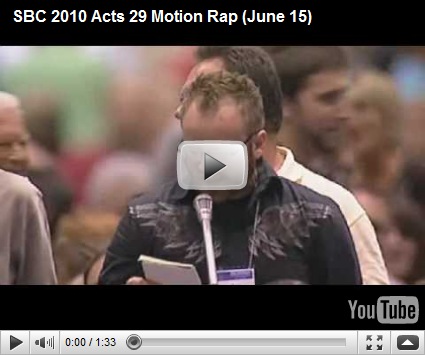
This is my first exposure to 5ptsalt.  Today he takes issue with Joshua Shank’s rap-motion at SBC 2010.  I showed the video a few days ago, but if you have not seen it you can do so here:

From what I can tell here is the gist of 5ptsalt’s argument:

Thesis:

Joshua was “more set on promoting Acts 29 than presenting a serious, worthwhile motion”. 

Support:

“not being satisfied with the proper use of the English language”

not “maintaining some degree of decorum”

he rapped his motion to the “shame of everyone who has even a modicum of an education”.

he spoke like an “ignorant, uneducated brute”

Conclusion:

Shank is “silly and self-absorbed”, “degraded the very existence of the SBC meeting”, and is a horrible witness and only recognized as a pastor but not one really. 

------

I want to be upfront and say that I do actually wish that Shank would have made his motion and not rapped it.  It was fun as well as funny.  But I do think that it caused it to not be taken seriously.  And the content was actually not all that silly

However, I take serious issue with what 5ptsalt is asserting here.  It grieves my heart.  And I want to let you know upfront my motivation in posting this.  I am not simply trying to call out him as a person or merely this article.  My desire is to look at the issue, make an argument that his evidence does not warrant his conclusion or support his thesis, and in the end look at my own heart. 

The Ignorant and the Gospel

Timmy Brister gives us a back story to the intention behind this post.  Like it or not here is what the motion was about: “expressing appreciation and affirmation for the investment of the Acts 29 Network for their work in planting gospel-centered churches in the SBC?” 

So, maybe 5ptsalt is onto something.  Or is it possible that the aim behind promoting Acts 29 is to promote gospel-centeredness and to do away with all of the division and hatred towards Acts29?  I think that is closer to the intent.  What I think Brister, Mitchell, and Shank have in mind is promoting the gospel above our extra-biblical divisions.  (Yep, that just opened up the whole can of worms about whether we should be for or against A29). 

spurge Let’s just say for the sake of argument that the motion really was ignorant, brutish, improper, and shameful to the educated.  Doesn’t the gospel trump this?  Is it possible that having someone rapping a motion is actually a better gospel witness because of its display of the diversity within the body of Christ?  Do we really want to make the argument that ignorant, brutish, and improper people cannot make motions or lead churches? 

"Redolent of bad taste, vulgar, and theatrical."  That is what a newspaper (and it was not alone) once said of Charles Spurgeon.  Spurgeon spoke the language of the common people.  Perhaps, Joshua Shank is doing the same. 

Looking at my own heart

But I am often guilty of this same thing.  I have certain things that I greatly dislike and some things to me seem like great issues that in the end probably are not.  I have to ask these questions of my own heart.  Do I have the attitude of Paul that is excited that the gospel is being preached, even if with wrong motives?  See Philippians 1:15, and this article

Do I have patience and grace with those that are doing things perhaps not the best or even most biblical way?  Do I have humility to say that I may be wrong—and perhaps I am not doing things the best or the most biblical way? 

Thankfully, Jesus used fishermen, tax collectors, zealots, redeemed prostitutes, former extortionist, and all manner of outcasts for his glory.  He even used wealthy and refined people too.  I’m thankful that his grace is big enough to cover my sin, and that his glory is great enough to overshadow and use broken vessels like me. 

Saturday, April 14, 2007

To live is Christ, To die is gain????

Wednesday I challenged you with a couple of questions. Can you truly say that your life=Christ? And again can you truly say that your death would be gain? The only way to answer in the affirmative on either of those questions is a life that is consumed by faith in Christ. Below are links to two sermons; the one on Wednesday and then the one that I preached at the FCA event on Friday:

Wednesday's sermon can be found at http://uncutsermons.blogspot.com/2007/04/lifechrist-deathgain-philippians-119-26.html and the FCA sermon can be found at http://uncutsermons.blogspot.com/2007/04/harvest-is-plentiful-matthew-936-38.html

Also, I am really hoping that I am able to begin the devotionals again soon. Let me briefly explain the delay. First of all Brian McMillen and I are working hard on (more Brian than I) on revamping the youth building. Secondly, I am in the process of implementing our summer student leadership program. So, my time has been taken up in these ventures along with sermon preperation. Also, I have been battling an ongoing cold for the past week or two. So, hopefully Lord willing next week my schedule will be a little better and I can begin putting more time into the blog...

Friday, March 30, 2007

Only that Christ is Preached

“Some indeed preach Christ from envy and rivalry… [they] proclaim Christ out of rivalry, not sincerely but thinking to afflict me in my imprisonment”


One of the most penetrating questions I must consistently ask myself is this: “Why are you preaching the gospel”? It is imperative that as ministers of the gospel (that means all who are Christians) that we check our motivations. It is so unbelievably easy to preach the Word of God with the wrong motives. I can preach for my own glory. I can preach to tickle someone ears (making men happy). I can preach to follow the mold of great preachers of the past (glorifying men). I can preach for money. I can preach out of envy. I can preach to harm others ministries. There are numerous motivations and aspirations in preaching the gospel. I can even use the gospel to further political causes or social issues.

What motivated these preachers who were preaching Christ “from envy and rivalry”? Some commentators erroneously believe it is a heretical group like the Judaizers. But it is obvious from the context and Paul’s stern rebukes in Galatians 1 that these are not heretics. Paul would not commend or call any type of heretical teaching “preaching Christ”. Perhaps these men are trying to create a “strife by preaching and thus incur the anger of Rome, in order to bring down upon themselves and Paul suffering, persecution, even martyrdom, in the belief that tribulation (was necessary to hasten the end of the world and the return of Christ?”[1] But that view cannot be correct either, as Hawthorne later points out, “(a) since, similar to “good will” and “love” the words “envy” “strife,” and “selfish-ambition” are relational words, (b) since these latter words are exactly parallel to the former words, and (c) since Paul was the object of those former words—“love” and “good will”—therefore one is forced to conclude that, for whatever reason, he is also the object of the latter words—people reacted against Paul himself and thought to hurt him by their preaching.”[2]

I think our best bet at understanding this passage is to look at an example given by Vincent Cheung. “In the University of Pennsylvania a professor of history read to his class Jonathan Edwards' sermon "Sinners in the Hands of an Angry God." The aim of the professor was to show how harsh, disagreeable, and morose the New England Puritans were. Because of his reading, however, at least one student was converted to Christianity.”[3]

The point that Paul is making and the reason Paul is still able to rejoice (see v.18) is because even though they are not preaching Christ from the right motives the gospel is still being preached. And Christ is still being proclaimed and for this we have cause to rejoice. Amidst all of this we must ask the question; “Am I even preaching the gospel”? What a shame that those who are proclaiming Christ from wrong motives actually give more cause for rejoicing than Christians who sit on the truth of God’s Word and never proclaim it. Get off your duff and proclaim the beauty of Christ to the nations!

Tomorrow we will look at the correct motivation for preaching the word of God

[1] quoted by Gerald Hawthorne in Word Biblical Commentary. Taken from www.biblecentre.net
[2] Ibid
[3] quoted by Cheung, Vincent www.rmiweb.org/books/philippians.pdf pg 33

Tuesday, March 27, 2007

Boldness through Chains--Philippians 1:14

“And most of the brothers, having become confident in the Lord by my imprisonment, are much more bold to speak the word without fear”
 
One of the most powerful and influential books in the history of mankind is John Foxe’s Book of Martyrs. It chronicles the lives and stories of Christians who have been persecuted from the time of Christ up until the reign of Bloody Mary in the late 1500’s. It held such influence that at one time it, along with the Bible, was chained to the pews in many Protestant churches throughout England. (Books were often so rare and valuable that they would chain them to the pews to keep them from being taken). In the introduction to one edition of Foxe’s Book of Martyr’s a man by the name of James Miller Dodds said it well:

"After the Bible itself, no book so profoundly influenced early Protestant sentiment as the Book of Martyrs. Even in our own time it is still a living force. It is more than a record of persecution. It is an arsenal of controversy, a storehouse of romance, as well as a source of edification."[1]

It is evident from the great influence Foxe’s Book of Martyrs (or even the modern Jesus Freaks) that people giving their life for the cause of Christ is a great motivator towards evangelism and a great source of edification. Something stirs deep within me whenever I read these stories of men and women who gave their lives for the cause of Christ. I am always inspired to ask myself two questions whenever I read these accounts; do I love Christ so much that I would suffer for Him and do I love Christ so much that I am willing to live every moment for Him?

Apparently the Apostle Paul’s imprisonment had the same impact upon those Christian’s who had heard of his situation. The way that this sentence is worded helps us to know that it is not as if the Philippians had been not preaching the word at all—it is more that they are no more passionate and bolder than they have ever been and because of this Paul is rejoicing.

So, we see the mighty influence that Paul’s chains are having. Even though Paul is chains the gospel is not. The great truth that Paul is proclaiming to us is that even though Christian’s might be killed or chained their message (the gospel) cannot be fettered (chained). The great gospel of the glory of God cannot and will not be stopped-and for this Paul (and we) will rejoice. As John Eadie eloquently puts it, “though they might grieve at the confinement of the man, they would be comforted that the cause with which he was identified had not been arrested in its progress.”[2]

Today:
  • Rejoice in and worship the Lord who will not be thwarted
  • Be emboldened in the cause of Christ and continue to advance the gospel without fear
  • Ask yourself, “Do I love Christ so much that I am willing to suffer for Him?
  • Ask yourself, “Do I love Christ so much that I am willing to live for Him?
For your benefit Foxe’s Book of Martyrs can be checked out of the youth library (as can Jesus Freaks). Also you can read Foxe’s Book of Martyrs at http://www.ccel.org/ccel/foxe/martyrs/files/martyrs.html
[1] Taken from http://www.pinn.net/~sunshine/book-sum/foxe.html but can also be found in the Forbush edition of Foxe’s Book of Martyrs
[2] Eadie, John. The Epistle of St. Paul to the Philippians. Taken from http://www.biblecentre.net/

Monday, March 26, 2007

The Glory of Christ spread through chains

“I want you to know, brothers, that what has happened to me has really served to advance the gospel, so that it has become known throughout the whole imperial (praetorian) guard and to all the rest that my imprisonment is for Christ”

In Rome there were for basic types of custody: imprisonment (with or without chains), military custody (which might include being chained to a soldier), release into the custody of a trustworthy person, and release on one’s own recognizance.[1] More than likely Paul would have been in military custody. It is quite likely that while Paul was dictating this letter he would have been chained to a Roman guard.

It is not difficult to imagine that Paul would have had a significant influence upon these men that he was chained to. They would have undoubtedly witnessed Paul’s character, his attitude, and his deep love for Jesus Christ. It would not be hard to imagine Paul even preaching sermons to these men. These men were chained to the preaching of the gospel—Paul had a captive audience. With each shift change Paul would have a new person to share the gospel with. You can see then how Paul’s chains where used to spread the gospel all throughout Rome. As William Hendriksen noted, “Paul’s case and even better, Christ’s cause, became the ‘talk of the town’.”[2]

It is also possible that Paul’s imprisonment would have been a little different. Even if Paul where not specifically chained to a Roman guard (praetor) Paul’s meaning does not change: The gospel is not hindered in fact it is actually advancing. As Hendriksen further commented, “when the apostle went to Rome as a prisoner, it was in reality the gospel that went to Rome”.[3] What Hendriksen is saying is that no matter where Paul was or in what circumstance he was in the gospel went with him. Even in his death Paul would bear witness to the greatness of Christ.

The questions that we must ask ourselves today are thus:
  • If I were chained to a guard would they consistently here the gospel and see the gospel modeled in the way I lived my life?
  • Does the gospel go with me wherever I go? Meaning: Am I a witness to the greatness and glory of Jesus Christ no matter where or in what circumstance I am in?
Tomorrow we will learn about the second way the gospel is advancing through Paul’s imprisonment. Today we learned that Paul’s chains are advancing the gospel into the community at Rome. Tomorrow we will see how the gospel is advanced inside the Church through Paul’s imprisonment.

[1] Arnold, Clinton. Zondervan Illustrated Bible Background Commentary. p351
[2] Hendriksen, William. NT Commentary: Philippians, Colossian, Philemon. p69
[3] Ibid, p68

Saturday, March 24, 2007

How do chains advance the gospel?--Philippians 1:12

“I want you to know, brothers, that what has happened to me has really served to advance the gospel...”

The word that Paul uses for “advance” is the Greek word prokopen (pronounced prok-op-ay’). As Hawthorne notes prokopen was originally used to refer to, “pioneers cutting a way before an army and so furthering its march”[1] So what Paul is saying is that his imprisonment has been like pioneers cutting they way before the army so as to further the march. Paul’s imprisonment is how the gospel is going to advance into the Roman military and the Roman government. History has shown that “chains” (sometimes even people dying for their faith) has served to advance the gospel. In fact an early Christian writer Tertullian proclaimed that, “the blood of martyrs is the seed of the church”. Meaning that it is through Christian blood being spilled that the door us opened up for the advance of the gospel. The story of Jim Elliot and 4 other missionaries to the Auca Indians portrays this beautifully:

“In the Autumn of 1955, missionary pilot Nate Saint spotted an Auca village. During the ensuing months, Elliot and several fellow missionaries dropped gifts from a plane, attempting to befriend the hostile tribe. In January of 1956, Elliot and four companions landed on a beach of the Curaray River in eastern Ecuador. They had several friendly contacts with the fierce tribe that had previously killed several Shell Oil company employees. Two days later, on January 8, 1956, all five men were speared and hacked to death by warriors from the Auca tribe.”[2]

These men never had the opportunity to share Christ with the Auca tribes—at least not with their lips. What is really interesting to note is that a few years after Jim Eliot was martyred his wife, Elisabeth, among many of the other missionary wives were able to make contact with the Auca Indians and many where led to Christ; in fact it is told that Elisabeth had the opportunity to lead the Indian who had killed her husband to faith in Jesus Christ. Jim Elliot and those 4 other missionaries where much like the Apostle Paul—pioneers cutting a way before the gospel could march through.

Jim Elliot’s now famous quote sums up well the motivation of those who give their lives (whether in life or death) to the cause of Christ. In a journal entry a few years before he ultimately gave his life Elliot wrote, “He is no fool who gives what he cannot keep to gain what he cannot lose.”
  • Ask yourself today am I giving my life for what I cannot keep? Or am I giving my life to gain what I cannot lose? To put that another way—are you living for eternity or for the fleeting pleasures of today?
  • In what areas of your life is God calling you to be a “path cutter”?
  • In what areas of your life is God calling you to advance the gospel after those who have already “cut a path”?
The movie, End of the Spear, is about Jim Elliot and the other missionaries. Elisabeth Elliot has also published two wonderful books about the mission to the Auca Indians and her husband’s life: Through Gates of Splendor and Shadow of the Almighty. You can also check out Jim Elliot’s journal in from our youth library.
[1] Hawthorne, Gerald. Word Bible Commentary. Taken from http://www.biblecentre.net/
[2] Taken from http://www.intouch.org/myintouch/mighty/portraits/jim_elliot_213678.html

Friday, March 23, 2007

Paul's Situation--Philippians 1:12


“I want you to know, brothers, that what has happened to me…”

Around 57 AD Paul wrote his letter to the church at Rome. In it Paul says this, “I long to see you…I want you to know, brothers, that I have often intended to come to you…” We learn further from Acts 19:21 and 23:11 that Paul’s longing was to preach the gospel in Rome. Perhaps he knew the impact this would have upon the world. If the gospel can spread to Rome then it can spread throughout the world. Paul had longed to go to Rome as a freedman and preach the gospel.

But something happened shortly after Paul wrote his letter to the Romans. He was imprisoned in Caesarea. It certainly would have appeared that this evangelist’s days were over (and perhaps he would never be able to preach the gospel in Rome). But God in his great wisdom actually used this circumstance to further His kingdom and fulfill Paul’s passion; this imprisonment would lead Paul to Rome. Gerald Hawthorne in his commentary to the Philippians says it well:

“When Paul was arrested in Jerusalem (Acts 21) and shut away in prison in Caesarea (Acts 23, 24), one could easily imagine that this was the end of his ministry, especially as his imprisonment dragged on month after month (Acts 24:27). But in the providence of God the place of his imprisonment, the Praetorium of Herod (Acts 23:35), and the length of his imprisonment, both served to thrust the gospel up into higher levels of Roman society than it had ever reached before.”[1]

We are going to learn in the coming days that this seemingly crummy circumstance has really served to advance the gospel. What I really love about this story is that Paul is dying to get to Rome—and in the wisdom of God he sends Paul to Rome as a prisoner. As we are going to learn in the coming days Paul was able to minister to people and places that had he not been a prisoner he probably would have never won an audience.

Before applying this I also want to mention another possibility of Paul’s circumstances. As one commentator noted, “Verse 12 does not seem to be a reference to his imprisonment, about which previous communication with the Philippians had informed them, but to more recent developments. Perhaps Paul had been moved from his hired house (Acts 28:30) to the Praetorian camp or to some place more accessible to the trial scene.”[2]

So, it is quite possible that it is not only Paul’s imprisonment that is causing concern. Paul certainly would have understood what James meant when he said, “you do not know what tomorrow will bring. What is your life? For you are a mist that appears for a little time and then vanishes. Instead you ought to say, ‘If the Lord wills, we will live and do this or that”. For Paul each day was up in the air. He had to live each day by faith.

Think upon this today:
  • What “crummy” situations in my life could be used for God’s glory?
  • Would your attitude be the same as Paul’s if things did not work out quite like you planned?
  • Do you live each day by faith or do you plan out your entire life?
[1] Hawthrone, Gerald. Word Biblical Commentary. Taken from http://www.biblecentre.net/
[2] Kent, Homer. Expositor’s Bible Commentary. Taken from http://www.biblecentre.net/

Thursday, March 22, 2007

Living for a blade of grass

Last night you were challenged to give your life to something far more significant than a blade of grass. I really hope that you caught the significance of what is being said. My prayer for you is much the same as Paul's...I pray that your love might abound more and more...I pray that your love might be grounded in knowledge and discernment...I pray that you might approve that which is vital...I pray that you might be presented to Christ as pure and blameless.

It is significant to note that Paul is "praying" for these things. One of the areas that I think I failed in last night is portraying that your "approving that which is vital" comes from our relationship with Jesus Christ. All of these things come as gifts of grace to us from God. You can not do this on your own. Remember John 15, "Apart from me you can do nothing". Not wasting our lives on a blade of grass is a lifelong endeavor. It is a constant struggle. Our sinful nature and our enemy the devil are constantly waging war on us. We will always struggle with this until we are finally made whole in Christ Jesus. But struggle we must! In the near future I hope to do a series on spiritual warfare.

The full-text for last nights sermon can be found at the following address:
http://uncutsermons.blogspot.com/2007/03/essentials-to-gospel-advancement-focus.html

However, it will be a little different than the actual delivery. That is why we are working on taping each service. We were able to get the music aspect of the worship service last night on video (I am still working on formatting it and figuring out how to effectively put it on the website).

A new WHO AM EYE will be posted today (Thurs.) a new quiz will hopefully be posted tomorrow (Friday) and a new devotional will either appear tonight or tomorrow!

Thursday, March 15, 2007

The essential element of love

Last night we discussed the essential element of love. Unfortunately I believe that the message was missing a very essential component--"so what". I feel as if in many ways I did not hook you in a productive way so that you realized the desperate need that we have for "love" in advancing the gospel. Yet I do believe in the Holy Spirit and know that the Great Sovereign King can do all things and can use even this scattered sermon to sear deeply in your heart the "so what" of this message. The Lord can teach you this awesome need and it is my hope that you are passionate about advancing the gospel--and that you are passionate about advancing this gospel with love and in love. Remember the acronymn D-E-A-R for growing in love. Dig deep-Experience God-Ask for it-Realize the truth of the gospel! Do not forget there is not one square inch (or one second of the day) that does not belong to Christ!

The full-text sermon can be found at http://uncutsermons.blogspot.com/2007/03/essentials-to-gospel-advancement.html

Also, a new quiz and a new WHO AM EYE? Will be posted either today (Thursday) or Friday. A new devotional might appear sometime today or tomorrow as well.

Tuesday, March 13, 2007

How to produce fruit you must have--Philippians 1:11

“…filled with the fruit of righteousness that comes through Jesus Christ…”


This is such a difficult concept yet it is profoundly simple. You must produce fruit. The Bible is clear about that. 1 John is replete (full) of examples of this great truth. Jesus often spoke of those who do not produce fruit being “cut down”. Yet Jesus is equally stern in reminding us that “Apart from me you can do nothing”. (John 15:4) And it is at this point that we so often get confused in the way we live our lives. The Christian is called to produce fruit, yet we in our own strength can NOT produce this fruit, yet in Christ Jesus we WILL produce this fruit of righteousness. As Paul’s prayer states, “the fruit of righteousness THAT COMES THROUGH Jesus Christ”.

How do you have fruit in your lives? It is by being attached to Jesus Christ, by abiding in the vine, that you will bear fruit. If you are not producing fruit then it is because you are not in Christ. Sadly, in our modern “churchianity” we have made up a third type of person. We have erroneously used Paul’s words in 2 Corinthians to create a “carnal Christian”. We have told people that there is a “Spiritual Christian” and there are people who are “Carnal Christians”. These carnal Christians are those who are not following after the Lordship of Christ. They perhaps are not filled with the fruit of righteousness. By their own stubbornness and sinfulness they refuse to abide in the vine (although they did make a decision for Christ at one time) and therefore they do not bear fruit. We are told that we cannot question their salvation, because they sincerely believed in Christ, yet they produce NO fruit! Biblically speaking there is no such thing as a “carnal Christian” as defined above. There is no such thing as a Christian that ultimately does not follow after Christ as Lord. There is no such thing as a Christian that does not produce fruit.

The point for us to understand from today’s passage is that Christians are expected, yea commanded to produce fruit! Yet, this fruit is not something we in ourselves can produce. It “comes through Jesus Christ”. Therefore, we must cling to Christ all the more. We must trust in Him to produce this fruit of righteousness.

Ask yourself today?

  • Is the fruit of righteousness (check Galatians 5:22) evident in my life?
  • Am I trusting in Christ to produce His fruit in and through me or am I trying to produce fruit by my own flesh?

For more information on the unbiblical notion of Carnal Christianity please read:
http://www.wayofthemasterradio.com/pdf/ElvisCarnalChristian.pdf
http://www.soundofgrace.com/feb99/khmarks.htm
http://www.eternallifeministries.org/lrs_gospel2.htm

If you would like resources on “producing fruit” check out the following resources:

Even though it does not specifically deal with “producing fruit” John Piper’s book entitled “Faith in Future Grace” is an excellent resource for “living the Christian life”.

Many of the articles at the following address will help in your “sanctification”:
http://www.monergism.com/directory/link_category/Sanctification/

Monday, March 12, 2007

Being clean when Jesus comes

“…and so be pure and blameless for the day of Christ…”

In ancient times the finest pottery was thin. It had a clear color, and it brought a high price. Fine pottery was very fragile both before and after firing. And this pottery would often crack in the oven. Cracked pottery should have been thrown away. But dishonest pottery salesmen would fill in the cracks with a hard pearly wax that would blend in with the color of the pottery. This made the cracks practically undetectable on the shelf, especially when the piece was painted or glazed. This wax ruse however was immediately uncovered if the pottery was held up to bright light, especially sunlight, for the cracks would show up as darker lines. It was said that the artificial element was detected by “sun-testing.” Such a vase was known as "sun-judged". It is notable that the honest pottery dealers would mark their product with the words "sine cera" which means “without wax”. Our English "sincere" comes from the Latin words "sine cera"!
[1]

“Sun-judged” or “without wax” is precisely what the Greek word that is translated here “pure” is referring to (some translations use the word “sincere”). In essence what Paul is saying is that he prays that the Philippians love might abound more and more and that its abounding love might be grounded in knowledge and all discernment. This type of love then leads to approving that which is vital, which in turn leads to being made pure (without wax) and blameless in preparation for the day when we stand before Christ.

How can approving (choosing) that which is vital lead to our being found sincere and without hypocrisy? How does living our lives daily in conformity to that which vital create in us purity? Perhaps whenever we are spend our lives for that which is vital we no longer have lives focused on self (and therefore lives focused on sin). Our approving what is vital serves as a filter. It removes that which we should not be spending our lives on and creates in us a pure and single-minded heart that goes fully after God and the advance of His beautiful Kingdom.

The word for “blameless” can either mean, “Not cause others to stumble” or perhaps “to not stumble ourselves”. How can approving (choosing) that which is vital lead to our “not stumbling” or “not causing others to stumble”. Certainly having a singled-minded focus on the advancement of the Gospel (or “knowing God and making Him known”) will create in us an others-oriented lifestyle. As we line up with God’s great purpose in our lives we are no longer concerned with building our own kingdom but instead we are focused on advancing His. This causes us to be focused on others. Also, having a God-centered life and purpose will allow us to persevere.

In one sense of the word we will stand before God without any purity or blamelessness of our own. We will stand before God filled with our own guilt, yet consumed by the righteousness and the beauty of Jesus Christ! We (those in-Christ) truly will stand before Jesus totally clean.

  • Read Ephesians 5:26-27 and meditate on how you will be presented to Jesus Christ. Also notice how that will come about—how is it that God transforms us into a pure and spotless bride?
  • What are areas in your life that are not as “pure” as they need to be? How can those change?
  • Do you often stumble yourself? Do you cause others to stumble? How can this change?
[1] http://www.preceptaustin.org/philippians_19-17.htm#1:10

Saturday, March 10, 2007

How to Make Decisions--Philippians 1:10


“…so that you may approve what is excellent…”

 
Today you will be faced with many decisions. You will be encountered by many people and will engage in many conversations. More than likely you will make decisions about how to spend your time, how to spend your money, who to spend your time with, etc. You will be making decisions about what movies or television programs you view. You will decide which music to listen to. Ultimately you will decide each and every day and in every moment of each day whether you will approve that which is excellent or whether you will not.

The word that Paul uses for “approve” is the Greek word dokimazo (pronounced dok-im-ad’-zo). In Greek culture “dokimazo was used…to describe the [the testing] of precious metals (especially gold or silver coins), usually by fire, to prove whether they were authentic and whether they measured up to the stated worth. That which endures the test was called dokimos and that which fails is called adokimos.”
[1] Paul then is saying that he prays that with every decision the Philippians are faced with they might through it in the fire and test whether or not it is something which they should esteem.

Paul has thus far prayed that the Philippians love might abound more and more, but not only emotional love. We learned yesterday that it is a grounded love; a love that is filled with knowledge and discernment. Discernment, of course, is the ability to distinguish between the good and the bad, or perhaps able to detect the good from the better. The reason Paul wants their love to abound more and more and it to be a grounded love is because this type of love (for God and man) will enable you to approve that which is excellent.

Also it is worth noting that which they should be “approving”. The Philippians abounding love should create in them a knowledge and discernment which approves (testing and choosing) that which is excellent. The word for excellent could (and perhaps should) be translated vital. Notice that Paul is not necessarily saying merely to distinguish between good and evil, but more than that we are to discern the good from the best. There will be many things in your life (and perhaps even decisions you make today) which are “good” things, but perhaps not the “best” things. We must have such a love that is grounded in knowledge and discernment that we are able to distinguish between that which appears to be good and that which is actually the plan of God.

I fear that so often in our culture we settle. I have heard many of our youth make comments about movies, “It’s really not that bad”. “There is only one bad scene”. “That CD is actually pretty good; it only has a couple of songs that have cuss words”. Sadly, its not only youth culture that struggles with this. There are many good “How to” sermons, yet they fall short of biblical preaching. If our life (this includes our preaching the gospel, our ministries, our decisions, etc.) is not totally consumed by Christ so that daily we are approving of that which is excellent (that which is reflecting Christ and His preciousness) then we are missing it.
  • In what way do I sell myself short by approving of that which is “good” or “not all that bad” yet it is not that which is excellent?
  • Am I concerned with approving that which is excellent?
  • What are things in your life that need to be taken captive for the sake of Christ so that you can forsake that which is unnecessary for that which is vital?
[1] http://www.preceptaustin.org/1_peter_17.htm#Tested%20dokimazob

Friday, March 9, 2007

Grounded Love--Philippians 1:9


“And it is my prayer that your love may abound more and more, with knowledge and all discernment…”


In the 1730’s-40’s America encountered what is known by historians as the First Great Awakening. It was a time of great spiritual revival. Many souls were converted and many who had been stagnant Christians were embolden in the gospel. As J.I. Packer defines revival it is “God’s quickening visitation of his people, touching their hearts and deepening his work of grace in their lives.”[1] However, often with these mighty movements of God comes much heretical teachings and spurious (false, quick to turn away) conversions. During the First Great Awakening many people were questioning the movement of God. Some (and rightfully so) were cautious due to the excess of emotionalism.

Jonathan Edwards, one of the greatest instruments of the Awakening, had this to say regarding emotions and truth:

I should think myself in the way of my duty, to raise the affection of my hearers as high as I possibly can, provided they are affected with nothing but tuth, and with affections that are not disagreeable to the nature of what they are affected with.

That is Edwards’ way of saying, the truth had better cause us to rejoice in who God is in such a degree that our affections are aroused. Yet, Edwards also in that same statement safeguards against emotionalism when he says, “with affections that are not disagreeable to the nature of what they are affected with”. In other words, if I am preaching upon hell and judgment it would be inappropriate for us to break out in laughter. The affection (emotion) must match the truth that is being presented; otherwise it is probably not of God.

In some measure this is precisely what Paul is praying for in the lives of the Philippians. He is not only praying that their love might abound but he is also praying that it might be a love that is grounded. In his commentary on Philippians Vincent Cheung points out that the word here for knowledge, “always refers to intellectual knowledge about the kings of God, a ‘mental grasp of spiritual truth’, ‘doctrinal knowledge’, and ‘theological knowledge’. Therefore studying Scripture, hearing sermons, reading books and engaging in theological discussions all have a direct relationship to your growth in love and obedience.”[2] Or as Cheung later puts it, “Theology makes love possible”[3]. You cannot say that you love God if you do not know Him. You’re love will not abound more and more and lead to Christian fruit if it is not grounded. Paul is not talking about mere emotionalism when he prays for their love to abound more and more. Paul is talking about a deep love—or deep affections (much the same way Edwards said). Therefore, we must strive all the more to love God (and others) deeply and with knowledge and discernment (which we will discuss tomorrow).
  • Do you love God with your entire mind?
  • Do you seek to study Scripture, hear biblically deep sermons, and read books that engage in deep thinking and theology? Are you content with mere shallow emotionalism?
  • If Edwards is right then the deeper and more profound we understand the truth of God then the deeper and more profound will our affections be engaged. Dig DEEP!!!!

Joyously Advance the Gospel

Wednesday night we continued our series on Philippians. This was the first time (hopefully the last) that I preached the entire sermon wearing handcuffs. I could not imagine what it would have been like for many in the early church (and many even still today) who preached the gospel in the face of death itself. Perhaps someday God will give us the grace to be persecuted for His name's sake.
Of all that we mentioned on Wednesday the one thing that I want you to catch more than anything else is this, "Joy is only found in fellowship (KOINONIA) with God and His great cause of advancing the gospel". It is only when we are sold out to the cause of advancing the gospel of God's glory that we will find our soul's greatest satisfaction.

Perhaps you were really excited as I began the sermon--perhaps you were hooked by the prospect of knowing how to have joy beyond our circumstance. Yet you felt that I did not do an adequate job of answering all of the questions that you have (which I am certain is the case). Joy, and joy in Christ, is a deep well and is a life long battle. If you are wanting to learn more about our struggle to have joy beyond circumstances I suggest to you the work of a man named Jeremiah Burroughs. He has written an excellent book called "The Rare Jewel of Christian Contentment".

You can find this book in audio form at http://www.stillwaterrpc.org/rare_jewel.php or you can find the printed version free online by visiting http://www.bibleteacher.org/jbcontent1.htm. I would highly recommend going to one of these sites and checking out what Burroughs has to say about our Christian Contentment.

The full text for Wednesday's message is available at:
http://uncutsermons.blogspot.com/2007/03/joyously-advance-gospel-despite.html

Do not forget that your answers to this weeks quiz need to be submitted by Tuesday March 13th. They are very easy questions and a good way for you to get a CD. Also, the first installment of Who am EYE will be appearing sometime on Friday! It's your chance to get a free candy bar.

Thursday, March 8, 2007

Abounding Love--Philippians 1:9


“And it is my prayer that your love may abound more and more…”


Robert M. McCheyne was a minister in Scotland in the early 1800’s that was used mightily by God. McCheyne however died shortly before his 30th birthday. In fact much of McCheyne’s life was filled with sickness, as his biographer A.A. Bonar comments, “Yet it was plain to him now that personal trouble was to be one of the ingredients of that experience which helped to give a peculiar tone to his ministry”.[1] As McCheyne himself would later say, “my sickly frame makes me feel every day that my time may be very short”.[2] Yet, McCheyne continued to preach and labor for the advance of the gospel as he had time. His love for Christ and his love for souls poured forth from him as if he had an eternal well from which to draw.

I now compare Mr. McCheyne to my own wicked heart. There have been many times when I have seen people in need, sometimes people even as dear to me as my wife, and I feel as if I have “little to give them”. Perhaps I have had a tough day at work, maybe I have been in my study for a few too many hours, or maybe I like McCheyne often did feel too sickly.

This passage of Scripture, coupled with the love of a McCheyne who modeled it, humbles me. I realize that so often my love does not “abound more and more”. This is the center of Paul’s prayer for the Philippians. His ultimate purpose and hope in prayer is found in verse 11, “to the praise and glory of God”. Yet, this ultimate purpose is to be realized through the abounding love of those who have been redeemed.

Did the Philippians love? Of course they did. That is modeled by their continual giving and partnership in the gospel. They were very loving, yet Paul is encouraging them to not settle. So often in our lives we settle and have the false idea that we have “arrived”. Paul is saying that he prays for the Philippians continually that their love may never stop growing. The word for “abound” can also be translated, “riches, superabundance, supply unlimited”. Paul’s prayer for the Philippians (which can even be extended to a prayer for all those who are involved in advancing the gospel) is that their love might overflow; their love for God and their love for people.

As Paul stated in Romans 13:8, the only continuing debt we should have should be to love one another. You never can love enough. You never can say to another, “I’ve given enough” or “I’ve paid my dues of love”. Our love should be abounding more and more as if it is coming from an eternal source; simply because Christian love does come from an eternal source. If we are to love with the affection of Christ Jesus, if we are to advance the gospel in love, then it must be the love which comes from Christ Jesus—and that love is never exhausted.
  • Is your love temporal, occasional, and shallow in nature?
  • How can you grow in your level of love so that it abounds more and more?
  • Pray today for yourself and for others (in humility) that our love might abound more and more
  • Meditate on the abounding love of Christ

If you are interested in reading more about Robert Murray McCheyne then his biography can be found at http://worldinvisible.com/library/bonar/mccheyne/contents.htm


[1] Bonar, A.A., Memoirs and Remains of Robert M. McCheyne. p53.
[2] Ibid, p91.

Wednesday, March 7, 2007

The Affection of Christ Jesus-Philippians 1:8


“For God is my witness, how I yearn for you all with the affection of Christ Jesus”

There are two principles that have stuck with me since learning them in college. One is that, “nobody cares what you know until they know what you care”. Or to put that another way, nobody cares what you have to say until they know that you really truly care about them. The other principle is very similar. “You can tell anyone about anything so long as they know that you love them”. I believe there are many in our youth group that I can tell “about anything” simply because they know that I deeply love them and care only for their best.

This is precisely what Paul is establishing in verse 8. He calls God as his witness (who else could have testified to his deep emotions). Paul is letting the Philippians know that he dearly loves them. It was customary in Paul’s day to begin letters with a “thanksgiving” to the gods. Here Paul is letting the Philippians know that his “thanksgiving” and “yearning” for them is not only a mere sentiment. He does not only love them with lofty words, he is not merely using flattery, he really truly loves them.

Note also how Paul loves them; not only with Paul’s affection, but with the affection of Christ Jesus. It would be one thing for me to say that I love my wife, but to say I love my wife with the very affection that Christ Jesus loves is quite another. Look with me briefly at the love of Christ.
It tells the truth even when it hurts. It washes feet. It shares living water with an unfaithful woman. It touches lepers. It turns over tables in the temple. It ultimately sheds its blood for the beloved. It secures eternal joy and love. It fully gives of self.

It also worth noting what J.A. Bengel did, “It is not Paul who lives within Paul, but Jesus Christ, which is why Paul is not moved by the [affections] of Paul but by the [affections] of Jesus Christ.”
[1] The reason that Paul is able to love with the affection of Christ is because Christ is overflowing out of Paul. It is not Paul who lives but Christ Jesus (Galatians 2:20). In as much as Christ lives and overflows from us we too will have for other the “affection of Christ Jesus”.

From this passage do two things:
  • Ponder (that means think about) the deep love that Christ has for you
  • Ask yourself whether or not the love of Christ is flowing from you, so that you can truly say that you have for others the “affection of Christ Jesus”

    [1] Bengel, J.A., Studies 2, 426

Tuesday, March 6, 2007

The Ground of Paul's Joy and Confidence--Philippians 1:7

“It is right for me to feel this way about you all, because I hold you in my heart, for you are all partakers with me of grace, both in my imprisonment and in the defense and confirmation of the gospel.”
What do you aspire to in this life? When you come to the end of your life, what do you hope to have accomplished? What do you want your tombstone to say?

In Hebrews 11:33-38 we read of those in the “Hall of Faith”. They “conquered kingdoms, enforced justice, obtained promises, stopped the mouths of lions, quenched the power of fire, escaped the edge of the sword, were made strong out of weakness, became might in war, put foreign armies to flight…some were tortured…others suffered mocking and flogging, and even chains and imprisonment. They were stoned, they were sawn in two, they were killed with the sword. They went about in skins of sheep and goats, destitute, afflicted, mistreated—of whom the world was not worthy-wandering about in deserts and mountains, and in dens and caves of the earth.”

As we look at Philippians 1:7 we see that Paul is in prison as he is writing to the Philippians. Yet we see that the Philippians remained with Paul—they showed evidence that they truly were partners with Paul, thereby displaying that they truly are partakers of the grace of God. Peter O’Brien sums it up well, “God in his grace had prompted the Philippians to alleviate Paul in his imprisonment, so that they were not shamed or intimidated by the bonds of their apostolic founder; they were prompted to cooperate with him in defending and propagating the gospel as well as to suffer for its sake.”
[1]

How would the Philippians have answered the above questions? Their aspiration in life was the same as Paul’s, “that Christ will be honored in my body, whether by life or by death”. Their hopes, dreams, goals, everything was tied up in this great calling—to advance the gospel of God’s glory. They probably did not care what their tombstone said; only that Christ might be honored. And we see this reflected in their refusing to forsake Paul in the midst of prison, they even went so far as to put themselves in a place where suffering is not only likely but inevitable.
They were not concerned with putting themselves in a place for personal blessings, they were not concerned with ensuring their own personal comfort—they were concerned with spreading the glory of God, despite the costs. And this is why Paul has confidence. This is why Paul has joy. This is why Paul is thankful to God for them. The work of God is evident in their lives, as Hendriksen says, it is the “operation of God’s grace which enables one to work in the interest of the gospel, to suffer for it, and to assist those who proclaim and defend it”.
[2]

Ask yourself:
  • Is the grace of God evident in my life?
  • Am I willing to suffer for the cause of Christ?
  • Do I assist those who proclaim and defend the gospel?
  • Do I proclaim and defend the gospel myself?
  • Do my dreams and aspirations more accurately reflect “Christians” of American culture or Christians of the biblical times?
[1] O’Brien, P.T., NIGTC Epistle of Philippians. p70
[2] Hendriksen, William. NTC Philippians, Colossians, and Philemon. p.56

LinkWithin

Related Posts Plugin for WordPress, Blogger...