…had the heart been well guarded at first, it had never come to this height: the temptation had been stopped in the first or second act. And indeed there it is stopped easily: for it is the motions of a tempted soul to sin, as in the motion of a stone falling from the brow of a hill; it is easily stopped at first, but when it is set agoing, [it gathers strength as it goes]: And therefore, it is the greatest wisdom in the world to observe the first motions of the heart, to check and stop sin there. The motions of sin are weakest at first, a little care and watchfulness may prevent much mischief now, which the careless heart not heeding, is brought with the power of temptation. (John Flavel, from A Saint Indeed, emphasis mine)
Monday, October 24, 2011
A Little Care and Watchfulness Now…


Tuesday, October 18, 2011
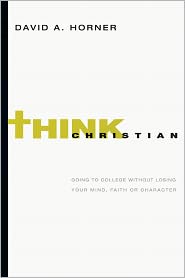
Review of Mind Your Faith by David A. Horner
The statistics are startling. Consider this from Steve Henderson in a Christianity Today article:
“More than 52 percent of incoming freshmen who identify themselves as born-again upon entering a public university will either no longer identify themselves as born-again four years later or, even if they do still claim that identification, will not have attended any religious service in over a year.” (From “Price Versus Cost”)
 Perhaps that “statistic” is a reality in your home, or at least you know of a strong Christian family rocked by their college son’s newly acquired atheism. For at least a decade churches have been considering how to equip teenagers for the faith attacks they will endure in college. How will the church prepare its teenagers to not lose their faith once they enter college?
Horner’s Solution:
David A. Horner, in his book Mind Your Faith, argues that what students are really losing is their mind. He ably argues that if parents and churches can help a student learn to think well then the student will not lose his faith and will inevitably live well.
Horner’s approach is unique as he focuses, “on mind, faith, and character, dealing with each detail and brining them together into an integrated vision of flourishing as a college student and beyond.” (24) Horner, rightly, believes that “our thinking undergirds everything else that we do, including our believing and our acting”. (33) Because of this conviction the largest portion of the book is given to helping students develop clear thinking skills.
In chapters 2-4 Horner attempts to build a foundation of healthy thinking. His second chapter is a serious call to love God with our minds. Here he very helpfully takes to task those that have embraced an intellectually unengaged brand of Christianity and attempts to sound the bell on the imaginary war between head and heart (in which head always seems to lose). What does it mean to love God with our mind?
We use our minds for distinguishing between truth and falsity, learning, evaluating, memorizing, communicating, planning, inventing, and deciding. In fact, we use our minds in doing everything else that we do. Loving God with our mind, then, is doing all of those things—the best we can, for the glory of God, as an expression of gratitude, love, and worship of him. (47)
The third and fourth chapters are the most technical of all of the chapters, but perhaps the most helpful. They serve as crash courses on philosophy and Aristotelian logic. That may sound daunting but Horner explains them as if he is explaining them to a freshmen high school class. I am a seminary student that has taken classes on philosophy and logic and I learned a good deal in these chapters do to Horner’s simplicity (not simplism) and masterful teaching.
In chapters 5-7 Horner takes his foundation out for a spin. Chapter five is a helpful primer on “thinking contextually”. The main argument is that we consistently need to think like missionaries. We must consider whether we are in a Jerusalem setting (where people assume certain biblical truths but need to have a bridge built to Jesus) or whether we are in Athens (where people are largely ignorant of biblical truths and more bridges need to be built). Horner then looks at Paul’s ministry at Athens and encourages the reader to find “points of contact”, “points of need”, and “points of tension”.
The sixth and seventh chapter are attempts at helping students learn to ask good question and give good reasons. In these sections Horner also attempts to serve students by helping them connect the dots in establishing their own worldview and assessing the worldviews of others.
In the second part Horner begins to deal with the nature and necessity of faith. He also is quick to help students handle doubts and objections (both their own and that of others). His eleventh chapter is a formulation of worldview apologetics.
Finally, in the third section Horner considers how character stems from the mind and faith interacting. The last chapter is an exploration of the French community Le Chambon and how it is a model of what Horner is encouraging students to do, live out a robust faith that is not intellectually stagnant but intellectually vigorous.
My Take
As I reflect upon this book—which I thoroughly enjoyed reading—I asked myself three central questions. Would I hand this to a senior in high school that is getting ready to attend a public university? Would I suggest this book to an unbeliever? If followed would this book cause a freshman in college to not only keep his mind and faith but to grow in his passion to make Jesus the only boast of his generation?
Would I give it to a high school senior?
Unless she already had a good solid foundation, loved Jesus, but had a sense of fear and trepidation I am not certain that she would read it. Though shorter than most Twilight books the lack of pale-looking vampires on the cover would probably seem daunting to most teenagers that are stooped in anti-intellectual culture.
And that is unfortunate because I would love to have every high school student read through this book (more on that in a moment). There are certain students that I have in mind that I would love to give this to, and probably will. I am thinking of those students that are more prone to asking questions and that seem to have a thirst for knowledge. Those type of students would eat this book up. But on a popular level I’m not sure most high school students would take the time to read it.
Maybe I am wrong, and I hope that I am. Honestly, I would strongly suggest parents pick up this book when your teenager is a freshman in high school. Go through the book with him/her and start helping them think well even in high school. Honestly, the onslaught of students faith is increasingly entering our public schools at younger and younger ages. This book should not wait until college to reach your teenagers hand.
Would I suggest this book to an unbeliever?
I think I would, if this unbeliever were more the intellectual type that has a thirst for knowledge. Much of what Horner says here could be used to “blow the roof off” many of the unbelievers assumptions. It could be used to expose some of the faulty premises to his/her worldview.
Obviously, there would be certain places that unbelievers would probably disagree with. But Horner does a tremendous job of presenting the faith in such a way that is both engaging and grounded in the truth of the gospel. You may not find a full-orbed gospel presentation in this book but it certainly would raise enough questions to lead to such a discussion.
Would it work?
Maybe. There are at least two things that may make this work. But there is one glaring omission that may present a formidable stumbling block.
One of the things that may make Horner’s book “work” is his continual emphasis of community. I absolutely love his continual call for staying in a community of believers and working out questions, and doubts within that context. We need one another and it does not matter how “strong” a student is going into college, if he does not quickly make himself a part of a Christian community his faith will grow stale. We need community and Horner does a good job of continually pointing this out.
The other very helpful thing in this book is its gritty honesty and room for doubts and questions. The worst thing for students is to have a handbook of apologetics that is quickly blown up. Books with cut answers to overly simplistic questions will get students blown out of the water once they actually engage with real people. Few of these books have follow up questions. What do you do when the person doesn’t accept your “easy answer”? Or what if the simplicity of these explanations is exposed? Many students “lose their faith” or as Horner would say “lose their mind”.
To this end Horner deals with the roots and not fruits. He does not attempt to answer all of the questions that will be posed. This is not a manual on what to say when your atheistic professor questions Creation. Or how do you prove a young-earth theory. This is a guide to thinking (perhaps alongside your professor) about some of these difficult issues. That makes this work an invaluable tool.
There is one glaring omission in this book, Horner deals very little with postmodernism and its questioning of the Christian faith. Because it does not pass the test of Aristotelian logic postmodernism is quickly dismissed. “At the core of philosophical postmodernism is a logical contradiction”. This may be so (and I believe it is), but a good majority of people and professors that these students will be interacting with are drifting away from Aristotelian logic and embracing philosophical postmodernism.
This, unfortunately, becomes like equipping a solider for modern warfare with weapons used from the Civil War era. Horner’s thinking is sound and for the most part I believe with him that postmodern thinking is largely bankrupt and self-refuting. But does it really work to refute it with Aristotelian logic when the person holding to it rejects the logic you are using. You first have to win the battle of which logic is best. At the end of the day you may win a convert to modernism (or at least not lose yourself to postmodernism) but have you really won the war?
Conclusion:
Ideally, I would love to see father’s pick this book up and go through some of its principles with their younger children. Then later (perhaps as the young man or woman becomes a freshman in high school) give him/her their own copy. I would also like to see it supplemented with a few works that address’ postmodernism.
It would also be helpful for pastors, youth pastors, and Sunday school teachers to pick this up and consider ways to teach and engage students with some of the material that is found here. And perhaps churches could buy a good number of these books and give them to their graduating seniors as gifts (or even as incoming high school freshmen as a transition celebration).
The book is well worth the 15 bucks. For those that have doubts or feel discouraged by some of the questions that proponents of new atheism raises, this work may even help you mind your faith. Buy it here.
---
I received this book free from IVP in exchange for a review.
Friday, October 14, 2011
Week 6 NFL Picks 2011
Who Cares?
New England 31 over Dallas 21
New Orleans 38 over Tampa Bay 24
Chicago 27 over Minnesota 15
NY Jets 20 over Miami 6
Upset Special:
Indianapolis 17 over Cincinnati 13
SEE BROWNS
No Brainers:
Atlanta 31 over Carolina 23
Green Bay 51 over St. Louis 3
Pukesburgh 29 over Jacksonville 6
Tough Calls:
NY Giants 34 over Buffalo 28
Detroit 31 over San Francisco 21
Philadelphia 27 over Washington 18
Baltimore 24 over Houston 17
THE BROWNS:
Cleveland 23 over Oakland 21
Week 6 Fantasy Studs: (Top Scorers at Each Position)
QB: Michael Vick (PHI)
RB: Ahmad Bradshaw (NYG)
WR: Greg Jennings (GB)
TE: Jimmy Graham (NO)
D/ST: Pukesburg Steelers
SLEEPER: Naaman Roosevelt (BUFF)
Wednesday, October 12, 2011
Frequently Going Out of Tune
Thankfully the Lord knows our frame and is able to keep us though this is ever so true:
For though grace hath, in a great measure, rectified the soul, and given it an habitual and heavenly temper: yet sin often actually discomposes it again: so that even a gracious heart is like a musical instrument, which, though be it never so exactly tuned, a small matter brings it out of tune again; yea, hang it aside but a little, and it will need setting again before you can play another lesson on it; even so stands the case with gracious hearts; if they are in frame in one duty, yet how dull, dead, and disordered when they come to another. (John Flavel, from Saints Indeed)
May we long for the day when we no longer “get out of tune again”.
Is it Hard to Hug and Arminian?
Something is bothering me.
Before I explain what is bothering me—hopefully for your edification and my own—allow me to make a few qualifiers.
First, it is very possible that I am assigning motives and issues of the heart that are not really there but only a reflection of my own sinful tendencies.
Second, this piece is intended to be a caution to my Reformed/Calvinistic brothers and sisters. If you do not fit that bill then you can use this piece to look at your own heart as it relates to the “theological camps” that you tend to frequent. However, this is not to be used as fodder to fire your cannons against Reformed theology. A sinful expression of a theology does not mean the theology is in error, it means the person espousing it is sinful like everyone else.
Now onto what is bothering me…
When I first embraced the doctrines of grace I was a jerk. I know, contradiction in terms, right?!? Part of this jerkiness was the way that I made your beliefs on Calvinism a measuring stick of orthodoxy. I made it THE issue.
If I found myself in a strange place with other believers that I did not know I kept my eyes open for certain clues as to whether or not they were Reformed minded. Part of this was an immature understanding of other positions. Part of it was being a minority and trying to find a kindred spirit. It wasn’t all jerky.
Whenever I found someone that wore the Scarlet C like me I felt a much deeper kinship. The handshakes were more hearty and the conversations more genuine. Those that had not yet given their heart to Calvin I tended to keep at a distance. I’d be cordial but not fervent in my relationship with them.
But I have grown up…I think.
I seldom look for the Scarlet C. I’m more concerned with a passion for Jesus and a humble evangelical spirit. And because of this “tempering” I tend to not wear my “yep, I’m a Calvinist” T-shirts. When I meet new people I no longer ask questions that will somehow let me know if they are Reformed or not before I really open up.
Awhile back I found myself in the company of a good number of pastors from different backgrounds and different beliefs. I had the unique advantage going into the group of knowing where many of these gents stood on the Calvinism question. They, on the other hand, had no idea if I’d rather hang out with Arminius or Beza.
You know what I noticed? Many of the non-Calvinists were more apt to give me a hearty handshake and say, “welcome to the group”. Not so with those who were more Reformed…I got a cordial welcome but not an open armed “welcome to the group, brother”. If I had been wearing my scarlet C I can’t help but think that it would have been different.
This leads to my simple point. Is our fellowship more centered around the gospel or our adherence to the doctrines of grace? If it’s harder to hug an Arminian what really is the central tenet of our faith? If fellowship is “self-sacrificing conformity to a shared vision”, and if our fellowship is deeper once you find out I’ve got a bookcase devoted to Puritans, Calvin, Newton, and Spurgeon what is our “shared vision”? Is it Jesus or Reformed theology?
Feel free to push back…
Subscribe to:
Posts (Atom)
LinkWithin
