Showing posts with label 9 Marks. Show all posts

Saturday, August 7, 2010

Concerns with House Church

Aaron Menikoff has voiced some of my concerns with the house church movement. 

My desire is that these house churches be, in fact, churches. Whether the pastor is seminary-educated is not the point. Is the "church" led by a man or men who meet the biblical qualifications of an elder? Is the Word of God clearly taught week in and week out? Are the ordinances of baptism and the Lord's Supper regularly celebrated? Is there a careful accounting of who is "in" the church by virtue of repentance and faith and who is "outside" the church by virtue of unbelief.

If you do comment, I encourage you not to necessarily comment on the “led by a man” section.  If this is a discussion I would prefer this to be about the ecclessiology itself and not the gender debates.

Thursday, July 23, 2009

Thinking Through the Deliberate Church Chapter 6

As always, if you are just joining the discussion then please check out the foreword, intro, and chapter one. You can catch up pretty easily. If you have yet to buy the book I would suggest buying it for a paltry 9 bucks, here.deliberatechurch

Quick Summary:

Chapter 6 is a very short and simple chapter.  The goal of this chapter is to introduce the reader to the difference between the Regulative Principle and the Normative Principle.  The regulative principle “states that everything we do in a corporate worship gathering must be clearly warranted by Scripture.  Clear warrant can either take the form of an explicit biblical command or a good and necessary implication of a biblical text.” (77)  The Normative Principle on the other hand states that, “as long as a practice is not biblically forbidden a church is free to use it to order its corporate life and worship.” (77)

Dever suggests that we ought to adhere to the Regulative Principle rather than the Normative Principle.  Again, it is worth noting that there is usually very little difference in content between the two in practice.  And as D.A. Carson has said, “there is no single passage in the NT that establishes a paradigm for corporate worship.”  Nonetheless, the only thing worthy of binding the conscience is Scripture.  Therefore, the regulative principle, Dever argues, is the most viable option. 

The rest of the chapter Dever makes note that “worship is the purpose of redemption” and as such God cares about worship and specifically how He is to be worshiped.  The chapter closes with considering four passages of Scripture and what they say about worship.  Exodus 20:4 shows us that God cares how he is worshipped not simply that He alone is worshipped.  Exodus 32:1-10 helps us to see that we cannot choose how we worship Him, “we are to worship in His way on His terms.”  John 4:19-24 helps us to see that you can only properly worship God when you worship Him as He has revealed Himself to be.  Finally 1 Corinthians 14 helps us to see that worship is regulated by revelation. 

Quotables:

If corporate worship is the goal of redemption, then it only makes sense that God would reveal to His redeemed people how He wants us to worship Him when we gather.”  (78)

Corporate worship—even charismatic worship—is regulated by revelation.”  (79)

Questions:

  • Which do you think is the correct paradigm: The Regulative or Normative Principle?
  • Does your church seem to follow the regulative or normative principle?
  • The following two are from Dever.  Read 1 Corinthians 14.  What do you observe here about the dynamics of corporate worship?
  • Read Leviticus 10:1-3.  What was it that made God angry, according to the text? 

Friday, July 17, 2009

Thinking Through the Deliberate Church Chapter 5

As always, if you are just joining the discussion then please check out the foreword, intro, and chapter one. You can catch up pretty easily. If you have yet to buy the book I would suggest buying it for a paltry 9 bucks, here.deliberatechurch

Quick Summary:

Chapter 5 covers the issue of church discipline.  Few things are more neglected, abused, and misunderstood as the issue of church discipline.  This chapter (along with a few books) needs to be circulated throughout all churches.  I had read this chapter previously but after reading it again I was blown away by something I had missed the first time: building a foundation. 

Dever begins this chapter by showing the difference between formative and corrective discipline.  Formative discipline is like exercise; it is what you do to keep healthy.  Such things as Bible study, prayer, small groups, worship, are in place to help followers of Jesus to grow.  Corrective discipline is like surgery; it is what you do to regain health.  This can be as “simple” as a loving rebuke or admonishment or as trying as public church discipline.  Both forms of discipline are necessary for a healthy church.

“…before discipline can be productive, there must be a context of both meaningful spiritual relationships and structurally sound leadership.”  This is the part that I missed reading this chapter the first time.  I think my view of discipline was so transformed that I desired us to return to a biblical view of church discipline.  But as Dever says, “loving engagement in each other’s spiritual lives must be normalized in a positive and formative way before corrective discipline can be sustained.”  Furthermore, there should be a solid structure of leadership in place; otherwise it looks like only the pastor is pushing for discipline.  Such a thing prevents an “us v. him” mentality.

We are also given a couple tips to assist us in the process of corrective church discipline.  Dever suggests forming a “care list”.  He suggests presenting such a list verbally at a congregational meeting.  The “care list” does not necessarily mean that you are involved in sin, it only means you need prayer.  Making a person’s name available to the congregation helps in the process.  In such instances we ought to make it open for members to “privately air questions”. 

Another helpful thing is to teach beforehand what excommunication means.  Remind the congregation what it means to remove someone from the membership rolls.  What does it mean to treat someone like an unbeliever?  It does not mean that they are not allowed to come to church.  It just means that we cannot have biblical fellowship with them.  And certainly we would not allow known unbelievers to serve in church positions. 

Dever then closes up not only this chapter but the entire section by again reminding us to patiently teach and preach the Word of God.  Be patient!  And trust in the fact that Jesus is building His church.

Quotables:

“Neglecting corrective discipline can be deadly for a church.  No one likes the prospects of going under the knife.  But sometimes it is the knife that saves your life.”  (68)

“Sin needs darkness to grow—it needs isolation disguised as ‘privacy,’ and prideful self-sufficiency disguised as ‘strength.’  Once these conditions prevail, sin is watered with the acid of shame, which then makes darkness appear more attractive to the sinner than light.  But when we walk in the light by confessing our sins, we realize that we are not alone in our struggles, and we open ourselves to the protective rebukes and loving corrections that function as pesticides to curb the destructive and enslaving potential of habitual sin.”  (68-69)

“Healthy member relationships must be recovered before corrective discipline can be carried out realistically.”  (69)

“Without [a] context of deeply interpenetrating spiritual relationships, corrective discipline will be like walking up to a child whom you see only once a month and spanking him in the street.”  (69)

Questions:

  • What does your church do to create an atmosphere of discipline?  What types of things do you do for formative discipline?  What does your church do for corrective discipline?
  • Dever suggests reading Matthew 18:17; 2 Thessalonians 3:6-15; and Titus 3:9-11, then answering this question: How should we treat disciplined members?
  • What do you think of Dever’s suggestion of a “care list”?
  • Do you have any appropriate stories that you would like to share about church discipline? 
  • What are your thoughts on this chapter?

Friday, June 26, 2009

Thinking through the Deliberate Church Chapter 3

After a brief hiatus we will return to our discussion on The Deliberate Church. As always If you are just joining the discussion (that as of yet has not been much of a discussion) then please check out the foreword, intro, and chapter one. You can catch up pretty easily. If you have yet to buy the book I would suggest buying it for a paltry 9 bucks, here.deliberatechurch

Quick Summary

This chapter is one that holds a very passionate place in my heart. I have had to counsel a decent amount of teenagers that are confused because of irresponsible evangelism. I have been to conferences, children’s ministry events, motorcycle evangelism shows, etc. where a good number of students “accepted Christ” but had absolutely no clue what that meant nor had a passion to follow the biblical Christ. I have seen from experience the importance of heeding what Dever is saying in this chapter.

On the positive side of things, Dever encourages two over-arching principles: Be God-centered and be certain to include the essentials. What are the essentials? Dever makes it easy for us God—man—Christ—response. For a very great extended discussion on this check out Dever’s book, The Gospel and Personal Evangelism.

In this chapter Dever also talks a couple examples of irresponsible evangelism: extending invitations (at least in an irresponsible way), entertainment-centered evangelism, manipulation. This first one is probably the most controversial in Southern Baptist circles. It is important to understand that Dever is not saying that it is irresponsible to, “invite people to repent and believe the Gospel” (52).

What Dever is cautioning against is the “no evidence required” assurance. Allow me to give you an example of this from my own personal ministry. A few years back our church had previously committed to be a part of this motorcycle (X-games type) evangelism event. They had drama, music, and a cool motorcycle guy that did tricks that shared his testimony. At the very end of the event the speaker did one of those bow your head and close your eyes moments. He had people come forward, he prayed for them, assured them, and invited them to speak to a counselor.

After the event I found out that our youth group had somewhere around 20 “decisions for Christ”. I began the process of counseling these youngsters that were, keep in mind, assured of their salvation by this speaker and probably a fair amount of counselors that had prayed with them. As I began talking to these teens it was apparent that the only thing that really had happened was emotional manipulation and shoddy evangelism. Only one of these students actually had a helpful experience with Jesus. The others were assured of salvation and yet wanted little to nothing to do with Jesus or other believers.

This is what Dever is talking about: Draw a crowd with entertainment--sneak the gospel in the back door, have some heart tugging music, the preacher using his voice in a mellow way, etc. to manipulate people into decisions and then assuring them after those decisions are made that they are absolutely saved. That is not responsible evangelism, and our 16 million with only around 40% in attendance SBC is sadly a testimony to the effects of such evangelism.

The evangelism that we are to be engaged in is the whole church presenting the whole gospel to the whole person. Another great resource for this is Will Metzger’s excellent book Tell the Truth.

Quotables:

“If we’re not getting the evangel (gospel) right according to the Word, then whatever we are doing, it can’t be called evangelism.” (51)

“The only external evidence that the Bible tells us to use in discerning whether or not a person is converted is the fruit of obedience.” (53)

“The Gospel is inherently and irreducibly confrontational. It cuts against our perceived righteousness and self-sufficiency, demanding that we forsake cherished sin and trust in someone else to justify us.” (55)

“Churches are most healthy when the gospel is most clear; and the gospel is most clear when our evangelistic methods are most plain.” (55)

Questions:

  • Dever mentions things that we confuse as saving responses with the only thing that is a saving response (repentance and faith). What are some of these things that we confuse with a saving response?
  • When speaking of a “public profession of faith” Dever seems to be saying that baptism and not altar calls are to serve as that. What do you think?
  • Have you been guilty of or had any experiences with irresponsible evangelism?
  • These are Dever’s questions: Are there elements in your churches evangelism that are more entertainment than informative? Are there ways in which your churches evangelism strategy is more like a marketing strategy? Could your churches evangelism method be perceived as emotionally manipulative? If yes to any of these, how might you pursue change?

Thursday, June 11, 2009

Thinking Through ‘The Deliberate Church’: Chapter Two

If you are just joining the discussion (that as of yet has not been much of a discussion) then please check out the foreword, intro, and chapter one.  You can catch up pretty easily.  If you have yet to buy the book I would suggest buying it for a paltry 9 bucks, heredeliberatechurch

Quick Summary:

This chapter gives us instructions for beginning the work.  The most important thing to do early on is to clarify the gospel.  In the previous chapter we were urged to be patient.  In this chapter that statement is qualified: “…the one thing you don’t want to be slow about is preaching the Gospel.” (44)  The Gospel is the most important aspect of our ministry.  Perhaps one of the most important principles in this book is contained in this sentence: “What you win them with is what you win them to.” 

So, how do you go about clarifying the gospel?  Dever gives a few tips.  1) Put yourself in the background, and preach Christ crucified.  2) Let the content of the gospel do the work.  Rather than working on attracting people to you work on attracting them to the Gospel.  3) Let Jesus do the talking as much as possible.  It would be wise to begin preaching through one of the Gospel accounts.  Dever closes this section with this: “The more your congregation is clear on the Gospel, the less likely it is either tepid nominalism or carnal divisiveness will find air to breathe…”  (45)

Alongside clarifying the Gospel another important beginning work is to cultivate trust; because “people have to trust you if they’re going to follow you”.  We are then given three ways to cultivate trust.  1) Expositional preaching.  This will show people that you stand upon the Word of God and not your own ideas.  2) Personal relationships.  This is simple, people will trust you if they know you.  Dever did not mention it but the old adage is fitting here: people do not care how much you know until they know how much you care.  3) Humility.  If you pursue accountability and correction it will go a long way in bringing trust.  Not only that the accountability and correction will serve for your own personal growth.

Another beginning work is to clean the rolls.  (This may be the most difficult and controversial).  Rotary clubs clear members so why doesn’t the church?  Church membership should mean more than membership to a Rotary club.  There are biblical, pastoral, and evangelistic reasons for cleaning the rolls.  Dever will discuss this in more detail in a later chapter.  A good way to begin this work is to “contact negligent members in order to instruct them and notify them of your intentions, and remove them.”  (48)

The last thing suggested as a beginning work is to conduct reverse membership interviews.  Dever suggests going through the church membership, start with the most recent members, and begin interviewing them.  This helps to clarify the Gospel, to look for genuine conversion, and to build relationships. 

Quotables:

“…when we assume the Gospel instead of clarifying it, people who profess Christianity but don’t understand or obey the Gospel are cordially allowed to presume their own conversion without examining themselves for evidence of it—which may amount to nothing more than a blissful damnation.”  (43)

“The Gospel of Christ has never needed the gimmicks of man to effect conversion in the soul.”  (44)

“…leaders usually have more opportunities to do things wrongly!”  (46)

“If membership is the church’s public affirmation of a person’s conversion, then to leave a nonattender on the rolls could very well be damningly deceptive.”  (48)

Questions:

  • What do you think of a pastor that insist on keeping a “professional distance” between he and his congregation? 
  • What are you preliminary thoughts on “cleaning the membership rolls”?
  • What is your opinion of reverse membership interviews?
  • Are there other ways to cultivate trust than those mentioned?

Friday, June 5, 2009

Thinking Through ‘The Deliberate Church’: Chapter One

If you are just now joining us you can catch up by reading our discussion on the foreword and the introduction.  Again I want to encourage you to comment so that we can discuss some of the very important issues raised by this book.  If you still need a copy of the book you can buy one here for only $8.99

Quick Summary:

Dever begins this chapter reminiscing about his call to be pastor at Capitol Hill Baptist Church.  When someone asked him if he had a plan for a program to implement, Dever responded with a no and an explanation of the Four P’s that govern his ministry.  deliberatechurch Those 4 P’s frame this chapter. 
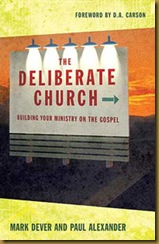
The first P is the preaching of the Word.  It is the authors conviction that this is the vital aspect to a ministry.  Dever even goes so far as to say that every other aspect of his public ministry could fail so long as he was faithful in preaching the Word.  His reason?  Dever is firmly convinced that God is always in the business of using His Word to “create, convict, convert, and conform His people”.  (34)  His reason for such a conviction is well grounded, and that truth is displayed in the fact of everything the Bible says about the Word of God.  The Word of God: sustains us, grows and fights, builds us up, preserves us, is the effective power for salvation, creates faith, performs God’s work in believers, convicts, brings about the new birth, saves us, and furthermore the Word is made flesh in Jesus incarnate.  “There is creating, conforming, life-giving power in God’s Word…that’s why we need to be teaching our congregations to value God’s Word over programs” (35). 

The second P is prayer.  Prayer is a wonderful display of our dependence upon God.  But what should we be praying?  Dever gives 5 suggestions: 1) the prayers recorded in the biblical record 2) pray for the preaching of the Gospel 3) pray for increased maturity and faithful testimony of your body of believers 4) pray for sinners to be converted 5) pray for opportunities for evangelism.  Dever also suggests one practical way of praying; assemble a church membership directory and pray for your fellow believers. 

The third P is personal discipling relationships.  This is an especially fitting “P” for pastors, but I think it can extend beyond that.  The concern here is to build intentional relationships with people in your congregation.  Discipling is simply another channel through which God’s Word can flow into another persons life.  Furthermore, as a pastor you ought to be encouraging these type of relationships with others.  Also, such relationships with people will break down some of the “defensive resistance to your pastoral leadership”.  This one is simple and needs to be heeded by pastor and congregation alike: build meaningful relationships.

The fourth P is patience.  When Dever first came to Capitol Hill he waited three months before preaching his first sermon.  He wanted to get to know the people and what they were accustomed to.  This also communicated patience.  In this section Dever reminds us that God is very patient; “[He] is working for eternity, and He has been working from eternity.  He’s not in a hurry and we shouldn’t be either.” (39)  How do you cultivate such a perspective?  We are given three areas to have a right perspective on: time, eternity, success. 

Patience in the pastoral “requires thinking in terms of twenty, thirty, forty, or even fifty years of ministry”.  This is a call to commit to the church that you are called to pastor.  And I suppose this same thing should be said to non-pastors and members of any church.  Furthermore, we must have a proper view of eternity.  This is a call to “shepherd the flock in a way that you won’t be ashamed of on the Day of Accounting”.  Finally, we must define success in terms of faithfulness.  Otherwise, we will become frustrated and burn out.  This is a call to "stake your ministry on the power of the Gospel.” 

Quotables:

“Prayer shows our dependence on God.”  (35)

“Your prayers for people don’t have to be long—just biblical.”  (36)

“The best way to lose your place of influence as a pastor is to be in a hurry, forcing radical (even if biblical) change before people are ready to follow you and own it.  It would be wise for many of us to lower our expectations and extend our time horizons”.  (38-39)

“As you work for change, work also to extend genuine, Christian goodwill toward people.”  (39)

“If you define success in terms of size, your desire for numerical growth will probably outrun your patience with the congregation, and perhaps even your fidelity to biblical methods…But if you define success in terms of faithfulness, then you are in a position to persevere, because you are released from the demand of immediately observable results, freeing you for faithfulness to the Gospel’s message and methods, leaving numbers to the Lord.”  (40)

“Stake your ministry on the power of the Gospel.”  (41)

Questions:

Do you agree that “there is only one thing biblically necessary for building the church, and that’s the preached Word of God”? 

In this chapter Dever calls for patience in change.  Should we be patient with sin and with sinful structures?  If the church in unbiblical why should we go slow in change?  (I’m not saying I agree with the assertion behind my question—just wanting to think through this). 

These are Dever’s questions: 

What three Bible passages will you memorize for the purpose of praying for your church?

Could your ideas of time, eternity, and success be cultivating a spirit of impatience with the congregation you serve?  If so, how?  How might those ideas need to be re-formed? 

We are also given an assignment.  Pick one person in your church to get together with for spiritual good, and pick a book or booklet to read and discuss with him/her. 

Any questions you have?  Don’t forget to discuss.

Tuesday, June 2, 2009

Thinking Through ‘The Deliberate Church’: Introduction

If you missed our discussion on the Foreword it is here. Also, I might mention that the entire point of having an online discussion is to…wait for it…DISCUSS!!! That means that it could be a good idea to write some comments on the blog. I know its scary; but God is powerful. You can do it. If you have yet to buy the book you can do so for only $8.99 here. deliberatechurch

Quick Summary:

Before you start building something it is vital that you know exactly what you are building. Because the church is not a Fortune 500 club or just another social gathering it is important that we know what a healthy church is supposed to look like; there is no secular model from which we can take our cues.

What is a local church? Dever gives a few pointers. 1) It is a corporate display of His glory and wisdom, both to unbelievers and to unseen spiritual powers. 2) we are a corporate dwelling place for God’s Spirit, the organic body of Christ in which He magnifies His glory. Summary definition: The church is God’s vehicle for displaying His glory to His creation. (26)

Furthermore, the church is unique because of her message; namely, the Gospel of Jesus Christ. And therefore, the distinguishing marks of a church are the “right preaching of the Gospel and the right administration of the biblical ordinances that dramatize it. (26)” The church then is God-centered and outward-looking. It is a ministry of magnification where “we are building a corporate, organic structure that will accurately magnify God’s glory and faithfully communicate His Gospel.” Jesus is the One who is ultimately building His church.

Now that we know what a healthy church is we have to ask, “how do you build it?” There are numerous options and diverse answers to that question throughout evangelicalism. Dever gives a four quick points to help govern the relationship between the Gospel and the method of its ministers:

  1. Theology drives method
  2. God’s methods determine ours
  3. The Gospel both enables and informs our participation in God’s purposes
  4. Faithfulness to the Gospel must be our measure of success, not results

Quotables:

No matter how beautiful the facade, the structure will crumble if we build on a sandy foundation or with shoddy materials.” (25)

Ignoring God’s plan for the church and replacing it with your own will ensure the eternal futility of your work.” (25)

Our power is in our unique message—The Gospel—not in our innovations.” (27)

Questions:

How would you answer the question, “What is a local church”? Do you like Dever’s summary definition?

These are Dever’s:

What’s driving your church—the content of the message, or the uniqueness of the presentation?

Is your ministry method driven by biblical theology, or by what works?

Do you measure success by results, or by faithfulness to God’s Word?

Thursday, May 28, 2009

Thinking Through ‘The Deliberate Church’: Foreword

A couple of years ago I read Mark Dever and Paul Alexander’s excellent book The Deliberate Church.  Recently a friend of mine as well as a couple other people have made mention of this book.  I thought it would be helpful to journey through this book with adeliberatechurch few other believers.   It has been awhile since I read it and could certainly use other believers to think through some of these issues—especially others from different churches.  I will attempt to summarize each chapter (so maybe those that are not reading the book can still follow along) and then ask a few questions that we can discuss in the comments. 

If you have not bought this book yet, you really should.  It is only $8.99.

Quick Summary:

Dever wonders ‘why did you buy this book’?  Accident, discouraged, wanting to make an impact, disillusioned, or looking for new life in your church (the next great thing)?  Regardless of the reason for your purchase (or following along with us as we read through it) it is important to know from the beginning what this book is not.  It is not new, it is not a program, and it is not a quick fix.  This book is not about innovation it is about biblical faithfulness.

Dever defines the purpose simply as this: “To be deliberate about treating the biblical Gospel as that which feeds the church’s growth, drives its progress, and governs every aspect of the church’s corporate life and leadership.” (21) 

The foreword is closed out by asking a very important question:  Is it replicable?  Thankfully, it is absolutely replicable.  It is important as well to catch what Dever says on page 23, “[these] are not intended to be taken as either exhaustive or exclusive, but simply as an attempt to revive a warm conversation about how we feed, lead, and protect the flock of God.”  It will take patience and it depends on the sovereignty of God.  The goal is faithfulness. 

Quotables:

Healthy growth takes time, prayer, hard work, patience and perseverance.”  (20)

Our goal isn’t to see how innovative we can be.  Our goal is to see how faithful we can be.”  (21)

…human method has to remain plain, or else it will naturally supplant the Gospel’s rightful role…the Gospel is cast in bold relief against the backdrop of our own admitted weakness.”  (22)

Questions:

  • So why did you buy this book?  Or why do you want to discuss it? 
  • What do you think of this statement: “When the Gospel enjoys functional centrality, the church gains traction in the culture…”?
  • This one is from the book:  “Does the Gospel enjoy functional centrality in your church?  Why or why not?  Are there ways in which your current model of ministry might siphon off the glory of the Gospel for itself?  How so? 
  • What other thoughts and questions do you have?

Monday, December 31, 2007

Borrowed Light: Today in Blogworld 12/31

Looks like bloggers are back to work this morning; as soon as I looked at my Google Reader I noticed 28 new posts. It being New Year's Eve, I thought it wise to point you to a couple articles on the New Year. Matt Harmon points us to Jonathan Edwards Resolutions; which are always good to read this time of year. It is especially important that we remember Edwards' beginning statement: "Being sensible that I am unable to do anything without God's help, I do humbly entreat him, by his grace, to enable me to keep these Resolutions, so far as they are agreeable to his will, for Christ's sake." I reminded our youth on Sunday that even if we make our New Year's resolution something to the effect of "determining to know nothing in 2008 but Jesus Christ and Him crucified", we will fail by January 2nd or 3rd. Therefore we must live under and preach the gospel to ourselves daily.

Many people use this time of year to reflect upon the past year, and sometimes their entire lives. John Piper considers it a yearly dress rehearsal for meeting Jesus. Therefore, this time of year can serve to awaken us to a realization of another year passed and another moment closer to meeting the Lord. Pyromaniacs use the last words of Benazir Bhutto to remind us of the frailty of life. How ironic that her last words were "Long live Bhutto". As this year draws to an end we must remember that the only way to accurately proclaim "Long live..." is to have a relationship with Jesus Christ.

Last night Tim Challies summarized the Reality Check Conference. He concluded his blogging on sessions 6 and 7.

Timmy Brister concluded his 2007 Year in Review with post 10-6 and 5-1. One of these posts that particularly caught my interest was On Hitting Homiletical Homeruns. The conversation was also carried over at Said at Southern, here. The discussion is over plagiarism in the pulpit. The discussion began when James Merritt suggested going to his website and preaching his sermon instead of spending so much time putting together their own. This is not an uncommon thing. I frequently get fliers in the mail encouraging me to stop preparing sermons and do what really matters (and apparently what I should really want to do)--spend time with our youth. I wonder if this might be an unbiblical practice on top of another (shout out to Garrett). I wonder if we had a plurality of elders maybe a teaching pastor could spend time on sermon prep and the other elders could do some of those other things. Maybe the pastor was not meant to be the lone ranger and having to rip sermons off the internet because he spent 30 hours this week at the hospital and in counseling.

The 9 Marks newsletter has been posted online. This newsletter focuses on Corporate Prayer and will be worthy of checking out.

John Piper points us to Clyde Kilby's 10 Resolutions for Mental Health.

Lastly, the Irish Calvinist draws our attention to a video posted on James White's site. It compares Joel Osteen, The Secret, and Stuart Smalley. It would be humorous if Osteen did not boast 20,000+ deceived members. The reason I am so strongly opposed to Osteen is because he is a false prophet that deceives many. He preaches a half (maybe quarter) truth that is divorced from the bloody Cross of the Gospel. The problem is not that God doesn't want to bless us. The problem is that the blessing is not in material things it is in God Himself, and it comes through the Cross. Not only the Cross of Christ but also ours (Matthew 10:38). Here is the video:

LinkWithin

Related Posts Plugin for WordPress, Blogger...