Wednesday, April 6, 2011

Seeing Life Through My Fingers

“You seem really stressed out and intense, lately”, my wife graciously pointed out to me. 

“No!  I’m not intense”, I said, rather intensely. 

It wasn’t until a few days later that grace broke through and I was able to see that for a good month or so I had been running furiously on a performance treadmill.  I was functionally denying the gospel and bowing to an idol of control and self-sufficiency.  I was doing what Paul Tripp says is like putting a hand in front of my face:

“Imagine that you have placed your hand, with fingers narrowly separated, in front of your face. When you attempt to look through your fingers, your vision is obstructed.  As long as your hand is in front of your face, no matter where you turn to look, your vision will be altered by your fingers.  So it is with an idol in my heart.  It will exercise inescapable influence over my life.  Wherever I go, whatever I am doing, the idol will influence what I do and how I do it.  This is the reason God says, “It makes no sense for me to talk about anything else, because whatever I say somehow, some way, will be used to serve the idol that rules your heart.  Therefore, I want to deal with your idolatry.  That is my priority.”  (Paul Tripp, Age of Opportunity, p30-31)

I am sure that I still have my hand in front of my face in certain areas.  I pray that the Lord exposes these idols and lays them bare.  But I know also that unless these idols are replaced with a firm fixation on Christ, I’ll settle for throwing my hand in front of my face. 

Here is something to ponder…In what way does the truth of what Tripp is suggesting shape your relationships with other people?  What role does a hand in front of the face play in our arguments with other people?

Tuesday, April 5, 2011

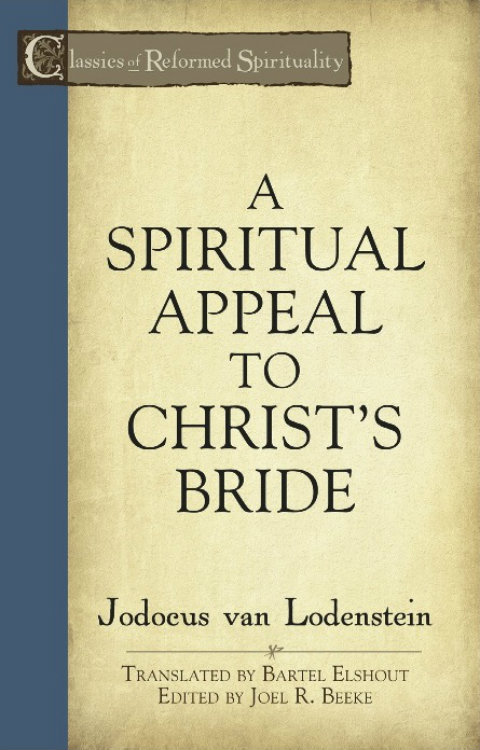
Review of A Spiritual Appeal to Christ’s Bride

A few months ago I bought an iPod Touch.  And I was perfectly content with my little iPod.  In fact it was awesome!  There was so much that could be done on it.  It expanded my world.  My iPod Touch was by far the coolest gadget that I owned. 

Then a very dear and gracious friend decided to simply bless me with an iPad.  (Yeah, I know you need to figure out where to get friends like mine).  Now my iPod seems tiny, stunted, and a little sad compared to my iPad.  An iPod can’t hold a candle to an iPad.  Compared to the greater the lesser doesn’t look so sweet. 

As I reflect on this I realize that this is the plight of many teenagers that I have ministered to.  Okay, I’ll be honest.  It’s the plight of my own heart.  I can be pretty content with my iPod to the neglect of the much greater iPad.  Rather than really striving to grab hold of and experience the fullness of Jesus I settle for a little bit. 

So as a pastor it is my task to encourage people that there is more to Jesus than the paltry experience that we often settle for.  And as a follower of Jesus I must constantly be reminded that my own heart is far too easily pleased. 

Jodocus van Who?!?!?

When settling for a paltry experience of Christ is the norm for the Church we are indeed in perilous times.  This was the climate that Jodocus van Lodenstein found himself in.  Lodenstein (1620-1677) was a preacher and poet of the Dutch Further Reformation; a movement that paralleled English Puritanism. 

Lodenstein believed that the Reformation did not go far enough in terms of practice.  It had recovered sound doctrine but in his mind that doctrine had yet to penetrate the culture of the church.  “Lodenstein equated the Reformation to Ezekiel raising bones in the valley of dry bones.  The Reformation renewed good doctrines, but it was only a skeleton on which flesh was yet needed.” (23)  What was needed for a thorough Reformation was the Spirit. 

To use our earlier analogy, Lodenstein firmly believed that those living in his day were satisfied with the iPod (doctrinal Reformation) when the iPad was much better (spiritual Reformation).  To this end he stressed the need for the Spirit’s work as well as the Christian life.  “He stressed sanctification more than justification…in so doing he paved the way for later pietists to follow in his steps.”  (31)

That which was dear to Lodenstein’s heart has been captured in the latest from the Classics of Reformed Spirituality series: A Spiritual Appeal to Christ’s Bride.  This book is a compilation of nine sermons preached by Lodenstein, that aim to awaken the nominal Christian from spiritual slumber and to experience more deeply the benefits of Christ. 

Summary

Since very few people have heard of Lodenstein the first twenty or so pages are dedicated to introducing the reader to his life and times.  Written by Joel Beeke, this section is worth the price of the book for history nerds like myself.  I’ve studied English Puritanism pretty extensively but have heard little of the parallel Dutch Further Reformation.  This introduction is helpful and informative.

The nine sermons are pretty typical of his era of preaching.  He introduces the text, makes a spiritual/theological point, raises objections, answers the objections, and then offers some application.  If you have read any of the English Puritans you know how they often take one verse, look at it from all angles, and then preach 25 sermons on that one verse.  Lodenstein is similar though he tends to be more heavy on applications than some of the English Puritans. 

Lodenstein does not engage in what you would term expository preaching but he has some real gems that need to be shared.  His passion for an experiential religion bleeds throughout his sermons.  You can feel his passion and angst for the people he ministers to as he pleads with them to reject vanity and embrace the fullness of Christ. 

Rather than discussing all of these sermons it may be beneficial to list their titles and then explain their common themes. 
  1. Belonging to God Involves Self-Denial (1)
  2. Belonging to God Involves Self-Denial (2)
  3. Self-Denial Involves Submitting to God’s Will
  4. Dead Hearts
  5. God’s Departure from the Church
  6. Divine Illumination in Conversion
  7. Vain Excuses for Turning from Christ
  8. The Bride’s Charge to the Daughters of Jerusalem
  9. The Bridge Brought into Christ’s Chambers
As you can see self-denial is a major theme for Lodenstein.  By this he means that “belonging to God therefore means that we possess nothing for ourselves but that everything is for the Lord.”  The first three sermons serve to flesh out this idea. 

Another major theme is Spirit-wrought repentance.  Lodenstein believed that his Church was living in Ezekiel 37; they were a lifeless body of professing believers but ones that lacked the Spirit.  “The life-giving Spirit who is in Christ Jesus was lacking, by whom the power of sin, which formerly held sway over us, must be slain.”  Because there was no Spirit there was no morality.  Therefore, Lodenstein prays for and pleads for a Spirit-wrought repentance.

The final theme that I will mention is the one that gives the book its title; the relationship of Christ’s Bride to her husband.  Lodenstein saw the Song of Solomon (as was typical in his day) as an allegory of Christ and the church.  As such he saw a few pictures of the Bride turning away from her husband.  These he used to call the church back into a vibrant relationship with her husband.  This passionate plea informs the entirety of his sermons. 

Concerns

There is one other theme that runs through at least the first few sermons fairly prominently; we must submit to God even if he doesn’t give us grace to over come sin.  Consider these quotes:
“…we are obligated to acquiesce in what God prescribes, which includes being submissive even if God does not give an increased measure of grace to obey His will.”  (37)
“Should he permit you to fall into sin and become spiritually dull and lethargic, you must learn to say, ‘Yes, Lord, my delight is in Thy will.’”  (39)
“…you should submit to God’s sovereign dispensation insomuch as He has been pleased to determine that you shall not gain further victory over sin.”  (109)
Now I don’t think that Lodenstein is encouraging his people to be comfortable with sin and just wait until the Lord gives them grace to overcome it.  That would contradict his frequent calls of repentance.  But I do think that he is taking his “Calvinism” into dangerous territories. 

He is practically denying the truths of Romans 6-8.  We have been freed from bondage.  It seems to me that he is assuming that the will is in bondage even during sanctification, and that is simply not the case.  We are free to obey the Lord. 

Perhaps, I am misunderstanding Lodenstein, and if so I welcome correction.  I also am sensitive to the fact that he ministered in a much different time than I do (although not so different really).  The church and the community were often so interwoven that the lines between believer and unbeliever were often muddied.  And Christian living was often expected of those even that were unbelievers.  So I can understand how the lines between justification and sanctification could get muddied.  But there is a hopelessness to some of Lodenstein’s appeals that really do not apply to someone that DOES have the Spirit of God. 

Why You Still Need This Book

Nonetheless, this is still a book worthy of adding to your personal library.  I am not certain that this would be the greatest fit for the average layman that is unfamiliar with reading 16th and 17th century literature.  There would be other books that would be more helpful introductions. 

However, to the pastor and student this book is helpful.  I hope to see more works from the Dutch Reformation.  There are some very reach truths in this work that will benefit many.  The history is also worthy of your ten dollars.  I found it interesting to see the way that a man from the Netherlands in the 17th century handled text and dealt with some of the same spiritual struggles we have in our day. 

There is much we can learn from Lodenstein, and to that end I recommend this book.  You can pick it up at Reformation Heritage for only 8 bucks

More Mercy in Christ Than Sin in Us….So What?!?

One of my favorite quotes is this gem by Richard Sibbes: “…there is more mercy in Christ than sin in us…”  If you have time do a Google search for that quote and you will notice that I am not alone in my love of this precious gospel statement.  But it is even more beneficial to understand what Sibbes is saying in the larger context:

“It is dangerous, I confess, in some cases, with some spirits, to press too much and too long this bruising, because they may die under the wound and burden before they be raised up again.  Therefore it is good in mixed assemblies to mingle comfort that every soul may have its due portion.  But if we have this for a foundation truth, that there is more mercy in Christ than sin in us, there can be no danger in thorough dealing.  It is better to go bruised to heaven than sound to hell.  Therefore let us not take off ourselves too soon, nor pull off the plaster before the cure be wrought, but keep ourselves under the work till sin be the sourest, and Christ the sweetest, of all things.”

Sibbes is saying that because there is more mercy in Christ than sin in us we cannot dig so deep as to find sin that is not covered by grace.  For Sibbes the more that sin is exposed the more we begin to realize what Christ has delivered us from. 

Now, some of the Puritans (as we can as well) had a tendency toward a morbid introspection.  That can be very dangerous to go on a quest, turning over every rock, trying to find sin only for the sake of discovering sin.  That is not what Sibbes is referencing.  The “bruising” that Sibbes is talking about is actually akin to a deep conviction of the Spirit.  He is encouraging us not to undercut the Spirit’s work but to cooperate in such a way that we really deal thoroughly with sin. 

Often when the Lord begins to bring conviction we want to move quickly to the warm fuzzy experience of forgiveness.  And many times this robs us of substantial healing.  This is why Sibbes says, “nor pull of the plaster before the cure is wrought”.  He is comparing our tendency to move quickly through repentance to our common tendency to take the cast off a broken arm before healing has been complete. 

Now because there is more mercy in Christ than sin in us we are able to endure this season of bruising with a profound joy, because we know that it only leads to healing.  Repentance becomes sweet when you know that you cannot out sin God’s mercy.  It is also sweet when you come to realize that the reason the Lord brings conviction is because He aims to heal and to further our experience of joy and delight in Him. 

Monday, April 4, 2011

Isaiah and Hannah, Daddy Was Resurrected

Do your children know your story? 

If I interviewed your children about your relationship with Jesus what would they say?  What would they know? 

Look at what happens if your children don’t know your story:
When Joshua dismissed the people, the people of Israel went each to his inheritance to take possession of the land. And the people served the LORD all the days of Joshua, and all the days of the elders who outlived Joshua, who had seen all the great work that the LORD had done for Israel. And Joshua the son of Nun, the servant of the LORD, died at the age of 110 years. And they buried him within the boundaries of his inheritance in Timnath-heres, in the hill country of Ephraim, north of the mountain of Gaash. And all that generation also were gathered to their fathers. And there arose another generation after them who did not know the LORD or the work that he had done for Israel.   (Judges 2:6-15, emphasis mine)
If you are a believer in Jesus Christ and you have children then you have a Christian family that is charged with the task of raising up another generation to see Jesus Christ as their only boast. 

Wouldn’t you think that God parting a sea would be a story you’d want to tell?  Seriously.  Hollywood decided it was good enough to tell and they told it ala Prince of Egypt.  It is an awesome story.  Wouldn’t you think this would be one of those stories you would want to tell your children and their children?  Nope, not Israel.  They are living in the comfort of the promised land. 

But, Christian mom and Christian dad, you don’t understand…what God has done in your heart is a gazillion times cooler than the parting of the Red Sea.  He brought a dead God-hating heart out of darkness and slavery and breathed new life into it.  Yes, you were raised from the dead.  That’s a pretty cool story, don’t you think? 

And if you don’t share that story then your kids and your grandkids will forget that there is a God that raises the dead.  They won’t know that there is a God that is powerful enough to change the leopard’s spots, to melt the heart of stone, to rescue, to heal, and who is mighty to save.  

So, don’t be like the Israelites in the Promised Land…Enjoy His grace and extend His glory; especially to your own children. 

Borrowed Light Book Club: Winning Book Announced

At the end of last week I offered a chance for you to vote for what book you would like to study together.  After tallying all of the votes it was a tie between Jared Wilson’s Your Jesus Is Too Safe and John Piper’s God is the Gospel.  And so because this is my blog I get to break the tie.  That means the first book we will study is Piper’s God is the Gospel.

Actually there is a reason that I chose this one; it is actually to serve you better.  Piper has graciously made this book available for totally free at the DG website.  If you are comfortable with being an e-reader then you can download a PDF version of this book here for absolutely free:

God is the Gospel in PDF format

If you prefer to purchase the book you can get it on Amazon for just a little over 10 dollars:

God Is the Gospel: Meditations on God's Love as the Gift of Himself

As you are deciding whether or not you should commit to reading this book, perhaps it would be helpful to know why we are starting this project.  The first reason is that it is very difficult to stay committed to reading a book.  Many of us probably have a stack of books that we would love to read but we never seem to get around to it.  A book club like this allows us to remain accountable to one another and spurs us on in reading good Christ-centered books.  I want us to spur one another on.

The second reason for this project is that I want our enjoyment of God’s grace to deepen.  I believe that our stomachs need to be stretched in our appreciation of God’s Word and the implications of His gospel.  One way that this happens is through reading solid Bible-saturated books.  I want our appetite to grow.

Lastly, I believe that as our enjoyment of God grows our passion to extend His glory will also grow.  A good book has a way of spreading.  When God uses a book to shape your life it is quite common to have a deep desire to spread that to others.  So whenever we read books that are God-centered it has a way of shaping us, and that shaping influence has a way of spreading the glory of God to others.  I want our study to equip and multiply.

I encourage you, then, to join us.  You may find Piper a little difficult at times—that’s okay.  Our study is a time for us to learn together.  We all come from different perspectives and backgrounds and your comments and struggles through the book are needed.  Your insights matter. 

Every week (Monday) I will provide a short summary to each chapter and then open up the comments for you.  This will be your chance to offer your thoughts and/or questions.  You can leave a comment here, you can leave a comment on Facebook, or if you have your own blog you can interact there and provide a link.  If you’re a quiet lurker then feel free to simply read and enjoy. 

So, now it’s your turn to either buy the book or start reading the PDF.  Leave a comment and let me know if you are going to join us…

LinkWithin

Related Posts Plugin for WordPress, Blogger...