Showing posts with label family. Show all posts

Tuesday, November 27, 2012

6 Principles For Spiritually Nourishing Your Family

I have been reading The Shepherd leader at Home by Timothy Z. Witmer. It is a short book that packs a pretty solid punch. Witmer encourages husbands and dads to know, lead, protect, and provide for their family. In his chapter on Spiritual Provision, Witmer lists six principles* that can help assist the spiritual reflection times you have with your family:

  1. Be realistic. Don’t set plans that you can’t actually sustain
  2. Be systematic. Do have a plan, though
  3. Be flexible. Rigidity will lead to disdain, it’s okay to miss a night
  4. Be consistent. Missing a night should be the exception, not the rule
  5. Be interactive. Be intentional about encouraging involvement
  6. Be real. Make this a natural reflection of your own walk with Christ

I have found Witmer’s book helpful. You may as well. You can purchase it at Amazon for only 8 bucks.

---

*The points are Witmer’s, the summary is mine

Friday, November 9, 2012

Suggested Resources For Family Ministry

I recently had a dear friend ask me to give him a few resources for implementing a family ministry structure in the church that he pastors. I thought that perhaps others might benefit from the list I provided.

Conceptual:

“Our church wants to begin doing family ministry”. That sentence can mean any number of things. The people in your church probably have differing ideas as to what actually constitutes family ministry. That is why you need to have a season where everyone gets on the same page as to what family ministry actually consists of. The most helpful book for doing this is 3 Views of Family Ministry edited by Timothy Paul Jones from the Perspectives Series. (Read my review here).

Though I ultimately embrace a different model, one book that will need to be considered is Voddie Baucham’s Family Driven Faith. Here he makes a strong case for the necessity of family ministry. I prefer the Family-Equipping model and so I believe that Baucham overstates a few things. However, this is a valuable resource in showing the need for doing family ministry.

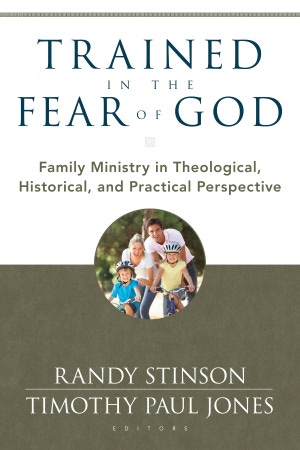
Another helpful book is Trained in the Fear of God edited by Timothy Paul Jones and Randy Stinson. This books gives theological, historical, and practical reasons for installing a family-equipping ministry model.

Implementation:

If you have everyone on the same page as to what actually constitutes family ministry, and you everyone decides that the family-equipping model is the best option then you will need to figure out how to implement a family ministry strategy. There is no better book for doing this (from a family-equipping perspective) than The Family Ministry Field Guide by Timothy Paul Jones.

Another helpful resource, though honestly I think you only need Jones’ book, is The Family-Friendly Church by Freudenburg and Lawrence. This book will serve as somewhat of a vision casting book. You will see here what other churches are doing to help equip families for a “home-based, church-supported ministry”.

Day to Day:

You’ve got your family ministry up and running. Now what? Here are a few books that I have found helpful in the day to day operations of family ministry:

Age of Opportunity by Paul David Tripp (excellent resource for parents of teens)
Family Shepherds by Voddie Baucham (excellent resource for dads especially)
A Parent Privilege by Steve Wright (great reminder of the privilege of parents)
Give Them Grace by Elyse Fitzpatrick (read my review)

SBTS

I am probably biased on this point. Forgive me. But I do think I am correct. SBTS seems to me to be leading out in the field of family-equipping ministry, thanks in part to the leadership of Timothy Paul Jones. I say this to say keep your eyes open for things coming from SBTS in this field. They are usually pretty high quality and cutting edge in this relatively new perspective on family ministry. One particular resource that you need to subscribe to is Family Ministry Today. This journal will help make you aware of new books in the field of family-equipping ministry as well as various issues that you might have.

Furthermore, I have found the folks at SBTS to be very accessible to the local church. If you have questions that arise during your implementation of family ministry contact the school.

Bottom Line:

If you are lost in all of these suggestions and you really only want to get 1 book get The Family Ministry Field Guide. If you can get two then add the Perspectives book. And be sure to keep an eye on the Family Ministry Today site.

Wednesday, August 1, 2012

The Soul of the House

The wisest of women builds her house, but folly with her own hands tears it down (Proverbs 14:1)

Commenting on this passage Charles Bridges says:

…the wife [is] a blessing or a curse to her husband.  Such is she to his house.  Her wisdom may supply many of his defects; while all the results of his care and prudence may be wasted by her folly.  The godly matron is the very soul of the house.  She instructs her children by her example, no less than by her teachings.  She educates them for God and for eternity; not to shine in the vain show of the world, but in the Church of God…

But mark the foolish woman—her idleness, waste, love of pleasure, want of all forethought and care, her children’s wills allowed, their souls neglected, their happiness ruined!  We see her house plucked down in confusion.  A sad issue, if an enemy had done this!  But it is the doing, or rather undoing, of her own hands.  In proportion to her power and influence is the capability of family mischief…

In other words the influence of the woman is very great as it concerns the spirit of the home.  It’s no wonder then that Bridges went on to say, “What responsibility then belongs to the marriage choice, linked with the highest interests of unborn generations!” 

Wives, pursue wisdom and drink deeply from the fountain of grace.  Husbands, nurture your wives.  Future wives, don’t wait for marriage to get wisdom.  Pursue it now.  Future husbands, look for a woman that is pursuing God and His wisdom.  

Monday, March 12, 2012

Review of Trained in the Fear of God

There is a classic story (that probably has Jewish roots) about a new bride that is cooking her first big dinner for her husband.  She decides to go with a recipe that has stood the test of time; a roast that was passed down to her by her mother, who in turn had learned it from her mother.  Part of the recipe called for cutting off the ends of the roast.  The husband, is astonished by this.  He asks, “why in the world do you cut off the ends of the roast?  That is the best part!”.  Her reply is simple, “That’s the way my mom always made it”. 

Later on in the week the new bride decides to question her mom about this practice of lopping off the ends of the roast.  The mother’s reply is the same as the daughter’s, “that was always the way my mom made it”.  The two curious ladies decide to ask grandma why she cut off the ends of the roast.  She says, “I always cut off the ends of the roast because that is the only way that I could get it to fit in the pan”. 

The point of the story is that generations upon generations can dutifully follow a tradition without even understanding it.  What is worse when ripped from its original intention the new generation’s following of a practice is not only stupid it is also quite unhelpful and maybe even harmful.  What happened with the grandmother and her roast is that she taught the daughter the practice but never explained why she did it.  The daughter then was not able to contextualize the recipe for her own setting and so she slavishly followed a tradition and handed an unnecessary “must” down to her own daughter.

What is true of a three generations of ladies cooking a roast is just as true of many churches.  There are various practices and strategies that have become a “must” to churches but the historical, theological, and even practical reasons for doing them have not been handed down.   As a result of this oversight churches either neglect to key biblical practices (such as parents discipling their children) or they slavishly follow extrabiblical traditions without really knowing the reason why. 

Summary

Trained in the Fear of God is a book compiled by Timothy Paul Jones and Randy Stinson that aims at providing these historical, theological, and practical reasons for engaging in family-equipping ministry.  Family-equipping ministry is “the process of intentionally and persistently coordinating a congregation’s proclamation and practices so that parents are acknowledged, trained, and held accountable as primary disciple-makers in their children’s lives”.  It’s not a program to be added to your church but a philosophy of doing family ministry that attaches itself to everything the church does. 

This philosophy of ministry is catching on in many churches.  It is the philosophy of youth, student, and family ministry at The Southern Baptist Theological Seminary and is quickly spreading to many other institutions.  It is filling a void that is left in many other approaches to family ministry.  As such many churches are adopting it.  With such a spreading one of the dangers is that family-equipping ministry will just become the latest program and two generations from now it will become the next “lopping off the end of the roast” and its theological, historical, and practical foundations will be neglected. 

Trained in the Fear of God is divided into three sections: Biblical and Theological Framework, Historical Foundations, and Practice.  They are not titled that, but that is essentially the way the book is broken up.  There are seventeen different chapters from different contributors (many of them are professors at SBTS).  The reader is encouraged to check out the Table of Contents. 

The book not only makes a compelling case for the necessity of family ministry it also paints a picture of what family ministry looks like in practice.  There are helpful chapters that engage cultural misrepresentations (Al Mohler’s chapter on Homosexuality as an example).  There are chapters that deal with family ministry in various contexts (Kevin Smiths’ chapter on Family Discipleship and the African American Experience).  There is even a chapter on the child’s brain and how family ministry helps to shape the child’s brain.  There is much to offer in these pages.

Should You Buy It?

If you are a church leader you should really consider buying this book.  I am convinced that Family-Equipping Ministry (whatever it looks like in your particular context) is the way that churches need to minister to families.  Every church that buys “how-to” books for moving towards family ministry needs to be certain to also purchase this book.  It will build a foundation that will answer the question of “why” for generations to come. 

If you are a mom or dad you should also buy this book.  It will not only help you to see your valuable role in discipling your children but it will provide helps in doing so.  In places where the book itself does not answer the “how-to” questions it will point you to other resources that will. 

I highly recommend this book.  Also as a little tip I would suggest looking up the Table of Contents and then doing a Google Search for the articles.  You might be surprised what you find while you are waiting to purchase the book. 

You can buy it here.  It’s a little pricy but worth every penny.  Churches need this book as a resource, so do schools, and so do parents. 

Friday, March 9, 2012

The Spirit of the Christian Household

I will be reviewing Trained in the Fear of God on Monday.  Until then I thought you could benefit from a rather lengthy sample.  This is from Peter R. Schemm Jr.’s contribution:

I once thought that the defining mark of a Christian home was “family worship” in the living room every evening[1].I would not have put it that way at the time, of course. Yet I have since realized that I was far too invested in performing the act of family worship as a measure of my success as a father. I possessed the spirit of a Pharisee-and few attitudes are more unhelpful to the Gospel of Jesus than such a spirit. It is the spirit of one who works to impress God and others through religious achievements. It is the spirit of self-justification. It is not the spirit of a Christian household.

By the spirit of the Christian household, I mean something closer to what Dallas Willard suggests in his book The Spirit of the Disciplines. He says,

The spirit of the disciplines-that which moves us to them and moves through them to prevent them from becoming a new bondage and to deepen constantly our union with the heart and mind of God-is [our] love of Jesus, with its steadfast longing and resolute will to be like him.[2]

Spiritual habits and disciplines are hollow apart from a genuine love and affection for Jesus Christ. They tend to take on a “new bondage” and become a means to seek an evil and enslaving endpoint instead.

The spirit of the Christian household is inspired by the love of God whom “we love because he first loved us” (1 John 4:19). It is a disposition that consistently reflects God’s love through grace and forgiveness. This disposition moves us to and through the habits proposed below. Our habits and disciplines, founded on the love of God, become a good means to a greater end. They form and transform our families into redemptive communities. These habits and disciplines train not only children but also fathers and mothers, to repent of specific things such as anger and demanding expectations. Paul Tripp describes it this way, “As we-parents and children alike-face our need as sinners, the family becomes a truly redemptive community where the themes of grace, forgiveness, deliverance from sin, reconciliation, new life in Christ, and hope become the central themes of family life.”[3] In a word, the spirit of the Christian household is a spirit of redemption.

Fortunately I didn’t have to type all of that out.  I did a search to see if I could find this quote somewhere else.  Looks like the Family Ministry Today blog thought this selection was worthy of quoting as well.  Credit to them for typing all that out.  Lot’s of good stuff at that blog.  Check it out: Family Ministry Today.

Monday, January 9, 2012

Review of Family Shepherds by Voddie Baucham, Jr.

I apologize for the voice dub on the above scene—it is the only video I could find.  I also must mention that for the following illustration I am indebted to Dr. Timothy Paul Jones from SBTS. 

“BOB, It’s time to engage!” 

Voddie Baucham has written Family Shepherds to not only inspire men to engage and lead their families but also to give Christian men a resource to engage.  This practical call for men to take up their God-given responsibilities to lead their families is meant to be an encouragement to men and a helpful resource for churches to use to equip husbands and fathers. 

It has been my experience that most men in the church want to lead their families.  The problem is that they either do not know how or lack the confidence to embark on this difficult and life-long labor. 

I confess on behalf of men everywhere that we are quite often guilty of only playing the games we are good at.  If we can dominate at baseball but can’t quite master ping pong you will see us on the baseball diamond far more often than swinging a paddle in our basement.  The same goes with areas in our lives.  Many men feel confident in their jobs, social clubs, or hiding behind the success of their sports teams.  Few men feel confident as husbands, fathers, and spiritual leaders.  As a result many men disengage.

Sadly, though many fathers compare their own parenting not according to Scripture but according to their own fathers treatment of them.  Yet all across America families are being devastated by men that have “taken their ball and went home”.  As Baucham there are…

“a myriad of families strewn across battlefields of broken homes, having been ravaged by passivity, ignorance, cowardice, and usurpation.  They’re homes with fathers who have no earthly idea how to lead them, let alone the slightest inclination to shoulder the responsibility.  What’s worse, many of these causalities of war are wearing medals and have trophies on their mantle that read, ‘For Merely Showing Up’!  (19)

Men need to do far more than show up.  Baucham hopes that Family Shepherds will not only inspire men to pursue more valuable trophies but also the book will equip men.  Baucham’s desire is to help men “see their proper role and responsibility as a family shepherd” and then “give him the tools, motivation, confidence, and accountability he needs in order to step into that role and succeed.” (44)

The book is divided into five parts.  The first part is a biblical exposition of the family and a passionate plea for men to see themselves as the family shepherd.  The second part is meant to equip men to disciple their children by embracing their role as prophet and priest for their family.  The third part rightly emphasizes the necessity of a family shepherd to have a healthy marriage.  The fourth part deals with training and discipline by reminding dads that their goal is not to raise good little Pharisees but Jesus followers.  The last section is a lifestyle evaluation where Baucham challenges men to consider their church membership, use of time, and dual citizenship.  The book also has a short section meant to address the reality of fatherless families and then two short appendices: tools and a sample prayer gram. 

Does it succeed?

One of my “projects” at FB Jasper is to develop, implement, and work out family-equipping ministry in our church.  As such I am constantly looking for resources to not only inspire men to take up their God-given responsibility to be a family shepherd but also to equip men to fulfill that role.  I was very excited to see that Family Shepherds claims to accomplish both of these aims.  Does it?

If I ask the question of this book, “does it clearly define and inspire men to take up their God-given role of family shepherd” then the answer is a resounding yes.  Baucham not only navigates controversial aspects (such as discipline and male headship) but he also inspires men to do what God has called them to do.  I appreciate Baucham’s chapter on the necessity of a man putting his wife ahead of his children.  I further appreciate his emphasis on the necessity of the local church.  I would feel comfortable giving this book to any man that is wondering what his responsibility is as a husband and father. 

If I ask the question of this book, “does it equip men to confidently fulfill their role as family shepherd” I would humbly and disappointedly say not quite.  In my opinion the book does a good job of showing men what to do but it falls a little short in helping men actually figure out how to do it.  Though Baucham rightly points out the necessity of men discipling their wives, there is little in the book to assist men in accomplishing this task.  There is some practical help on catechizing, leading family worship, and disciplining children but as a whole the book does not seem to fulfill it’s promise to equip men as much as it does calling men.

The reader should also be aware of Baucham’s blunt style.  He is known as a teacher that simply says things as they are without leaving much room for grey.  There are times when this is necessary but some may be turned off by the way Baucham navigates controversial topics.  If one is not already in agreement with Baucham’s basic presuppositions I am not sure he winningly makes his case to convince a skeptical reader of adopting his position. 

I will save for a later date my distaste for the occasional shot that Baucham seems to take at those that do not fully embrace his family-driven faith model of church and family ministry. 

Conclusion 

Though the book has a few weak spots I would still recommend it.  The book is an excellent source for calling men to become family shepherds.  If it were to be used as a resource to inspire men to discover their God given roles with the occasional practical tip to live that out then this book is very helpful.  If you try using it as the resource (and I’m not sure Baucham would even suggest that) for equipping men to be family shepherds you will probably be disappointed. 

I am very grateful for Voddie Baucham and his ministry.  This book inspired me and taught me in areas where I have been lax.  I would encourage every man to at least give this book a quick look—and some may want to feast for awhile. 

I received the book free from Crossway in exchange for a review.  The review did not have to be positive.  If you would like to purchase the book you can do so for under 10 bucks.  Click here if you want to buy it. 

Tuesday, August 16, 2011

Somebody Wants to Tear Apart My Family

If I knew there was a man that lived down the street that hated my family and was hell-bent on our destruction it would, obviously, cause me to be quite unsettled.  It would radically change the way that we lived our lives and our level of comfort. 

One thing that I like to do is pray through the Psalms and occasionally insert my wives name into the I, me, or we sections.  It helps me to pray the Psalms over her.  When I did that this morning to Psalm 17:10-12 it really hit home:

They close their hearts to pity; with their mouths they speak arrogantly. They have now surrounded our steps; they set their eyes to cast us to the ground. He is like a lion eager to tear, as a young lion lurking in ambush.

That is a pretty apt view of my family from the perspective of hell.  This hellish army is indeed like a “lion eager to tear”.  To think that the forces of hell desire to devour my dear son Isaiah, my precious daughter Hannah, and my beloved wife Nikki, drives me to my knees in prayer. 

I know that there is only One that is powerful enough to protect them from this “eager lion”; namely the Greater Lion—the Lion of the Tribe of Judah.  So I pray with David:

“Arise, O LORD! Confront him, subdue him!”

Christ has indeed done just that.  He has conquered and rescued His sheep from this devouring lion.  And now I must pray that the Lord would see fit to draw my children to Himself, so that they too might find refuge in the Greater Lion, and will ultimately “be satisfied with [His] likeness”. 

Monday, July 11, 2011

Hey Daddy, Chill Out!

I’ll warn you in advance this will not be a neatly written treatise or anything like that.  I simply want to share something, hopefully briefly, that I believe the Lord is showing me.  So…no catchy introduction. 

Background: I really love my children.  I am very dedicated to my children.  I want to see them grow into a passionate Jesus-loving, kingdom-building, earth moving man and woman.  I want Isaiah to be a good daddy and great husband.  I want Hannah to be a good mommy and great wife. 

I’m also a sinner.  I have idols.  I have ridiculous self-righteousness.  Part of the reason I want my kids to be “good” Christians is because I want that to reflect upon my super-awesome parenting.  My children are (at least in part) a reflection of my relationship with Jesus.  And I want to look good. 

At the same time that I am passionate about my children I also have a sinful tendency to disengage and shut-down when I get overwhelmed.  I know this about myself so I fight it extra hard.  Part of this fighting extra hard sometimes leads to me cleaning the outside of the cup and neglecting the inside.  It pains me to say it but sometimes my time with my kids isn’t from the heart it’s just me faking it. 

The Point: I’m going to chill out and rest in grace. 

Instead of reading a million parenting books and trying to get my Christian-parenting down to a science I’m going to try to make it simple.  I am going to radically pursue a day by day relationship with Jesus.  One with bumps, bruises, failings, successes, gritty-honesty, shameful hypocrisy, and everything that comes from a desperate (and sometimes prideful not-so desperate) sinner relating to a sinless Savior. 

Same thing with my children.  I’m just going to be dad.  Probably the greatest thing that I can give my kiddos is to just be present with them.  I’m going to sin against them.  I’m going to be angry at times.  I’m going to discipline when I should have just let things slide.  I’m going to let things slide when I should have probably disciplined.  I’m probably never going to win a dad of the year award.  But Lord willing, I’m going to be there. 

Even if at the end of everything my children look back and say, “dad was pretty screwed up, he had a ton of faults, but he loved Jesus, he was growing, and he was always there for us.”  If that’s what they say I’ll be happy.  And I’d also like for them to say it with a smile on their face. 

I want my kids to smile. 

I want my kids to rest in grace because they learned how to do that from their daddy. 

I want my kids to see that God’s grace is sufficient and it’s something to be enjoyed. 

I want my kids to grow up in a home that dances (interpretively moves if you’re a Baptist) at the victory that Christ has already won instead of a home that mumbles, grumbles, and labors as if the gospel only won a partial victory. 

May grace reign!

Monday, June 20, 2011

Review of Bringing the Gospel Home by Randy Newman

If it wasn’t so sad it would be hilarious.  OK.  I confess.  I laugh at it.  “It” being C.S. Lovett’s (any relation to Lyle?) magic formula for evangelism.  You can read a sample of that lovely book here.  Essentially, Lovett unashamedly does what many books on evangelism have mildly done for decades; they promise quick results by following an easy formula that any person that loves Jesus can follow, and do without fear. 

The myriad of these books, and their infiltration into the church, leave those of us that still wet our pants while doing personal evangelism feeling as if we are failures as followers of Jesus.  This emotion is only magnified whenever we feel the burden of evangelism for those within our family that do not know Jesus. 

We think to ourselves, “If only I were obedient and had the guts and the know how to follow C.S. Lovett’s formula, then my family would be saved”.  Or worse yet, we use Lovett’s formula—it doesn’t work as promised and then we wonder why God dropped the ball.  No wait.  Even worse; we use the magic formula’s and we get somebody in our family to pray a prayer (just to shut us up), and then assume they are good with the Lord and we move on to evangelizing others within our family. 

Meanwhile those of us that aren’t so successful at using formulas and who especially have damp trousers when sharing the gospel with family continue to feel burdened but overwhelmed.  Thankfully Randy Newman has written a book, Bringing the Gospel Home, that is realistic, gospel-saturated, and remarkably helpful. 

Summary

From the very beginning Newman breathes fresh air into the countless number of evangelism books.  Newman notes that “when we’re told that witnessing should come naturally, we’re set up for failure and frustration”.  This is what drives Newman’s realistic and humble approach to evangelism. 

Newman also rejects the typical formulaic method of most evangelism books.  His philosophy is to give us a “richer understanding of biblical truth” and with this we will have a “firmer foundation for bold witness and clear communication”.  Because of this philosophy you will not find chapters on specific questions or how to minister to a specific family member. 

What we do find are 7 helpful chapters on family, grace, truth, love, humility, time, and eternity.  The first chapter is an exploration of the difference between God’s plan for the family and Satan’s plan for the family.  After this Newman weaves together six chapters that adequately display the maxim in his epilogue: “Witnessing to family takes TLC…”T” stands for time, “L” stands for love, and “C” stands for comprehensiveness.” 

Analysis

In the introduction the reader is given the purpose of this book:  “to offer hope”.  Newman certainly does that.  He manages to practically present an unapologetic biblical theology of the gospel and evangelism that infuses the reader with hope.  But not hope because I now feel equipped with awesome Ninja-like evangelism skills.  No, what happens in this book is that my evangelism “skills” do not necessarily grow, but my confidence in God does. 

Your view of God will get bigger as you read through this book.

As your view of God gets bigger you will be infused with hope.  And this new found hope that maybe God actually can and will save your family members is further refined with Newman’s patient and humble approach to living the gospel and speaking the gospel. 

What I love most about this book is that Newman not only applies the gospel to “them” but also applies the gospel to the one hoping to see a beloved family member come to Jesus.  After all the deeper the gospel goes in our own hearts the better witnesses we will become.  I found this particular selection refreshing:
“Isn’t grace amazing—and breaking?  Isn’t it absolutely breathtaking that a holy righteous God forgives people like me…and you!  Doesn’t that just break your pride and arrogance and self-absorption!  Doesn’t that kind of news sound really good?  Doesn’t it change your tone of voice and posture as you tell your family that Jesus died for them?  Until the grace of God strikes you as both amazing and breaking, it may be best for you to just pray for your family.  Pray that God brings others into their lives to witness to them while he works in your life to fill you with wonder and joy.” 
This book is full of such gospel-centered wisdom and insight.  Each chapter even ends with a few “steps to take”. 

If you have a desire to “bring the gospel home” to your family then this is a great book to read.  It will infuse you with hope, strengthen your own relationship with Jesus, and assist you in taking the gospel to your family. 

You need this book. 

Get your copy here!!!

Randy Newman Interview- "Bringing the Gospel Home" from Crossway on Vimeo.  (HT: JT)
**I apologize that I was not able to cite the page number for various quotes.  Chalk it up to my technological ignorance.  I am unsure how to get the page numbers off of my iPad when I use the Kindle app for books I bought somewhere other than the Kindle store. 

Monday, April 4, 2011

Isaiah and Hannah, Daddy Was Resurrected

Do your children know your story? 

If I interviewed your children about your relationship with Jesus what would they say?  What would they know? 

Look at what happens if your children don’t know your story:
When Joshua dismissed the people, the people of Israel went each to his inheritance to take possession of the land. And the people served the LORD all the days of Joshua, and all the days of the elders who outlived Joshua, who had seen all the great work that the LORD had done for Israel. And Joshua the son of Nun, the servant of the LORD, died at the age of 110 years. And they buried him within the boundaries of his inheritance in Timnath-heres, in the hill country of Ephraim, north of the mountain of Gaash. And all that generation also were gathered to their fathers. And there arose another generation after them who did not know the LORD or the work that he had done for Israel.   (Judges 2:6-15, emphasis mine)
If you are a believer in Jesus Christ and you have children then you have a Christian family that is charged with the task of raising up another generation to see Jesus Christ as their only boast. 

Wouldn’t you think that God parting a sea would be a story you’d want to tell?  Seriously.  Hollywood decided it was good enough to tell and they told it ala Prince of Egypt.  It is an awesome story.  Wouldn’t you think this would be one of those stories you would want to tell your children and their children?  Nope, not Israel.  They are living in the comfort of the promised land. 

But, Christian mom and Christian dad, you don’t understand…what God has done in your heart is a gazillion times cooler than the parting of the Red Sea.  He brought a dead God-hating heart out of darkness and slavery and breathed new life into it.  Yes, you were raised from the dead.  That’s a pretty cool story, don’t you think? 

And if you don’t share that story then your kids and your grandkids will forget that there is a God that raises the dead.  They won’t know that there is a God that is powerful enough to change the leopard’s spots, to melt the heart of stone, to rescue, to heal, and who is mighty to save.  

So, don’t be like the Israelites in the Promised Land…Enjoy His grace and extend His glory; especially to your own children. 

Monday, December 13, 2010

Our Super Adorable Children

Thought I’d post these.  Nikki decided to do a little photo shooting today:

isaiah.1

This is Isaiah’s “Oops, I ripped my pants pose”

isaiah.2

isaiah3 

The ones of Hannah did not turn out very good, we’ll try to get some better ones soon.  Here is one:

hannah.1

Monday, January 18, 2010

Monday’s Ministry Musing: The Importance of Being a Faithful Pastor to Your Little Church

I’ve had to learn something the hard way again…imagine that!!!  The Lord is painfully showing me the need of being a faithful pastor to that which Jonathan Edwards called your little church: “Every Christian family ought to be as it were a little church.”  I cannot be a faithful pastor to my wife and son at “big” church until I am a faithful pastor to my wife and son at our own little church. 

I think many pastors struggle with this.  I know I do.  I work at the office preparing sermons, spending time in study, time in prayer, time planning, and time solving all the worlds problems (or at least thinking I can).  By the time I get home at night I am exhausted.  Home is supposed to be your haven.  The place where you go to “get away from work”.  The problem is that my “work” is Jesus. 

Yeah, yeah I understand that my time at my office should be far more devotional and if my time spent at “work” were more energized by the gospel that when I came home I would be overflowing with Jesus instead of trying to escape ministry.  I agree.  And that’s the problem.  This is why what W.H. Griffith Thomas said hit me like a ton of bricks:

“We cannot make up for failure in our devotional life by redoubling energy in service for Christ. Our work will never rise higher than our devotional life. As water never rises above its level, so what we do never rises above what we are. And in our preaching we shall never take people one hair’s breadth beyond our own spiritual attainment. We may point to higher things, we may ‘allure to brighter worlds,’ but when we ‘lead the way’ we shall only take them just as far as we ourselves have gone. We shall never take people beyond our own spiritual attainment.”

If I can be boldly honest right now I’m less concerned about spiritually leading my congregation.  I am far more concerned about being faithful leading my wife and son.  If who I am at home does not reflect what I am in the pulpit then it will cripple and badly skew my families view of Jesus, the power of the gospel, and the deep love of God. 

If I get 1 less A at seminary, read 5 less books this year, preach 10 less sermons, go to 20 less meetings but my presence at home is far more impacting then I count those things as nothing.  What good is it for a preacher to gain his whole congregation but lose his own family?  If the Lord chooses to never use me to impact another soul except my wife and child(ren) then I will have been faithful. 

May I be faithful to my little church.  May it be a church that is filled with love and self-sacrifice.  May it be a church that I am willing to die for…and even more so may it be that which I am willing to live for.  May I never forsake this sacred charge.

LinkWithin

Related Posts Plugin for WordPress, Blogger...