Showing posts with label church history. Show all posts

Thursday, April 25, 2013

Why I Don’t Make the Sign of the Cross OR How to Think Through Early Church Practices

The sign of the cross is “a ritual blessing made by members of many branches of Christianity. This blessing is made by the tracing of an upright cross or + across the body with the right hand, often accompanied by spoken or mental recitation of the Trinitarian formula.”

This practice at least goes back as early as Tertullian (160-220) who said:

"In all our travels and movements, in all our coming in and going out, in putting off our shoes, at the bath, at the table, in lighting our candles, in lying down, in sitting down, whatever employment occupies us, we mark our foreheads with the sign of the cross."

Because this is such an early practice it really causes me to wonder whether or not we ought to follow suit and do what these early Christians obviously practiced. As I read through early church history there are many such practices that can, at times, be unsettling.

A person in the second century lived closer to Jesus than I do. And they lived closer to the apostles—some of them even disciples of the apostles. I’ve had to give some thought to how I think through early church practices. When I come across one of these practices I ask a couple of questions.

1. Does it directly contradict Scripture? Is it expressly commanded in Scripture?

Just because somebody lived in the 3rd century it doesn’t mean that he has to be right. Even the apostle Peter abandoned the teaching of Jesus when he hypocritically refused to eat with Gentiles. That means that anybody who isn’t the incarnate Son of God is fair game for questioning. And we question ourselves and history according to the Scriptures. (In fact if the claims of Christ were held up “according to the Scriptures”).

If a practice contradicts Scripture then I had better avoid it no matter what tradition says. On the other hand if something is expressly commanded in Scripture (and not merely descriptive) then I had better be sure to practice it.

2. How does it translate into today?

There is a reason why I don’t encourage the women in our church to wear head-coverings. It’s not because I believe what Paul was saying in 1 Corinthians 11 has no meaning. It is because I believe the symbol of head-coverings has lost the meaning that Paul wanted to highlight. Therefore, it’s pointless to make a stink about the shadow if the substance is retained in something else.

So if I see an early church practice I’m left to wonder whether it has that same meaning/symbolism in our day. If it doesn’t can that be recovered? Would it require a ridiculous amount of teaching to recover a 2,000 year old practice? Is there really a point in doing that—especially if it’s not something commanded in Scripture?

Also under this question I ask myself whether or not this practice would cause others to stumble. Is it possible that this practice is something that is associated with a former life that would cause my brother or sister to stumble?

What about the sign of the cross?

On my first question, I do not believe that it directly contradicts any Scripture. Unless you want argue that somehow the sign of the cross confers grace upon someone, then we’ve got a problem with sacramentalism. I also believe that it is not directly taught in Scripture. (I’m not persuaded by the instances in Revelation of marking the forehead with the sign).

Based upon this I’m not going to throw a massive stink if someone is using the sign of the cross as mnemonic tool to remind them of the Trinity, Christ, and His gospel. But am I going to do it myself?

No.

That is because it doesn’t pass my second test. I believe that the practice has become superstitious for many. Most of those that I’ve asked about doing the sign of the cross (which is a small sample size) have not really known what it means. “It’s just something we do”.

For most people in my Southern Baptist congregation making the sign of the cross is a “Catholic thing”. We live in a very Roman Catholic community. One in which people are brought up in the church but many do not have a vital relationship with Jesus*. When they truly come to know Christ they associate things like “the sign of the cross” with their former way of life—which to them was nothing more than superstitious idolatry. For me as a pastor to make the sign of the cross it would, I believe, cause them to stumble.

Therefore, I do not make the sign of the cross, but I don’t make a stink about those that do it—especially if they actually know what it means.

My major point in this article is actually not about making the sign of the cross but only to use that as an example of how I think through early church practices. I believe this is a grid by which we can decide whether or not an early church practice ought to be adopted in our congregations.

--

I’m not saying that a Roman Catholic cannot be saved. My answer to that question is similar to that of Doug Wilson.

Thursday, February 21, 2013

People You’ve Probably Never Heard of But Should: Bede

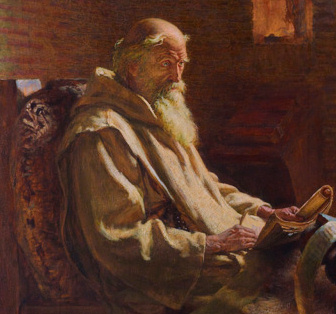
Bede (which rhymes with feed) lived his entire life in a monastery where he grew a beard which could house a flock of birds. Yet he is most known for his mind, which gave words to the history of England.

We know very little of Bede. We only know what he has recorded for us, which is not much. He was born in 672. He died in 735 while singing a hymn. He lived out most of the dash between those dates in a monastery in Jarrow (which is near modern-day Newcastle…which also doesn’t help me locate it any better).

Though the man himself is not much known his work is well preserved.

Why You Should Know Him:

Have you ever wondered why we use AD in our dates, or where this came from? Look no further than Bede. Actually, it wasn’t Bede who invented the anno domini but he did make it popular. Much like Justin Bieber didn’t invent bad music he just made it popular.

The anno domini is not why you should know Bede, though. We owe a great debt to Bede because of his Ecclesiastical History of the English People. Our information on the conversion of England would be dicey at best if it were not for this scholar, now known as The Venerable Bede. There are those that critique Bede’s work. And some of that criticism may be just. Yet his work has shaped history.

There is one other reason I believe we should know Bede; he seems to have really loved the Lord and passionately proclaimed the gospel. His commentaries are in Latin. Since the only Latin I know comes from Monty Python’s Holy Grail I couldn’t understand much. However, I was able to read a couple of sermons that were translated. One such sermon On the Meeting of Mercy and Justice is a wonderful exposition of the gospel (read an article about that sermon here).

Bede is an interesting figure in that he lived in the 700s and spoke of the world being round

Sample:

You can see his love for Christ in quotes like this:

"No words are able to speak," he wrote, "that beauty, that virtue, that glory, that magnificence, surpasses every expression, every sense of human mind. And if to attain to that ineffable sight and to be made radiant with the splendor of Christ's countenance it were worthwhile for you to suffer torment every day—if it were worthwhile for you to endure hell itself for a season, so that you might behold Christ coming in glory, and be joined to the number of the saints—is it not then well worthwhile for you to endure [mere] earthly sorrows that you may be partakers of such good and of such glory?"

This is a great quote for all students of history:

“If history records good things of good men, the thoughtful hearer is encouraged to imitate what is good: or if it records evil of wicked men, the devout, religious listener or reader is encouraged to avoid all that is sinful and perverse and to follow what he knows to be good and pleasing to God.”

Thursday, February 14, 2013

People You’ve Probably Never Heard Of But Should: Asahel Nettleton

If the Lord tarries for one hundred years and some chap like myself decides to start a series of blog articles on people you’ve probably never heard of, do you think that Billy Graham would be one of those forgotten leaders? That seems shocking doesn’t it? How could a man that has been influential in seeing thousands come to Christ be forgotten when we talk about church history? Impossible, right?
It is estimated that 30,000 people were converted to Christ due to the ministry of Asahel Nettleton. Yet, most of us have not heard of this man of God.

Little Asahel was born to a Connecticut farming family in 1783. He was converted during a season of revival in the early 1800s. His heart was soon stirred to follow Christ in missions. To this end, and with much difficulty, he attended Yale. At the time Yale was a sturdy evangelical school led by Timothy Dwight (the grandson of Jonathan Edwards).

By 1811 Nettleton was preaching. His intention was still foreign missions but the Lord would have him to be an itinerant preacher instead. Almost from the beginning the Lord blessed Nettleton’s preaching and ministry. By the time of his death in 1844 he was instrumental in seeing some 30,000 people come to know Christ.

Why You Should Know Him:

If you have any familiarity with revivals/revivalism you are probably asking yourself how many of those 30,000 decisions for Christ actually stuck. Consider this: “of the 84 converts in an 1818 revival at Rocky Hill, Connecticut — according to their pastor’s report 26 years later — all 84 had remained faithful. Similarly, only three spurious conversions out of 82 professed commitments were noted by another pastor in his report on revival services held in Ashford, Connecticut.” (Source)

There were two prominent contemporaries of Nettleton. One such man was Nathaniel Taylor. Taylor and Nettleton were actually friends at Yale. The two went separate ways. Taylor embraced what has come to be known as New Haven Theology.

Taylor denied original sin. He believed that Adam’s sin was not imputed to any man but that men were guilty when they have sinned themselves. All men are able to choose the right path but none do. Taylor further denied the doctrine of election. The New England Theology of Jonathan Edwards (Calvinism) was “in” during this time. Taylor and one of his disciples, Charles Finney, were instrumental in changing that tide. Taylor did not view the death of Christ as actually saving any man but only introducing a system whereby men might be saved.

Nettleton rejected this. He also rejected the “dangerous methods” of Charles Finney. Finney, a Pelagian, adopted a more emotional approach to evangelism. He hoped to influence the free will of men through their emotions. This led to an influx of such things as the altar call. Men like Nettleton rejected this and hoped to appeal to the will with the power of truth.

To contrast the ministry of Nettleton with Finney/Taylor is telling and instructive for our generation. By some accounts Finney had produced over 500,00 converts. “Produced” is probably the correct term. Finney’s contemporary supporters (and later even Finney himself) believed that a good number of these had not remained in the faith.

Nettleton serves as a great example of faithfully plodding in gospel ministry.

Sample:

Nettleton had a deep and abiding confidence in the power of God and His Word to convert sinners. That is evident in his various writings:

We have no new Gospel, no other terms of salvation than those that have always been held out for acceptance. The sinner has been taught invariably that he must not look for comfort without submission. And such has been the faithfulness of our spiritual teachers, that, in most cases, those who have been slain by the law, and brought to despair of climbing up some other way, have been led directly to the Saviour, who is the Way, the Truth, and the Life; and who has always been ready and willing to receive them.

Though he strongly opposed the work of Finney he was always cordial and loving in his discussions with him. He embodied what he said here:

We may talk of the best means of doing good; but, after all, the greatest difficulty lies in doing it in a proper spirit. Speak- the truth in love, in meekness instructing those that oppose themselves — with the meekness and gentleness of Christ.

Lastly, it is helpful in a day when Calvinism is equated with a lack of evangelism or passion for the lost, to read the words of Nettleton’s appeals to sinners:

A certain individual said to him: "I cannot get along with the doctrine of election."

"Then," said Nettleton, "get along without it. You are at liberty to get to heaven the easiest way you can. Whether the doctrine of election is true or not, it is true that you must repent, and believe, and love God. Now, what we tell you is, that such is the wickedness of your heart, that you never will do these things unless God has determined to renew your heart. If you do not believe that your heart is so wicked, make it manifest by complying with the terms of salvation. Why do you stand cavilling with the doctrine of election? Suppose you should prove it to be false, what have you gained? You must repent and believe in Christ after all. Why do you not immediately comply with these terms of the gospel? When you have done this, without the aids of the divine grace, it will be soon enough to oppose the doctrine of election . Until you shall have done this, we shall still believe that the doctrine of election lies at the foundation of all hope in your case."

Further Reading:

This is a nice short biographical sketch of Nettleton, The Forgotten Evangelist.

There is a book by Bennet Tyler on the Life and Labors of Asahel Nettleton. You can purchase it here. Or you can try to piece it together for free at Google Books (and also here). Honestly, if you are really interested I’d just spend the 15 bucks and get the book.

Iain Murray has done a ton of work on this period. Much is said of Nettleton, Taylor, and Finney in his work Revival and Revivalism.

Finding whole sermons of Nettleton’s is difficult. You’ll find most of the existing ones and a few other resources here.

Thursday, February 7, 2013

People You’ve Probably Never Heard of But Should: Basil the Great

This must be a pretty cool cat to not only have a spice named after him but also to get away with calling himself “the Great”. Actually basil the spice doesn’t derive it’s name from this guy. And neither did he call himself great. But that name was conferred upon him later. So what him so great?

Basil lived in the mid-300’s dying on New Year’s day of 379. He is most noted for his work in fighting Arian and Apollonarian heresies. With his homeboy’s Gregory of Nazianzus and Gregory of Nyssa (Basil’s brother) they formed a powerful trio known as the Cappadocian Fathers. While not selling a ton of their rap albums they did dispel the Trinitarian heresies of their day.

It was in west Caesarea that Basil was born and raised. In his grandma’s house is where he spent most of his days. Reading books and getting educated, when all of a sudden his life got flipped turned upside down. If you wait just a minute and sit right there I’ll tell you how Basil became known as the Great Hierarch.

It happened in 357 due to the influence of a cool cat named Eustathius of Sebaste. It appears that Basil had a profound encounter with Christ. As he would later write:

I had wasted much time on follies and spent nearly all of my youth in vain labors, and devotion to the teachings of a wisdom that God had made foolish. Suddenly, I awoke as out of a deep sleep. I beheld the wonderful light of the Gospel truth, and I recognized the nothingness of the wisdom of the princes of this world.

Basil was baptized and pursued an aesthetic life. But it held little appeal to him. Eventually he would leave and begin his own band of merry men. Eventually he became a leader in the church at Caeserea where he would eventually die in 379. Here he wrote a good amount of his extant writings.

Why You Should Know Him?

There are really two main reasons to know Basil and one somewhat secondary reason. The first concerns his monastic work. He is known as the Father of Eastern Monasticism. Though he himself was only a monk for five years his work in this area endured.

His form of monasticism seemed to be more concerned with matters of the heart. It was more concerned with “loving obedience” and had “less harsh discipline”. Basil empahsised more communal activities. In community the monks would do work (both intellectual and manual). If this sounds like the monasticism that you are familiar with there is a reason for that; Basilian monkery (if that’s a word) is the basis for most monasticism practiced in Eastern Orthodox churches even to our day. (Benedict of Nursia did something similar for the Western churches).

But why should we 21st century Protestants care about some dude establishing a monastery in the 4th century? Mainly because it was in many of these monasteries that the gospel was preserved. Basil’s emphasis on loving obedience planted significant seeds that is sprouting fruit even in our day.

Secondly, you should know Basil because of his work on Trinitarian theology. There were some that found it politically expedient to compromise with the Arians. The Cappadocian Fathers boldly refused. Who knows what history would look like if they had not refused. He also did a great amount of work on showing the divinity of the Holy Spirit.

And lastly it would do the reader good to read some of Basil’s letters. They are not only historically interesting but also occasionally devotional. Furthermore, there are some excellent quotes from Basil concerning the early churches views on things like abortion.

A Sample:

Here are but a few quotes to give you an idea of the heart and mind of Basil:

When someone steals another's clothes, we call them a thief. Should we not give the same name to one who could clothe the naked and does not? The bread in your cupboard belongs to the hungry; the coat unused in your closet belongs to the one who needs it; the shoes rotting in your closet belong to the one who has no shoes; the money which you hoard up belongs to the poor.

Do not measure your loss by itself; if you do, it will seem intolerable; but if you will take all human affairs into account you will find that some comfort is to be derived from them.

There is still time for endurance, time for patience, time for healing, time for change. Have you slipped? Rise up. Have you sinned? Cease. Do not stand among sinners, but leap aside.

Further Reading:

You can read all of Basil’s works and letters here.

Gregory of Nyssa’s eulogy is also instructive.

Of course you can check out the Wikipedia article here.

Michael Haykin also has a great chapter on Basil in his book Rediscovering the Church Fathers.

Covering Up What Christ Has Already Covered

“But when Cephas came to Antioch, I opposed him to  his face, because he stood condemned...” Galatians 2:11

In other words, Peter was being a hypocrite and Paul called him out on it. Not so says John Chrysostom:

Many, on a superficial reading of this part of the Epistle, suppose that Paul accused Peter of hypocrisy. But this is not so, indeed it is not, far from it; we shall discover great wisdom, both of Paul and Peter, concealed herein for the benefit of their hearers…But when some came from Jerusalem who had heard the doctrine he delivered there, he no longer did so fearing to perplex them, but he changed his course, with two objects secretly in view, both to avoid offending those Jews, and to give Paul a reasonable pretext for rebuking him.

Looks like it was just a secret plan concocted by Peter and Paul and not a true rebuke. What would motivate Chrysostom to engage in what seems like textual gymnastics to keep it from being the apostle Peter? His argument was that it couldn’t have been as it reads because Peter showed great boldness elsewhere:

He who when scourged and bound would not [shrink a bit] in his courage, and this at the beginning of his mission, and in the heart of the chief city where there was so much danger—how could he, long afterwards in Antioch, where no danger was at hand, and his character had received lustre from the testimony of his actions, feel any apprehension of the believing Jews?

It’s unthinkable to Chrysostom that Peter could have engaged in such hypocrisy. But isn’t that Paul’s point? Why the rush to defend Peter and come up with an intricate behind the scenes plan that is no where evident in the text?

Do We Do This Today?

I laughed at Chrysostom for a couple of minutes. Then I started to see myself in him. I find myself wanting to quickly come to the defense of some of the leaders that I greatly respect. Yes, even if they something stupid and wrong or do something hypocritical. When someone “opposes” one of the dudes that I look up to my first tendency is to come to their defense.

I actually think that is a good thing. It would be much better if our first response was to defend brothers and sisters in Christ. Yet this first instinct can quickly morph into something unhealthy. When Peter is wrong, he is wrong. No need to defend his hypocrisy or make up an imaginary scenario. To do so is verging on adopting a Corinthians mindset (“I follow Paul”, “I follow Cephas”). Peter’s identity—as is ours—is firmly wrapped up in Christ. He was being a hypocrite on this point. The gospel is big enough to cover that.

Let’s thank God that the blood of Jesus not only covers us but also the leaders that we revere. When they do something silly we don’t have to dismiss everything they have ever done or no longer respect them. We aren’t encouraged to tear 1 and 2 Peter out of our Bibles just because he was a hypocrite on this occasion. In the same way we hold our leaders in their proper place as dim reflectors of the splendor of Christ.

There is no need to spend our time trying to play cover up for sins that Christ has already covered. Let’s let the gospel rebuke our leaders. But let’s also be quick to remember that the gospel that rebukes is also the gospel that covers them. 

Thursday, January 31, 2013

People You’ve Probably Never Heard of But Should: Bertold of Regensburg

I have decided to resurrect an old series, giving a brief biography of people from church history that deserve a wider audience. Today I’m tackling a dude that I had never heard of before.

Bertold of Regensburg (also known as Berthold of Regensburg or Bertold von Regensburg or just plain ol’ Bertie) was a passionate preacher during the high Middle Ages. He was born sometime around 1220 in a town called Regensburg—hence the name von Regensburg.

Bertold was a Franciscan monk. In his twenties he set about as a preacher. He often preached against the excesses of his day. He was commissioned by Pope Urban IV to embark on a preaching journey to call heretics back to the faith. It was a sort of preaching crusade.

Some estimates have Bertold preaching to over 200,000 people at times even being called to preach in the open fields. Because his audience was so vast and diverse he spoke of contemporary matters in the common tongue.

He died in 1272, having retired from his preaching tours and living out the rest of his days in his Franciscan monastery.

Why You Should Know Him:

I cannot read German and I have only been able to get my hands on a few snippets from his sermons. I cannot commend his theology because I do not know it. I am not in a position to comment on whether he was an evangelical or not. Nor can I say whether we would benefit from his sermons.

Yet, I am intrigued by Bertold. He has been called by some the “Whitefield” of his day. One has to wonder if the simplicity and earthiness of his preaching did not in some way plant seeds of the Reformation. Certainly his wide appeal and methodology of calling common folk to repentance and confession would have influenced others. It is not a stretch of the imagination to envision those that he shaped being influential in the lives of some men like Wycliffe or Hus a couple centuries later. 

Further Reading:

There isn’t much out there. There is a 620 page book including his sermons that is edited by Franz Pfeiffer.

You can listen to an audio recording of one of his sermons in Middle High German. (This shows his influence. The fact that someone was able to time-travel to record him and decided to record him instead of others is telling).

There is a homepage of Berthold von Regensburg but it is in German. You can do the Google Translate and it helps some.

There are a few books out there on the social impact of Bertold. But again they are in German.

Nerd Assignment:

Do any of my readers know German? Can you get your hands on a few of these free books on Google (like this one) and tell me about this dude’s preaching. What can we learn from him? Did he plant any seeds of the Reformation?

Come back next Thursday to learn about Basil the Great…

Thursday, December 13, 2012

Seven Steps to Becoming a Heretic

Heretics usually fall into the role. Seldom does a man wake up in the morning, grab a cup of coffee, read the morning newspaper, put on his clothes, and then stare himself in the mirror and say “Today, thou shall become a heretic”. Heretics usually start by staring in the mirror and saying, “Today, thou shall be a difference maker”.

Consider Sabellius. Sabellius became what is now known as a modalist. They were very concerned with maintaining the truth that God is one. They also wanted to maintain that Christ was fully God. Sabellius emphasized these two truths to the neglect of another truth: that God is also three distinct Persons.

Tertullian responded to the modalists. (It is from Tertullian that we have the statement “one substance consisting in three persons”). To our knowledge, this would be the first time that the term Trinity was used. Sabellius and the other modalists were unmoved. Sabellius was eventually condemned a heretic in 220 AD.

His story is not unique. I share it simply because it is the typical pattern of heretics. If you want to become a heretic here is the way to do it:

Step One: Have a desire to be an epic difference maker.

Step Two: Find a truthful doctrine that is being neglected or under emphasized

Step Three: Make your ministry about restoring this precious doctrine.

Step Four: Begin emphasizing this truth to the expense of other equally true doctrines

Step Five: When people begin to question your overemphasis and/or your negating of other truths consider this the price of being an epic difference maker.

Step Six: Continue undeterred. Begin seeing this “other truth” that your opponents are emphasizing as part of the reason why your precious doctrine was under- emphasized. Find ways to minimize this truth, or even show that it is an error.

Step Seven: Emphasize your truth. Totally deny the other truth. Congratulations you are now a heretic that has denied a key doctrine of Scripture. 

---

The above picture is from a great series at The Resurgence on Know Your Heretics.

Friday, May 4, 2012

Review of Reformation: Yesterday, Today and Tomorrow by Carl Trueman

C.S. Lewis once advised against chronological snubbery by encouraging us to read older books along with the new:

"There is a strange idea abroad that in every subject the ancient books should be read only by the professionals, and that the amateur should content himself with the modern books.... Now this seems topsy-turvy. Naturally, since I myself am a writer, I do not wish the ordinary reader to read no modern books. But if he must read only the new or only the old, I would advise him to read the old.... A new book is still on its trial and the amateur is not in a position to judge it. It has to be tested against the great body of Christian thought down the ages, and all its hidden implications (often unsuspected by the author himself) have to be brought to light.... It is a good rule, after reading a new book, never to allow yourself another new one till you have read an old one in between.... The only palliative is to keep the clean sea breeze of the centuries blowing through our minds, and this can be done only by reading old books."

There is as Lewis noted a type of “uncritical acceptance of the intellectual climate common to our own age and the assumption that whatever has gone out of date is on that account discredited” in our day.  It may be less than in Lewis’ time—thanks in part to his wise words here.  Yet still there are many students and even elderly folks within our churches that think Martin Luther is the guy who gave the “I have a dream” speech.  Or perhaps he is that guys lesser known daddy. 

Many still in our day wonder, “what can we learn from guys that wore weird hair cuts and scratchy robes?” 

In July of 2000, Carl Trueman gave a group of lectures on the contemporary relevance of some aspects of Reformation theology.  He was attempting to answer the question of what we can learn from these guys with weird hair cuts and scratchy robes.  That group of lectures was made into a short book which sadly fell out of print.  Thankfully in 2011 Christian Focus decided to put Trueman’s thoughts back into print in the form of Reformation: Yesterday, Today and Tomorrow

Summary:

In this short book (127 pages) after defending the relevance of the reformation, Carl Trueman looks at the necessity of a theology of the cross, an emphasis upon Scripture, and a healthy doctrine of assurance.  Trueman believes that “the Reformation represents a move to place God as he has revealed himself in Christ at the center of the church’s life and thought” (17).  It is only natural then for Trueman to emphasize the cross and the Scriptures.  It may seem odd, however, that with everything one could draw from the Reformation that the author would focus on assurance.  Yet it is here, in our doctrine of assurance that we find the difference between the Reformation and Catholicism. 

In each chapter Trueman explains the “yesterday” the Reformation, he applies it to the churches “today”, and also sets a course for the church of “tomorrow”.  To see how Trueman weaves these thoughts together consider his explanation of how assurance and lamentation fit together

My Take:

I have always enjoyed the writings of Carl Trueman.  At times you have to pause and really think about the point that he is making, but he never fails to be profound and to make helpful points.  Even when I disagree with Trueman (which is rare) he communicates in such a way that the reader is left to clearly understand his position.  He is an engaging writer and one that clearly loves to display the excellencies of Christ and the sufficiency of God and His Word.  His helpful writing is on full display in this short book.

As in his other writings Trueman will make you think and to question certain deeply held beliefs.  Going through this study caused me to ask whether or not I am truly living according to these Reformation principles.  Of course, and Trueman would be the first to admit this, the goal is to live according to biblical principles.  So it may be better to ask whether or not we are living according to the biblical principles that found a renewed emphasis in the Reformation.  Not only am I living out these principles but are we living out these principles as we gather together? 

Reading through this book I was challenged and encouraged throughout.  It will cause church leaders to ask questions of their ministries and it will cause every believer to consider the man of sorrows.  I was also encouraged (as well as challenged) by Trueman’s treatment of assurance.  As he did throughout, the author did a tremendous job of showing the central issue and making it relevant for today. 

Should You Buy It?

If you like to study the Reformation and church history then spending 8 bucks on this little book will be a purchase that you want to make.  This book would also be very helpful for church leaders as well—the way Trueman applies these Reformation principles will cause us to at least ask whether we are being biblical in the way we live out the Christian life in these areas. 

Chances are if you clicked on the link for the book review and you have made it this far then you are the type of person that would greatly enjoy and benefit from this book.  So just do it, manGo buy the bookIt’s only 8 bucks

LinkWithin

Related Posts Plugin for WordPress, Blogger...