Showing posts with label church planting. Show all posts

Monday, December 3, 2012

Church Planters Need Curmudgeons

Last Thursday, Dave Miller asked a provocative question to his SBC Voices audience; namely, are we entering a post-cooperative program era in SBC life? It is an interesting piece that is worth reading. In the comment section Matt Svoboda asks a question that I have heard quite a few times. It is also a question that I share a good amount of agreement with:

When the older generation in the SBC wants to spend all of our time dealing with Driscoll books in Lifeway, keeping an anti-alcohol stance, crying about the growth of Calvinism and how its hurting the SBC, and has no desire to even have the missional conversation the rest of the country is having- why in the world would the younger generation want to have a strong identity in the SBC?

Matt goes on to note that “the SBC has a whole lot of unnecessary baggage that a lot of young pastors don’t want to have to deal with”. I responded to Matt, but honestly this article (and even my response to Matt at Voices) is not directed towards Matt.

Before I make my point allow me to explain how you could misread my point. If you think this is a defense of the SBC or the Cooperative Program you have missed it. If you think this is a response to Matt’s comment, you’ve missed it. If you develop the impression that I am against church planting then perhaps my point has not been clear enough. It is not my desire to paint with a broad brush or even to give an opinion about the SBC, the CP, and church plants. My aim is singular. I want to address the pastor’s heart. I want to humbly say, “Pastor, check your heart is it possible that what I am saying here is true.” If it not then move on.

Buzzwords

I am excited about the Jesus-centered/gospel-centered movement within the church. I am happy that many are giving themselves to planting churches and communicating the gospel in places where it seldom is communicated. I am thankful for the faithful gospel proclamation that is happening all throughout our cities, thanks to the renewed emphasis that NAMB is placing on church planting in our major metropolitan areas. It is wonderful that gospel advancement is being heralded as far more important than petty bickering. That is a good thing.

When guys say things like “what do we gain from being in the SBC” with all of the “baggage” that comes with it, I hear what they are saying. Believe me. As young pastor that happens to be a Calvinist I have dealt with my fair share of “baggage”. So I hear you. And I understand the pull to say, “why stay in the SBC when it is only slowing us down missionally”?  Why put up the fight any more? I have asked that question myself.

And that is a fair question for you to ask. And at the end of the day you may find that your church does not benefit from being affiliated with the SBC. That’s not my concern. What I am concerned about is the pastor’s heart. I know my own delusional heart and I know that sometimes I can use gospely sounding buzzwords to mask a love of comfort and a fear of conflict.

Saying, “I want to be free to advance the gospel and not have to deal with all of the SBC baggage” might be code for, “I haven’t the stomach or the faith to faithfully plod through conflict. It’s easier to plant a church because I can set things up the way that I want—the way I believe the Bible teaches—from the beginning, and I do not have to be bothered with all of the baggage of people that disagree with me theologically. So we can get on with gospel advancement much sooner”. (By the way I’m not saying this is what Matt is saying in his comments—remember the part about missing the point if you think it’s about Matt’s comment).

Ten Years from Now

Fair enough. But it seems to me that pastors are often crafted in the kiln of suffering and conflict. I have to wonder what a church and this pastor will look like in twenty years if this pastor’s heart continues to build his kingdom without baggage. Because the truth is, these believers—even the ones prone to being curmudgeonly—are God’s grace to us pastors. We need them.

Is it possible that our passion for gospel advancement extends to applying the gospel to the curmudgeon? Isn’t that one of the things that we say in the gospel-centered movement, “The gospel is not the ABC’s of salvation it is the A-Z”. “We need the gospel for the whole of the Christian life”.  Isn’t this true even if the chap in the pew thinks he doesn’t need the gospel from A-Z and he wishes those young whippersnappers would just join the Axe29 network with all their free body spray? Might gospel advancement make this “unnecessary baggage” necessary?

Pastor, your heart is prone to being deceived, just like mine. You have enough theological learning to make shameful fear sound holy and wise. “Good stewardship” can be a great mask for greed and fear. If you are striking out to make a difference and become a church planter, I just ask you to check your heart. Is it possible that you’re just wanting to start a new church because you love comfort and don’t want to do the hard thing of being used by God to revitalize a dying church? Or to be “boring” and faithful plod and proclaim the gospel in an average setting for twenty plus years? Is it possible that in your pride you think you have ecclesiology all figured out (of course, you and all the dudes you hang with) and don’t want to have to be chiseled by different opinions?

If that is the case and you get what you want, I feel for you. It will be to your peril to pastor a church that looks just like you. You needed sharpening even by those that might be theologically wrong. I can’t help but wonder what will happen when the perfect church that you built (with the sovereign Lord’s help of course) starts going a way that you did not envision. Will you leave? Will you plant another church—referring to yourself as “just a pioneer”? Will you continue spiritualizing your love for comfort and fear of conflict? Or will you finally stay and be chiseled?

Don’t leave because of fear or comfort. But don’t stay for those reasons either. 

Wednesday, October 31, 2012

Should Churches Dream Like Steve Jobs?

Yesterday, I listened to a talk from Steve Jobs from 1983.  I’d encourage you to at least play it in the background or give it a skim listen at some point:

Did I mention that he gave this talk in 1983?!?!  In this hour he predicted the world that we live in today.  And he did it with passion and confidence.  It felt as if Steve Jobs had time travelled to the year 2000 and then went back to 1983 to tell people what he witnessed.  Amazing! 

As I listened to Jobs I couldn’t help but wonder whether or not churches ought to dream like Steve Jobs?  Jobs stood before these people and said, “This is what the world is going to look like in 10-15 years because of what we are doing at Apple”.  This got me wondering, should pastors stand before their churches and say, “this is what the world will look like in 10 years because of the impact of our church”? 
Maybe Not

My first instinct is to balk at the idea of a pastor or church speaking in this way about the work of God in their community.  There are several things that are different about what Jobs is doing and what a church is tasked with doing. 

For one, there is very little that is offensive about an Apple Computer (apart from maybe the price).  The gospel on the other hand is offensive.  Convincing someone of buying an Apple isn’t the same as convincing someone of the beauty of Jesus.  One requires the work of the Spirit the other is something that man can do. 

Secondly, the folks at Apple hand-picked the people that worked for them.  They only took the greatest of people.  The church is much different.  Christ does not look for the best and the brightest.  The church is not structured like Apple nor should it be.

Third, after I listen to this presentation from Steve Jobs I cannot help but marvel at the amazing Steve Jobs.  That seems opposite of what a Christian preacher ought to do.  James Denney was correct when he said, “No man can bear witness to Christ and to himself at the same time.  No man can give the impression that he himself is clever and that Christ is mighty to save". 

For these reasons and more I do not think it is wise to uncritically latch onto Steve Jobs’ passion and say, “church we ought to dream like this”.  People can build computers, only Christ can build His Church. 

At the same time, I do not think we ought to dismiss the passion of Steve Jobs.  There is something here that ought to be emulated. 

Maybe

There is something about Steve Jobs that ought to humble churches.  He had a vision, albeit one created in his mind, to change the world.  He believed that dream so much that he “gambled everything on it”.  He gave his life to the vision of Apple.  He could talk about 10-15 years down the road because he knew that he was going to still be at Apple.  The average pastor in the SBC barely stays for two years in one place—so how can he dream about 10 years down the road? 

There is also something to be said about the fact that Jobs would not settle for something that did not fit his vision.  If it was not ready he was not going to roll it out and sell people garbage.  He had a dream and rather than settling for what could be done today he kept plodding until his vision became reality.  There is certainly a sub-biblical way to follow Jobs in this way.  Yet, there is also something to be said for not comfortably camping out in a world that doesn’t yet reflect the heart and mission of Jesus. 

This leads me to ask, why can’t we take God’s story and His mission and dream like Steve Jobs?  If God is working to fill the world with his glory by rooting out of his kingdom all sin and unbelief and replacing it with passionate worshippers then why can’t we be like Steve Jobs in seeing this “dream” come to fruition?  We might not be able to say, “in 10-15 years” but we can certainly say with confidence “this is the world that God is creating”.  And let’s be like Steve Jobs and not rest until God’s vision for the earth is accomplished. 

If a man can be this passionate and confident about a dream of computers why can’t believers be that confident and passionate about the sure promise of God’s redemption? 

Wednesday, October 10, 2012

Churches Can’t Afford to Be the Cleveland Browns Part 2

Earlier today I noted that churches can’t afford to be the Cleveland Browns.  It seems that every couple of years they have to “blow the place up” and put a new vision in place.  I note that it doesn’t have to be that way.  Here is the

Our Core Values

Though I’m a Cleveland Browns fan I don’t want to see our church be like the Browns.  That’s why as we have considered “vision” for our church we have tried to keep it simple.  Our vision statement is to be “a church united to enjoy God’s grace and extend His glory”.  That statement isn’t grounded in a fad.  That statement is grounded in creation.  That statement is grounded by the story of God. 

We have six core values that explode out of the vision statement. 

  1. To be a kingdom-focused church—we aren’t “the church” we are “a church” united to enjoy God’s grace and extend His glory.  Therefore we will passionately pursue planting churches, partnering with like-minded churches, and praying for the church universal. 
  2. To be a gospel-saturated community—because we are a “church united” we believe that God calls us out of darkness and places us into a redeemed community of believers.  This community is to be marked by authentic relationships, vital companionship, and mutual edification that is brought together to partner for missions as well as to equip families. 
  3. To practice worship-fueled discipleship—we believe that the fight of faith is to “enjoy God” instead of idols.  Therefore we fight together in our battle to believe that God is the source of all delight instead of the fleeting pleasures of sin. 
  4. To be a hospitable people that offers a refuge for the broken—we believe that we are brought into community with one another and into enjoyment of God solely through grace.  Therefore, we too want to be a refuge for the broken with the hopes of Christ-centered transformation.
  5. To be a people that live sent to our local community and our global community, with the intention of spreading Christ for the joy of all peoples.  As we enjoy God’s grace we are called to extend His glory to every square inch of creation.
  6. To be a community of believers that is radically centered upon the glory of God.  Our fundamental purpose is to glorify God in all that we do. 

What that looks like will look different for every pastor.  But it is our hope that if the Lord calls us home or away that you won’t have to “blow the place up”.  Everybody will know the basic structure and vision.  It just might be played out different. 

As much as it pains me to say this…excuse me while I throw up in my mouth…churches should be closer to the Pittsburgh Steelers than the Cleveland Browns.  Notice what happened when Mike Tomlin took over for Bill Cowher.  The team looked a little different but the basic philosophy was the same.  No need to blow stuff up.  We know who the Steelers are. 

So pastors (and all those doing “vision”), be sure that we you are writing and coming up with will be able to house the guy that stands in your place when either your heart isn’t ticking or it’s ticking elsewhere.  Because churches can’t afford to be the Cleveland Browns. 

Churches Can’t Afford to Be the Cleveland Browns Part 1

I’m not going to make the point that you think I am.  You probably think I’m going to say, “The Cleveland Browns are horrible.  Churches can’t afford to be horrible”.  While that’s mostly true that is not my point.  My point today really gets at the root of why the Cleveland Browns are horrible.  If you aren’t a football fan please stick around through this little section on Browns history, because I think you’ll be able to appreciate my point. 

Why the Browns Are Horrible

The Browns moved away from Cleveland in 1995 and became the Baltimore Ravens.  They did not return to the NFL until 1999 when they became an expansion team.  Prior to the move the Browns were horrible.  They blew the whole thing up and became the Ravens. 

The first two seasons were horrible.  5 wins in two years type of horrible.  In 2001 Butch Davis looked like he was turning it around.  In 2002 the team actually made the playoffs.  They had some things going for them but for the most part their abysmal record in 2003 and 2004 was more accurate of the team.

In 2005 the Browns hired Phil Savage as GM and Romeo Crennel as the head coach.  They blew the place up again.  And it in its place they began building a pretty decent football team.  (Though many will disagree with that statement).  In 2007 they actually finished 10-6 but missed the playoffs.  They were pumped for the 2008 season.  But as it usually happens with the Browns the wheels fell off.  Injuries and poor decisions led them to a 4-12 record.  So guess what happened.

They blew the thing up again. 

They fired Crennel and Savage and hired Eric Mangini and George Kokinis.  They led for about a year.  Then Mike Holmgren came in.  And guess what he did?  He blew the place up.  He fired Mangini.  Hired Pat Shurmur.  And started the rebuilding process over again. 

Whew.  Browns fans are done right?  Nope.  In July of 2012 Randy Lerner sold the team to Jimmy Haslam who plans to…you guessed it—blow the place up.  In case you aren’t aware “blow the place up” simply means fire almost everybody and start over again.  That, my friends, is one of the main reasons the Cleveland Browns are horrible.  They never stick it out past the speed bumps.  They don’t have one singular vision that they stick to.  They do for a season and then they blow it up and try something different.  You’ll never win that way, and even if you do it will be a short-lived fluke. 

Why Churches Can’t Be Like The Browns

Many churches are like Browns.  Pastor Bill stays for 2 years and implements his vision.  The church rallies around the new vision (or at least most of them do).  Then Pastor Bill “gets called” to pastor a larger church in a different state.  Pastor Frank comes in.  He eventually blows the place up and implements his new vision which the church lives out for all of 6 months before they have to call their next pastor.  On and on it goes.  4 pastors in 10 years = at least 4 different visions for the church. 

Just as Browns fans get frustrated wondering if we are ever going anywhere, so church members get frustrated wondering what the church is going to look like in a couple years.  People are less enthused about following the new pastor’s vision because let’s face it, homeboy is going to be gone in two years and we’re just going to have to do some other Purpose Driven something to restructure our church. 

It doesn’t have to be like that. 

If pastors would simply lead their churches to implement a biblical structure and not worry so much about specific “vision” then you wouldn’t have to change it with every new pastor.  Sure the way that Pastor X decides to live out being a “kingdom-focused church” will look different.  But hopefully if a biblical structure is in place you won’t have to blow up the place with every new pastor.  (I am encouraged too that a good number of pastors are beginning to understand the benefit of sticking it out for years instead of being “called away” at every difficult time). 

Come back in a few hours and I’ll show you what we are attempting to put in place at our church to match this commitment to not be the Cleveland Browns of churches…

Thursday, August 5, 2010

What Gospel and Community Centered Might Look Like…

In their groundbreaking work Total Church authors Steve Timmis and Tim Chester outline what “being gospel-centered and community-centered might mean”:

  • seeing church as an identity instead of a responsibility to be juggled alongside other commitments
  • celebrating ordinary life as the context in which the word of God is proclaimed with “God-talk” as a normal feature of everyday conversation
  • running fewer evangelistic events, youth clubs, and social projects and spending more time sharing our lives with unbelievers
  • starting new congregations instead of growing existing ones
  • preparing Bible talks with other people instead of just studying alone at a desk
  • adopting a 24-7 approach to mission and pastoral care instead of starting ministry programs
  • switching the emphasis from Bible teaching to Bible learning and action
  • spending more time with people on the margins of society
  • learning to disciple one another—and to be discipled—day by day
  • having churches that are messy instead of churches that pretend

If these get your attention you may want to dig a little further by buying this excellent book for just a little over 10 bucks.

Wednesday, June 30, 2010

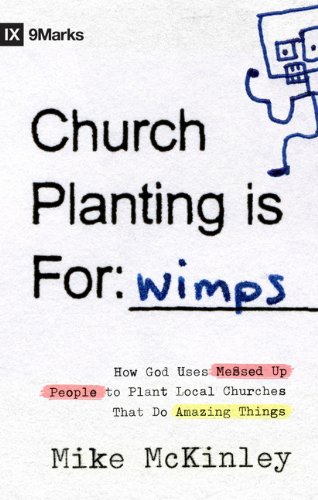
Review of Church Planting is For: Wimps by Mike McKinley

Author: Mike McKinley

Pages: 128pgs

Publisher: Crossway

Price: 7.91

Genre: Church Planting/Ministry

Quick Summary:

The subtitle of the book tells the story: How God Uses Messed-up People to Plant Ordinary Churches That Do Extraordinary Things. The idea behind this book is that you do not have to be extraordinarily gifted to plant churches. Often people think that it takes one type of personality to plant churches. This book hopes to break that mold.

It is, however, not about church planting (from scratch) but church “revitalizing” or “replanting”. Through connections with Capitol Hill Baptist, McKinley was hired as the pastor of a very small church. After spending time on staff at Capitol Hill, McKinley and a few members from there set out to revitalize Guilford Baptist about 45 minutes away. This book is their story, but it is filled with practical cross-situational advice.

What I Liked:

This was one of the most fun and thought provoking books that I have read in awhile. As an example of McKinley’s writing skill consider his description of the church building he inherited, "like a worm-eaten old cat sucking in its last few beleaguered breaths".

But it is not simply good writing that makes this book phenomenal. McKinley is unashamedly biblical; he exalts the sufficiency of Christ and His Word in building His church. This is a refreshing book on church planting/church growth. In the midst of so many pragmatic—“do this and be awesome”—books, comes a humble pastor encouraging us to patiently and passionately proclaim God’s Word.

Another added bonus is that McKinley does not just stop with how to do ministry in the church. In such a short book it is refreshing to see that an entire chapter is devoted to loving your family in the midst of such a difficult task.

Furthermore you could easily read this 128 pages book in one sitting. And it will keep your attention well enough to do so. I found myself unable to put this book down—although I had to at times to think about what is being presented.

What I Disliked:

I have never been involved in church planting so I am certain that there may be a few things that others would disagree with. Perhaps McKinley could be charged with over-simplification at times. But at the end of the day he is not really trying to say “do this and be awesome”. His plea in this book is the biblical plea of Paul—God uses ordinary broken vessels to spread His glory to the nations. I honestly cannot think of anything I disliked in this book.

Should You Buy It?

Even if you are not a church planter you should buy this book. Churches should be involved in planting churches (or revitalizing and replanting). If you are involved in church planting then you most certainly need to buy this book . You can read it in a couple hours and it’s under 10 bucks.

Rating: 5 out of 5 stars

Saturday, December 15, 2007

MBC/Acts29 Continued debate

The title is a little misleading. This really is not much a debate. Those who have made the decision have remained pretty silent as to the reasons for their decision. The only thing that could somewhat be considered a response is that of Don Hinkle. The BP has also ran an article that gives us a little light. If we combine these two responses we get a few vague reasons. It appears that Hinkle's reasoning is that this decision was made because the Executive Board is the highest authority (except of course the necessary shout out to Jesus and His Word). I always thought that it was the local church--but perhaps I missed that class in Introduction to Southern Baptists. Along with the "just because they can" argument it appears that Hinkle's other reason is that Acts29 is a renegade network with no accountability. Here is his statement: "Because Missouri Southern Baptist churches did not give their Cooperative Program gifts to fund the church plants of another organization. Nor did they give to plant churches who pledge to do one thing, then do another, often putting the church plant and convention at doctrinal odds — and without accountability, something Acts 29 seems to be lacking."

I am trying my best to be fair with these comments. But they seem to be not grounded in truth or any biblical basis so it is very difficult. Acts 29 is a network and does not require affiliate churches to give to them. Therefore, giving to this network is no different than a church giving money to the Purpose Driven Life or for that matter the MBC giving or taking money from Mormons (Tan-Tar-A, MO Baptist College). I am not certain what the "pledge one thing, and do another" is referring to. I know my friends church is doing everything they pledged to do. I think my main problem with Hinkle's statement is that it is not substantiated by anything. They are just accusations; many of which have been addressed and disproven (see here). Timmy Brister does a far better job and is more expansive than I in addressing this, read his response.

When we look at the BP article we learn that the newly elected President of the MBC, Gerald Davidson, "argued that only a handful of board members were informed enough about the Acts 29 Network to be able to vote on any motion that was critical of it. He said on two separate occasions that his knowledge was lacking." It would have been really nice if they had heeded advice and tabled the issue until April. But, as often is the case in our democratic Christianity the majority won: "But Dunn spoke for the majority of board members who have at least heard about The Journey's well-publicized barroom ministry and are bothered by it and vow that it will never happen again." The article is not extremely informative. Yet, it does help us to see that this issue is heated, emotional, and volatile and it appears to have a set course. What bothers me most is that the majority report by Theological Committee was accepted but not the minority report. Also comments by Mark Devine and mounds of evidence seem to be ignored. This really pains me because it is brother fighting against brother.

Also, the Lord has moved in the hearts of many brothers and sisters to set up a fund for these 9 churches that will be hurt by this decision. If you feel so compelled to give then you can do so by sending a check or money order to:
St. Louis Metro Baptist Association
(designate it for the “Show Me Church Planting Fund”)
Mailing
address:

St. Louis Metro Bapt. Assoc.attn.
Darren Casper
3859 Fee Fee Road
Bridgeton, Mo. 63044

LinkWithin

Related Posts Plugin for WordPress, Blogger...