Showing posts with label Biographies. Show all posts

Wednesday, May 2, 2012

People You’ve Probably Never Heard of But Should: Charles Bridges

Charles Bridges was born in 1794 to some guy with the last name Bridges and to a woman that he called mother.  He grew up to be an Anglican preacher, as well as a gifted writer and theologian.  He was ordained in 1817 and served the church of Old Newton, Suffolk from 1823 until 1849.  He then served churches in Dorset until he died in 1869. 

He was married to a woman named Harriet.  With her he had two sons (maybe more) and one of them became a physician. 

That’s all I’ve got.  I entangled myself in the world wide webs searching for all things Charles Bridges’ only to come up with these scant biographical blips.  Nearest that I can tell a guy named Ronald wrote a biography on him in 2004.  How he did this from one Wikipedia article is beyond me. 

Why You Should Know Him:

Charles Bridges has written two amazing works that greatly benefit the church.  His commentary on Proverbs was “worth its weight in gold” according to Spurgeon.  If you are curious it probably weighs about 2 pounds.  It is also available for free on the internets.  I have a hard copy of the book and my series on Proverbs for Christian Blogging is deeply indebted to Bridges’ work. 

The other amazing work (and I have to confess I know this second hand) is his book The Christian Ministry.  This is a book that I have had on my list for quite some time but because every edition that I could find of the book was apparently worth its weight in gold ($28.00 the cheapest I could find), I have yet to buy it and read it.  Thankfully the ninjas at Google have made the book available for free as well.  Yours truly is going to start reading through this one very soon. 

Bridges also wrote an Exposition of Psalm 119, a Memoir of Mary Jane Graham, a Manual for the Young, an Exposition of Ecclessiastes, Forty-Eight Scriptural Studies, and we also have some of his Correspondence.  Most of these can be found for free at Google and are well worth your time of at least browsing. 

Sample:

From his work on The Christian Ministry Bridges writes:

“It is faith that enlivens our work with perpetual cheerfulness. It commits every part of it to God, in the hope, that even mistakes shall be overruled for His glory; and thus relieves us from an oppressive anxiety, often attendant upon a deep sense of our responsibility.

The shortest way to peace will be found in casting ourselves upon God for daily pardon of deficiencies and supplies of grace, without looking too eagerly for present fruit. Hence our course of effort is unvarying, but more tranquil. It is peace—not slumber, rest in the work—not from it.

What I have read so far of Bridges in Proverbs and in the little I have read from The Christian Ministry is deeply encouraging, dripping with wisdom, and saturated with the savor of Christ. 

Further Reading:

These links are available from Bridges’ Wikipedia article

Wednesday, February 15, 2012

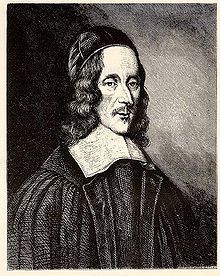
People You’ve Maybe Never Heard Of But Should: George Herbert

George Herbert was born in April of 1593 to a wealthy and artistic family in Montgomery, Wales.  Herbert attended Trinity College in Cambridge where he excelled in languages and music.  His intentions were to become an Anglican priest but his aims were thwarted when King James called him into parliament.  However, later in life (in his thirties) Herbert did take holy orders in the Church of England and became a rector of a little parish near Salisbury.  For the rest of his days Herbert faithfully served as the rector of Fugglestone St. Peter.  He died a month before his fortieth birthday of tuberculosis. 
Why You Should Know Him:

What sets Herbert apart from others is not only his stately nose undergirded by a faithful mustache, but also his beautiful poetry.  Herbert’s collection of poems entitled The Temple were given to Nicholas Ferrar instructing him to either use them for the “advantage of any dejected poor soul” or to burn them.  Thankfully Ferrar chose the former. 

Herbert also had a book of pithy sayings published after his death.  One of these sayings is probably familiar to you:  “His bark is worse than his bite”.  But more than anything Herbert’s poems are what set him apart from others.  Particularly cool are his “pattern poems” which take the shape of an object that the poem is about.  Regardless of the style, though, Herbert’s poems were always gospel-centered and aimed at promoting the beauty and majesty of Christ. 

Samples:

MY words and thoughts do both express this notion,
That LIFE hath with the sun a double motion.
The first IS straight, and our diurnal friend :
The other HID, and doth obliquely bend.
One life is wrapt IN flesh, and tends to earth ;
The other winds t'wards HIM whose happy birth
Taught me to live here so THAT still one eye
Should aim and shoot at that which IS on high—
Quitting with daily labour all MY pleasure,
To gain at harvest an eternal TREASURE.
(Colossians 3:3)

LORD, who createdst man in wealth and store,
    Though foolishly he lost the same,
        Decaying more and more,
            Till  he  became
                Most poor :
                With  thee
            O  let  me  rise
        As larks, harmoniously,
    And sing this day thy victories :
Then  shall  the  fall  further  the  flight  in  me.
My  tender  age  in  sorrow  did  beginne :
    And still with sicknesses and shame
        Thou didst so punish sinne,
            That  I  became
                Most thinne.
                With  thee
            Let me combine,
        And feel this day thy victorie,
    For,  if  I  imp  my  wing  on  thine,
Affliction  shall  advance  the  flight  in  me.
(Easter Wings)

Further Study:

There are many more poems from Herbert that will nourish your soul.  They are not only poetically brilliant but they also point to the fountain of life.  We live in a world of blogs and “quick reading” I invite you to look through some of Herbert’s poems and just sit awhile.  Read them a few times, they are profound and you will not catch everything on just a first glance. 

You can read the works of Herbert for free here:  The Works of George Herbert

Friday, July 16, 2010

Review of Martin Luther: A Guided Tour of His Life and Thought by Stephen J. Nichols

Author: Stephen J. Nichols

Pages: 240pgs

Publisher: P & R Publishing

Price: 8.39

Genre: Church History/Biography

Quick Summary:

Stephen Nichols has ironed out for himself quite a niche with these “Guided Tours”. They serve as introductions to many great figures in Christian History. One of these is his 240 page offering on Martin Luther. This book is an introduction to Luther and should be reviewed as such. Nichols aim is to orient readers to the life of thought of the great Protestant reformer.

The book is divided into three sections. The first section covers Luther’s life. This is the chronological and more biographical section of Luther. The second section concerns itself with Luther the Reformer. In this section Nichols attempts to let the reader into the mind of Luther as well as introduce some of Luther’s major writers during this period. The final section discusses Luther the Pastor.

What I Liked:

Somehow within 240 pages Nichols has summarized the life and thought of Martin Luther and has done it faithfully. Nichols writes in the spirit of one that loves the same gospel that drove Luther. The page is filled with helpful Luther quotes, cool pictures, and insightful information. This is probably the best work on an introduction to Luther. I think even those that have read numerous books on Luther will find enough information and helpful perspectives in this book to necessitate a purchase.

What I Disliked:

This is just a matter of personal preference and should have no bearing on whether you buy this book; but I never like the organization of a biography that breaks up the person’s story and makes it non-chronological. Considering the different facets of a person helps to see how he is more rounded as an individual but sometimes is unhelpful in seeing the story of how he became that well-rounded person.

Should You Buy It?

If you want to know about Martin Luther I can’t think of any other introductory book to purchase. If you are a big fan of Luther then you will want to purchase this too. If you care nothing about Luther and the Protestant Reformation then this book may change your mind. For under 10 bucks I see no reason to not purchase this book.

Rating: 4.5 out of 5 stars

Thursday, July 15, 2010

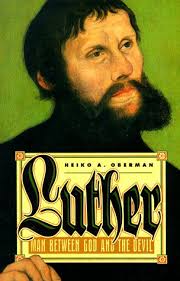
Review of Luther: Man Between God and the Devil by Heiko A Oberman

Author: Heiko A. Oberman

Pages: 380pgs

Publisher: Image Books

Price: 14.28

Genre: Church History/Biography

Quick Summary:

First published in 1982 Heiko A. Oberman offers a much needed German perspective of Martin Luther. Oberman sees Luther shaped by medieval theology more than we often realize. Luther, Oberman argues, sees all of history as a battle between God and the Devil. Luther finds himself engaged in this battle against the devil (often personified in popery). Oberman provides an interesting perspective on the life of Luther.

What I Liked:

Even for those that have read numerous works on Luther there is so much great information in this biography that it serves as a real page turner. I think Oberman offers a view of Luther and the Reformation that helps to balance who the man truly was. I always dislike it in biographies when the author tries to rescue the person from his own humanity. What makes Luther so great is that he was definitely human. Thankfully, Oberman allows the Reform to remain a man in need of reformation.

What I Disliked:

Even though, it is a helpful perspective I think at times Oberman may overplay the medieval theology of Luther. At times I think he overstates his case. There are occasions when some quotes seem to not support his position of Luther. But I am not anywhere near a Luther scholar so it’s quite possible that I’m totally off.

Oberman can be a tad wordy (I think about 300 pages would have been great for this book), and a little repetitive. There are some biographies that read a little smoother and stick in your mind a little better.

Should You Buy It?

This is not a sanitized biography of Luther. You get the man warts and all. And for that reason I heartily recommend it. Balance it with other works by other authors that may cast Luther in a tad different light, but nonetheless, this book needs to be considered by all that want to know about Luther. For an introductory study this may not be the one you want to read, but you certainly would not be disappointed if you want to tackle it.

Rating: 4 out of 5 stars

Tuesday, June 30, 2009

Review of Memoirs of an Ordinary Pastor by D.A. Carson

Author: D.A. Carson

Pages: 160 pages

Publisher: Crossway

Price: $11.19

Genre: Christian Biography

Quick Summary:

You have probably heard of Don (D.A.) Carson. Most Americans have probably never heard of Tom Carson (Don’s dad). Tom was an “ordinary” pastor to French speaking Canada. His son has taken his letters, journals, and other manuscripts and has turned them into a mighty gift to the church.

Throughout this book we learn of Tom’s life and struggles as a common pastor. We are allowed to enter into the world of a pastor struggling with discouragement, depression, and feelings of worthlessness. We see the joys of laboring for Christ mixed with the brokenness of a fallen perfectionist. We see a loving father and husband that are always striving to be better. We witness the pain of Alzheimer’s and death of a cherished spouse and life-long partner in the gospel. From the highs through the lows this book is shockingly real.

What I Liked:

I had to hold back tears when D.A. Carson’s “mum” died. Perhaps, it through me back to witnessing my own grandfather by the bedside of my grandmother. Nevertheless, such emotion for someone that I had never met or even heard of is a testimony to Carson’s vivid writing style and compilation of his father’s journals. It is easy for a rural youth pastor like me (even though only 27) to identify with some of the feelings of Tom Carson. It is also wonderful that Carson interjects biblical wisdom throughout these journals.

Carson also, wisely, provides us American readers with some Canadian church history to help tell the story. That is helpful otherwise I would have been totally lost.

What I Disliked:

There is really nothing that I can honestly say I disliked. There are two things that make it somewhat difficult to read, but those are common in a book of this sort. One, it is sometimes difficult to place yourself in a situation when you have little knowledge of the environment. Carson makes a wonderful attempt at making us Americans at least moderately adept at understanding the French Canadian environment. Two, many biographies do this and it’s a good thing, but it makes it difficult to read letters when people are referred to by initials. It just gets confusing. Almost all memoirs are this way, I just wish they weren’t. I’d prefer a “names were changed to protect the innocent” type of thing.

Should You Buy It?

If you absolutely have to have a hard copy then yes. You need to read this book. You can read it online for free by going here. Or you can buy it for 11.19. There are some things in the book that are worthy of underlining or keeping on file for further reflection. You may want to go ahead and purchase it, but if money is tight you need to at least read the free copy (I read it in about 6 hours).

Rating: 5 out of 5 stars

Friday, January 25, 2008

REVIEW--Spurgeon: A New Biography by Arnold Dallimore


Author: Arnold Dallimore

Pages: 252

Publisher: Banner of Truth

Price: 11.99 USD

Genre: Biography


Quick Summary:

In the past I have read Iain Murray’s The Forgotten Spurgeon and Spurgeon vs. Hyper Calvinism. Both of these works were excellent at getting to know the theology that drove the man. Yet their purpose was not to tell the life story of the man. Dallimore does just that. He says his goal will have succeeded if many “come to know him better and are both instructed and inspired by his powerful example”.

Dallimore begins his biography by showing the preparation of the man. This serves to help us see the foundation that was built in this mighty man of God. Young Charles had studied and read extensively on the Puritans. Certainly, they (along with Spurgeon’s passion for Scripture) were used by God to develop at a young age the passionate theology of Spurgeon. It is because of the “boy and his books” that Spurgeon became the “prince of preachers” that labored to earnestly contend for the faith.

In this shorter biography Dallimore will lead us from the boy preacher at Waterbeach to the embattled veteran defender of biblical faith against the onslaught of New Theology. We read of his early labors at the New Park Street Chapel to his thriving services at the famous Metropolitan Tabernacle. Dallimore champions throughout this work the exhausting labors of Charles Spurgeon. It is telling that after his death it took many men to carry on that which Spurgeon started and they still were not able to fill his shoes. We are introduced to many friends and even a few in opposition to Spurgeon. We also are honored to meet in these pages Spurgeon’s admirable wife Susannah.

Dallimore closes with a beautiful chapter on Spurgeon’s funeral. He writes as if he were there and takes the reader into the funeral services. I found myself holding back tears, mourning the loss of this wonderful saint. Therefore, I find as I close the book, that Dallimore has succeeded. I feel as if I know Spurgeon better, but more importantly I have been instructed and inspired by his powerful example.

What I Enjoyed:

Probably Dallimore’s best chapter is the conclusion. It was a wonderful idea to close a work on the life of Spurgeon as those that loved him did at his funeral. Dallimore causes the reader to feel as if you are sitting in a seat mourning with the rest of the crowd some 120 years ago. Knowing that Spurgeon’s ministry was based upon “knowing Jesus Christ and him crucified” causes those that are preachers, like myself, to be inspired and instructed. It fills us with a passion and a boldness to do the same.

As you read the biographies of Spurgeon, as well as Jonathan Edwards, one cannot help but feel saddened by a personal lack of labor and fervency in worship of our great God. After reading Dallimore’s work on Spurgeon I am encouraged by the words of McCheyne, "How feeble my spark of Christianity appears beside such a sun! But even his was a borrowed light, and the same source is still open to enlighten me."

What I Disliked:

In the beginning Dallimore, in my opinion, seems a little too uncritical in his praises of Spurgeon. This tends to be a theme throughout the work, but that is often to be expected in biographies. I would love to see biographies about men that desire nothing but seeing Jesus magnified having that same desire in honoring the man.

Another smaller area of criticism would be that while Dallimore proposes to give us a “definitive treatment given to his theology and preaching methods”, I do not see that in this work. Iain Murray does a much better job.

Yet for Dallimore’s overall purpose, of being a somewhat introduction to Spurgeon and dealing with his entire life in a short setting, he does a wonderful job. I find it difficult, other than that which is mentioned, to offer much disapproval.

Should You Buy It:

It is a wonderful work, for that reason I give a wholehearted “yes” to buying it. However, if you are wanting to buy a book dealing with his theology and preaching methods, Dallimore might not be the best place to go. I would suggest buying this book to be introduced to Dallimore’s life, but as an accompaniment I must encourage the reader to buy Iain Murray’s works on Spurgeon.

Rating: 4 out of 5 stars

Thursday, January 10, 2008

Borrowed Light: Today in Blogworld 01/11

This would be more appropriately titled, "What I missed in the last couple of days in Blogworld". But that's long. And compared to seeing our first child born, I missed nothing! Thanks to everyone for all of their prayers and support!

One of my favorite genres (at least I think it's a genre) is Biography. Michael Haykin gives us his Top 9 Biographies. To my dismay I have read only one! (HT: JT)

Challies, even while busy on his blog tour, gives us an answer to the question of whether or not there are errors in the Bible. If you want to follow Challies blog tour you can check out Day 1, 2, 3, 4, and 5.

Jonathan Leeman is blogging through Bill Hybel's REVEAL. In what looks to be a 6 part series Leeman has already posted Parts 1, 2, 3, and 4. I particularly like the Excursus listed as #3; in that post he asks, "do externals count for anything"? You are also encouraged to check out Greg Hawkin's response to Willow Creek's "repentance".

John Piper has made a statement that is gripping me: "Sometimes the best mark of holiness is not griping that sin abounds but groaning and grieving. " See the context here. The staff at DG has also posted a very helpful Favorite 2007 Reading list.

Founders points us to John Owen's comments on pastoral fervency. Owen admonishes pastors to consider the importance of these 3 things: (1.) Zeal for the glory of God in Christ; (2.) Real compassion for the souls of men; (3.) An especial conscientious regard unto our duty and office, with respect unto its nature, trust, end, and reward.

Thabiti posts his 2008 Evangelism Reading List. I was a little sad that Will Metzger's Tell the Truth was not on the list, but it's a great list and he will be blessed in his 2008 reading.

More controversy from Mars Hill. Steve Camp weighs in on Mars Hill's New Year's Bash--complete with a champagne bar. As Frank Turk began discussing the issue, as always it turned towards the issue of total abstinence (See also, here). Today, Phil Johnson attempts to recenter the discussion on whether or not it is acceptable to turn the church into a discotheque.

Michael Horton has written a great article on Christless Christianity.

There has been quite a bit I have missed, but this has been a decent summary. I will hopefully get back to normal posting next week. I hope to catch up on the McCheyne Reading Plan, and at some point I hope to write an article on this whole "alcohol issue".

Josh Harris gives us the New Attitude promo. I would love to attend this event in May:

LinkWithin

Related Posts Plugin for WordPress, Blogger...