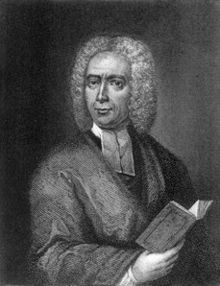
 Isaac Watts was born in July of 1674 in Southampton, England. His father, Isaac, was imprisoned at the time of his birth for his being a deacon of a dissenting church. Because of their non-conformity Watts was never able to attend the prolific Oxford or Cambridge but instead attended the Dissenting Academy of Stoke Newington.
After his education Watts took up a pastorate of a large independent chapel in London. John Owen had previously ministered in the church Watts now pastored. During this season of his life his intense study and dedication to the pastorate led him to have frequent attacks of illness. Within his first couple years Watts had to have a co-pastor (Samuel Price) assist him in his duties. Though often ill—and often having misgivings about taking a salary—Isaac Watts’ congregation refused to break their connection.
Watts finally succumbed to illness in 1748 dying in Stoke Newington at the house of the beloved Sir Thomas Abney family.
Why You Should Know Him:
Even if you do not know Watts you have more than likely read some of his hymns. He was one of the most popular writers of his day for his hymns. But he also was very popular for his catechism and his Scripture History—these were standard works for years. Even his books on philosophy were often used as textbooks. Watts, however, is most known today for his hymn writing.
Watts broke the mold of the day by introducing new poetry and new songs and hymns of spiritual worship. Previously churches would only sing hymns or other poetry found in the Scriptures. Watts’ use of extra-biblical poetry opened up the door for the hymns and songs we now sing in our churches.
Some of Watts’ more famous hymns include:
When I Survey the Wondrous Cross
Alas! And Did My Savior Bleed
Joy to the world
This is the Day the Lord Has Made
These are only four of over 500 hymns that Watts composed. You can read all of these hymns here. Watts’ poetry and hymn writing is very rich, God-centered, drenched in the gospel, and Christ-focused. It is worth noting that John Newton was very much influenced by the hymns of Watts. His mother would sing them to a young Newton and many believe that these seeds of truth were instrumental in Newton’s later conversion. Certainly, it influenced Newton’s own hymn writing.
Samples:
I gave you this last week but it fits here as well. This is classic Watts:
Hast thou not seen, impatient boy!
Hast thou not read the solemn truth,
That gray experience writes for giddy youth
On every mortal joy?
Pleasure must be dash’d with pain:
And yet with heedless haste,
The thirsty boy repeats the taste,
Nor hearkens to despair, but tries the bowl again.
The rills of pleasure never run sincere,
(Earth has no unpolluted spring)
From the curs’d soil some dangerous taint they bear;
So roses grow on thorns, and honey wears a sting
In vain we seek a Heaven below the sky;
The world has false, but flattering, charms;
Its distant joys show big in our esteem,
But lessen still as they draw near the eye;
In our embrace the visions die,
And when we grasp the airy forms
We lose the pleasing dream.
Earth with her scenes of gay delight,
Is but a landscape rudely drawn,
With glaring colors, and false light;
Distance commends it to the sight,
For fools gaze upon;
But bring the nauseous daubing night
Course and confus’d the hideous figures lie,
Dissolve the pleasure, and offend the eye.
Look up, my soul, pant toward th’ eternal hills;
Those Heavens are fairer than they seem;
There pleasures all sincere glide on in crystal rills,
There not a dreg of guilt defiles,
Nor grief disturbs the stream.
That Cannan knows no noxious thing,
No cursed soil, no tainted spring,
Nor roses grow on throns, nor honey wears a sting.
(Isaac Watts, Earth and Heaven)
Further Study:
Psalms and Hymns of Isaac Watts
A search for Isaac Watts on Google Books will give you a few very helpful books for free. Some by Watts and a few biographies from others.
Watts was more than just a hymn writer he was also a physician of the soul. Check out his counsel to those going through spiritual ups and downs.


 During a mission trip to inner-city Kansas City I found myself sharing the gospel with a homeless man. As his alcohol-laced breath washed over me I began wondering if this man was actually a believer. He was speaking as if he understood fundamental elements of who God is, that he understood the effects of the Cross, he seemed to understand and be convinced of the sinfulness of mankind.
  I have mentioned previously that I battle depression or perhaps the better term would be “fits of melancholy”. In fact our nation seems to be very much plagued by this malady. One particular study notes that, "An estimated 26.2 percent of Americans ages 18 and older — about one in four adults — suffer from a diagnosable mental disorder in a given year." That means that when you go to the grocery store 1 of every 4 people that you see suffers from a diagnosable mental disorder. That is huge.
 (HT:
(HT:  (HT:
(HT: 
 Thom is a fellow contributor to SBC Voices. Awhile back Thom gave me his book in exchange for a review. Unfortunately, it was one of the 8-10 books that sat in a pile for a lengthy time during a busy seminary semester. I did not get a chance to pick the book back up until a few weeks ago.
  Begin is “a journey through the Scriptures for seekers and new believers”. Within it’s pages is the complete ESV text of Genesis 1-11, the Gospel of John, Paul’s Letter to the Romans, and Revelation 21-22. Smattered throughout the contents are little comments and cross-references to help the seeker/new-believer understand Scripture better. Also helpful are the lines to the side of the book for brief note-taking or further questions. At the end of the book the reader will find a short article that seeks to answer “What Does it Mean to Be Saved” as well as a 10 point list and explanation of the “10 Basics to Boldly Proclaim a Biblical Worldview”.
 As it says in the press release, “Lucy Worsley is, by day, Chief Curator at Historic Royal Palaces, the independent charity that looks after The Tower of London, Hampton Court Palace, Kensington Palace State Apartments, the Banqueting House in Whitehall, and Kew Palace in Kew Gardens.” As such this makes Worsley someone “in the know” when it comes to the history of these homes. That is why this particular work is so interesting. You will not find footnotes but just secondary sources, making this a unique look into the history within the walls of England’s royal palaces.
 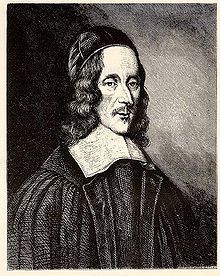 George Herbert was born in April of 1593 to a wealthy and artistic family in Montgomery, Wales. Herbert attended Trinity College in Cambridge where he excelled in languages and music. His intentions were to become an Anglican priest but his aims were thwarted when King James called him into parliament. However, later in life (in his thirties) Herbert did take holy orders in the Church of England and became a rector of a little parish near Salisbury. For the rest of his days Herbert faithfully served as the rector of Fugglestone St. Peter. He died a month before his fortieth birthday of tuberculosis.
 __61467_zoom.jpg) Baptist do not tend to do catechisms. I don’t know why. We should. One particular catechism that is well written and quite helpful (though perhaps with a few baptistic tweaks) is the Heidelberg Catechism. I knew very little about the catechism until I read
Baptist do not tend to do catechisms. I don’t know why. We should. One particular catechism that is well written and quite helpful (though perhaps with a few baptistic tweaks) is the Heidelberg Catechism. I knew very little about the catechism until I read  As a preaching pastor (for students on Wednesday evenings, Sunday morning Sunday school, and adults on Sunday evenings) about 6-8 times per year I come to that most difficult time when a series is almost completed and I have to decide on what book of Scripture or topic we will cover for the next few weeks/months.
 There were those of the legal variety who believed Paul was being loose on the law and too free in his grace. But then he often ticked off the other side too—those shouting race, unity, and love—believing the Paul was too light on grace and too strong on the law.